by Aaron Hoover
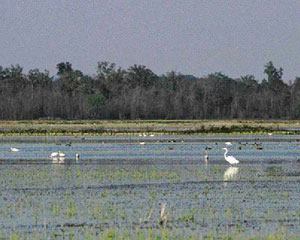
Wetlands form where rainfall, floods, or tides saturate the ground every so often. They crop up in low spots where groundwater burbles and in wet spots left behind by rivers or streams as they shift course over time. Because these areas usually provide habitat for a wide range of wildlife and help to absorb floodwaters, government agencies seek to protect these lands. But such protective policies often conflict with expanding development.
When it comes to balancing preservation of wetlands with vibrant coastal growth, Section 404 of the Clean Water Act seems promising: Developers who destroy wetlands can compensate by creating or restoring them somewhere else. In practice, however, the policy has some serious shortcomings. Proposed new regulations hope to amend those, and in the meantime, the science of wetlands restoration has made strong advances. In the long run, the chance of new or restored wetlands surviving increases dramatically when you have the right expertise.
Policy Debate
Since Congress passed the Clean Water Act in 1972, the U.S. Army Corps of Engineers has let developers who must destroy wetlands pursue “compensatory mitigation.” What that means is creating, restoring, enhancing, or — in unusual cases — preserving other wetlands. The policy can come into play for developers draining as little as one-tenth of a wetlands acre that is deemed connected to navigable waterways. Any destruction of such wetlands requires compensation in Florida and some other states.
Mitigation, which historically has required developers to create or restore more wetlands than they destroy, was supposed to contribute to “no net loss” of the nation’s wetlands. But scientists and other experts who have examined the policy’s impact agree it has not lived up to expectations. A National Academy of Sciences committee determined in a 2001 report that mitigation projects often fail to meet the conditions of their permits or — worse yet — don’t get completed at all. The report concludes: “The goal of no net loss of wetlands is not being met for wetlands function by the mitigation program, despite progress in the last 20 years.” Studies of wetlands mitigation in New Jersey, Ohio, and California have all arrived at decidedly mixed conclusions, however.
Meanwhile, through at least the late 1990s, the nation’s wetlands continued to shrink. In a periodic report on wetlands status and trends, the U.S. Fish and Wildlife Service estimated the annual loss at 58,500 acres between 1986 and 1997. That was less than in previous decades but augmented historical losses: Two centuries ago, wetlands covered 221 million acres of the continental U.S. Just under half of that acreage remained by the 1980s, according to a U.S. Geological Survey study.
Smaller “postage stamp” wetlands are more difficult to restore, but there are many success stories. The key is to contract with a company that will work with the builder from “cradle to grave.” A living wetlands, such as this one shown nine months after restoration was completed, is not something that can be torn apart, rebuilt, and then turned loose to thrive on its own at the end of a construction cycle.
Compensatory mitigation may be flawed, but it is not hopelessly so, insist many scientists and environmental managers. They lay the blame for the policy’s shortcomings on lax data collection and oversight by the Army Corps of Engineers. But they also say mitigation’s faults are tied to a major failing in the program’s implementation: namely, that permitting guidelines have traditionally favored on-site compensation — creating or restoring wetlands near development and urbanization — rather than off-site compensation in areas where wetlands are more likely to flourish.
Proposed new regulations seek to address that, says Ann Redmond, regional manager for ecological and water resources at the Florida-based engineering and environmental planning firm WilsonMiller. Redmond spent 12 years as Florida’s top mitigation specialist in the 1980s and 1990s. She also served on the National Academy of Sciences panel that issued the 2001 report.
The problem with on-site mitigation, Redmond says, is that for projects without a large amount of land, created or restored wetlands are often likely to fail. Building and development may have altered the groundwater table, meaning the wetlands get too little or perhaps too much water. Plus, wetlands in urban settings are more vulnerable to invasion by exotic plants, she explains. Both problems are aggravated by lax maintenance. Federal law requires maintenance, but compliance is more difficult to confirm for “postage stamp” wetlands. And some key techniques, such as fire, may not be possible in small or urban parcels. Managers may use fire, Redmond says, to kill off shrubs or trees that are slowly taking over plant-filled wetlands. “If we didn’t burn anything, all of our herbaceous systems would go to forest,” she explains.
Redmond adds, “Dozens of studies have shown that for freshwater wetlands mitigation, there is a very low success rate of trying to create wetlands in urban and suburban settings, and there’s not even a great amount of success for restoring wetlands in those settings. If you want mitigation that will succeed and be substantial and part of the long-term infrastructure, usually you need to go to an off-site area where you know the hydrology will remain intact and where you can use fire and other management techniques to manage the property.”
Wetlands Banking
Even though Section 404 has long allowed developers to meet mitigation requirements off site, the corp’s guidelines have made that choice more difficult. The new rules encourage a form of wetlands conservation called “wetlands banking” and emphasize that managers make decisions based less on localized topography than on entire watersheds.
“The biggest change is that we are now directed to look at the likely long-term sustainability of the wetlands mitigation project,” Redmond says.
The shift may implicitly acknowledge that off-site mitigation is becoming a more common solution despite the permitting roadblocks. One increasingly common vehicle is the “mitigation banks” — wetlands that have been restored expressly for purposes of compensation. Usually, the government grants the mitigation bank (whether publicly or privately owned) credits for every restored acre, and the bank sells those credits to developers who must compensate for losses.
The number of wetlands banks has increased 78% from 1991 to 2005, with 405 such banks operating today, according to a 2005 Environmental Law Institute report. In Florida, one of the states where wetlands banking is most common, there are 118,000 acres of wetlands in mitigation banks currently, compared with just 19,000 a decade ago, notes Victoria Tauxe, environmental manager for the mitigation section in the state Department of Environmental Protection.
This wetlands in Sarasota County has been scraped to a level about 6 inches below the final grade. After this, a layer of organic matter will be laid in to provide a seed bed before the coffer dams are released at low tide to allow water to flow into the site.
Critics worry that wetlands banks or other large isolated mitigation areas mean too few wetlands in urban areas that need their flood control and water recharge functions. But banks and other large mitigation areas have a number of advantages. One, they make it easier for regulators to verify compliance. Two, they have a stronger likelihood of surviving. Experts agree that small wetlands created on former uplands are particularly prone to fail. “We want to replace wetlands where wetlands should be,” Tauxe explains.
Finally, large mitigation areas by virtue of their size may offer more of the environmental benefits of wetlands, such as nurturing a variety of wildlife and sopping up pollutants.
Will the shift toward wetlands banks or other large tracts make the new regulations more successful than their predecessors? Only time will tell, but Redmond says management will be key. For Redmond, it’s imperative that owners of banks or other large wetlands, whether they are public or private, treat their wetlands “like state parks,” with staff members removing exotic plants and performing other regular maintenance. “You’ve got have somebody who loves it,” she says.
Restoration Success
Whether restoring a wetland on site or in a wetlands bank, the science matters. Any developers embarking on this course need to understand which details matter most, explains Tom Ries, vice president and director of land management for Scheda Ecological Associates, a Tampa-based environmental consulting firm. Ries routinely heads up restoration projects for developers trying to satisfy federal, state, or county regulations. Before he joined Scheda, he spent nine years at the Southwest Florida Water Management District. A veteran of an estimated 50 wetlands restorations, his projects have won 22 environmental awards.
Ries agrees with critics who contend that mitigation often fails. But he says the idea is not flawed — it’s the execution that is often the problem. “There are success stories out there,” he says. “It just has to be done right.”
The trickiest part of building wetlands is getting the hydrology right — knowing where the water is and how the available soils will drain to ensure a continual measured amount of water to support wetlands plant life. Wetlands engineer Tom Ries of Scheda Ecological Associates often must rely on historical data, such as this aerial soil map originally compiled by the Natural Resources Conservation Service to assist farmers.
Hydrology. The most obvious and important ingredient is also the trickiest: water. Too much of it means a pond; too little and native wetlands plants don’t grow, or die. “Ninety percent of the reason that wetlands fail is they don’t get the hydrology right,” Ries notes.
For this reason, saltwater wetlands are by far the easiest to restore, Ries explains. Tide tables and a visual survey reveal where the shore is regularly inundated, making it clear where to plant mangrove, cordgrass, or other saltwater plants. He even plans for sea-level rise by shaping the shore into a gradual slope so plants can migrate landward. “There’s no excuse for not making it work in a tidal environment,” he says.
Getting the hydrology right for freshwater wetlands is another matter entirely. Human activity has often so altered a site that original streams, ponds, or wetlands are no longer visible, Ries notes. So he consults decades-old aerial and terrain surveys originally compiled by the Natural Resources Conservation Service to assist farmers.
“If you go back to the first soils books that were done in the 1940s and ’50s, before the site was altered, you get an idea of what’s what,” he says.
The photos and surveys may reveal filled-in or much-diminished wetlands, which could indicate a promising spot to create or restore one. The surveys may also reveal historic groundwater levels during Florida’s wet summer and dry winter seasons. The obvious next step might seem to be removing enough of the soil to return the site to its old elevation, but it’s usually not that simple. Buildings and parking lots may have reduced the amount of rainwater percolating down through the soil to recharge the groundwater. Too, reshaping of the land may mean that groundwater no longer flows in its historic direction. So Ries has to figure out the current groundwater scenario. The best method is to monitor a network of water-table-measuring piezometers for at least a year. With a more urgent deadline, it’s possible to get a grasp based on lichen and plant growth, Ries says.
“This is the hardest thing,” he admits. “We need to get a good assessment of where the groundwater is today.”
Scrape and seed. The next step is to “scrape” the site to the proper elevation for wetlands to flourish. It’s crucial that the contractor overseeing the bulldozers get the numbers right. “You can be off a few tenths or a half of a foot, and that makes all the difference in the world as to whether it’s going to make it or not,” Ries explains.
Then it’s time to seed the site with wetlands plants. Ries says if a developer is destroying a quality wetlands, Ries may save the soil as a good source of seeds for the mitigated wetlands. If he is designing a freshwater plants wetlands, he plans for about 5,000 plants per acre, selecting from dozens of candidates, including pickerel weed, duck potato, and maidencane. For treed wetlands, the number is about 480 trees per acre. He plants irregularly when he can, to more closely approximate natural wetlands.
Monitoring and maintenance. Ries says agencies require a minimum of three years of monitoring and maintaining plant wetlands and ten years for forested wetlands. It’s especially important to keep nonnative plants out when the new wetlands is maturing. “Hopefully within one or two years, if you did everything right, you’ve helped the native plants to the point they can outcompete nonnative wetlands plants,” he notes.
Monitoring wetlands requires three things: documenting all plant life, measuring water levels, and documenting wildlife utilization of the area, if applicable. Here, Kathleen Barrett, a senior environmental scientist, works at the first stage of monitoring to sample new plant life at the edge of a quadrant at a mitigated wetlands.
Costs. The process isn’t cheap. Depending on the size of the site, Scheda charges from less than $1,000 to $5,000 for a feasibility study. The cost of designing for mitigation and applying for the relevant permits ranges from $12,000 to $50,000, again depending on size (this step is called the UMAM, an acronym for Unified Mitigation Assessment Methodology). Actual mitigation usually runs around $50,000 per acre. Maintenance and monitoring adds an additional annual $3,000 to $5,000.
How can a developer or builder make sure he spends wisely? First, Ries says developers should hire an environmental consulting firm to manage the entire project from start to finish — not just the assessment, permitting, and design portion, which is far more typical. “We’re always pulled in like a surgical tool: ‘Come in here and help us get a permit and design mitigation. OK, see yah.’ “
But if something goes wrong, expect a blame game among the designer, the contractor, and subcontractors hired to plant or maintain the wetlands. “It’s really important in my opinion for a developer to get somebody from cradle to grave, because then there’s no finger-pointing,” Ries explains.
Second, Ries advises developers to learn the basics of mitigation and actively scrutinize and question environmental consultant’s plans. “Developers could point out errors themselves,” he says. “They really should get educated in this.” ~
Aaron Hoover writes on science and the environment from his home in Gainesville, Fla., and is a regular contributor to Coastal Contractor. Photos courtesy of Tom Ries, except as noted.