- Q. What’s the right way to deliver power to an outbuilding? I’d like to have a panel capable of powering a small shop.
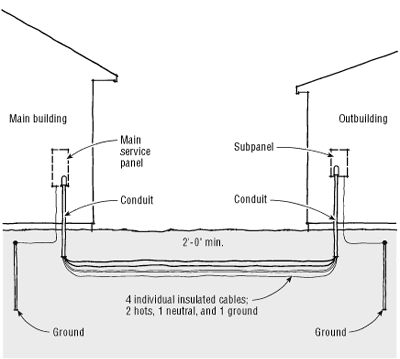
A.Rex Cauldwell responds: An outbuilding should be treated as a separate building, as opposed to an extension of the house. The takeoff point for the cables to the shop should be the home’s main service panel or a subpanel (see illustration, below). There should be four cables feeding the shop: hot, hot, insulated neutral, and ground. (There are times when code allows you to use three cables by combining the neutral and ground in one conductor. I don’t recommend that, however, and many electricians, including me, refuse to do it because combining the two conductors could result in a hazardous condition, especially for an electrician working on the circuit.)
The code requires an insulated neutral, which means you can’t use common USE (underground service entrance) cable with a bare stranded neutral. You should use four individual insulated cables approved for direct burial. Bury the cables at least 2 feet deep or whatever your local codes and utilities require.
The size of service depends on what loads you’re going to have in your shop. I would recommend at least a 50-amp/240-volt service (the same size as your electric stove circuit). Therefore, you’ll need two open slots in your service panel.
Typically, you would come out of the back of the panel, through the exterior wall, down along the exterior wall, and then underground. Since you are running individual cables, they need to be in conduit from where they leave the panel until they’re underground. I would use plastic conduit, not metal, because plastic is a nonconductor and easier to work with, since you glue the joints. Use at least 1-inch-diameter conduit; that allows extra room inside, which makes handling and pulling the cable easier. To make the turns from horizontal to vertical, use an LB, or elbow. Once the cables are underground, they don’t need to be in conduit.
Try to pick an approach to the shop that doesn’t take you under sidewalks and paved driveways. Always contact the utility-location company to verify that you’re not crossing any underground services.
Once at the shop, the cable must again be in conduit as it comes out of the ground, up the wall, and makes a turn into the shop service panel. The shop service panel must have a ground rod (or two) at its location, just like the main service panel at the house.
Rex Cauldwell is a master electrician in Rocky Mount, Va., author of Wiring a House, and a frequent contributor to JLC
Supplying Power to an Outbuilding
2 MIN READ