A salt finish is a simple and inexpensive way to dress up what would otherwise be plain concrete flatwork. It’s achieved by pressing coarse rock salt into the surface of fresh concrete, allowing the concrete to set, and then washing the salt away with a stream of water. The random indentations produced by this process give the surface a weathered and textured look. Long popular in the warm Western and Southern states, the finish is rarely seen in colder regions, where water could freeze in the indentations and cause the surface to spall.
Earlier this year, I visited a residential project in Alamo, Calif., and watched a crew form and pour a new driveway and walk. It was a big job that involved several loads of material, so crew leader Magdaleno Avarra decided to form and place the concrete in stages.
Complicating matters slightly, the customer wanted a colored surface. Although it’s possible to order integrally colored concrete (color is added to the mix itself), there’s always the chance that one load will not perfectly match the others. Avarra avoided this problem by using color hardener — a commercially produced mix of dry pigment, portland cement, and finely ground aggregate — to tint the surface of the concrete after it was placed. To ensure uniformity, he ordered enough color hardener to do the entire job and verified that it all came from the same production run.
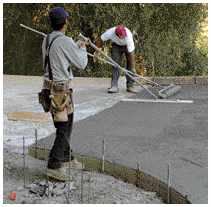
The job’s first few steps were the same as they would be for any concrete slab. Crew members formed the edges, installed reinforcing material, placed the concrete, and then bull-floated (1) and edged it. Next, they manually broadcast color hardener over the still-wet concrete (2), and floated (3) and troweled it into the surface. When the concrete was firm but not completely set, they broadcast salt over the surface (4), partially embedding it by tamping down with a magnesium float (5). (Some contractors use rollers to press in the salt.)
Avarra’s crew allowed the slab to set up overnight and then cleaned it the following day with a pressure-washer (6). The water dissolved the salt, leaving a series of irregular dimples where the salt crystals had been. Once the surface was dry, crew members sprayed it with a curing compound.
To give the driveway more visual interest, the crew salt-finished only the main thoroughfare (7); curbs and border areas got a light broom finish instead. — David Frane