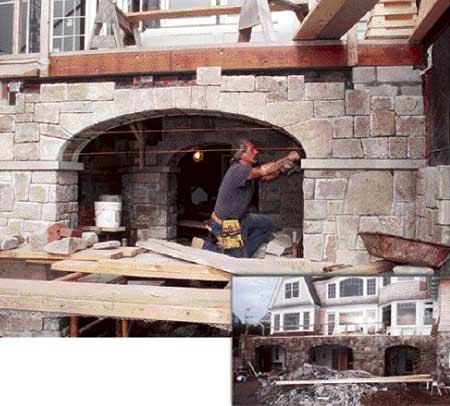
Building Stone Arches, continued
Forming an Arch
Although a stone arch is ultimately self supporting and load
bearing, it doesn't start that way. The shape of the arch is
first created by laying the stone over a precise wood form
provided, in our case, by the GC. I've probably laid a hundred
arches over the years without ever repeating the same radius.
But you never know; I find the forms too nice to toss and have
a sizable collection in my storage yard. The typical form is
made from a pair of plywood or solid lumber face panels that
describe the arch. The face panels are spread and reinforced
with framing, built to the approximate finished wall thickness.
The top of the form is covered with narrow planks or bendable
plywood to support the stone as it's laid.
The form is set to span between bearing points and is elevated
slightly on wood spacers and beveled shims. Pulling the shims
and spacers makes the form easy to remove later (Figure
3).
Figure 3.Wood shims under the arch form ensure
easy removal later. The author relies on the builder to
construct the form.
The arch ring is built of individual ring stones, typically
wedge shaped, that follow a radial pattern from the center of
the arch opening. I usually attach a length of mason's line to
pivot from the center of the bottom edge of the form and pull
it across the ring stone blank like a chalk line to mark the
radial lines. The arch ring is laid out one stone at a time,
working from one side, then the other, toward the center. I do
the spacing and proportions pretty much by eye unless a strict,
formal geometry is specified.
The top of the arch is closed with a keystone that locks the
construction together. With the keystone in place, the form can
be removed and the arch will stand independently. When working
with mortar, we leave the form in place for an initial curing
period of at least four days. Mortar not only binds the stones
but also fills gaps and distributes stress, adding even more
strength to the arch.
On this job, the architect stipulated that the ring stones
should not be different in shape or pattern from the "spandrel"
— the general vertical facing above and around the
arch. That made me a little uneasy, so I still worked a wedge
in among the ring stones wherever I could. Most stone arches
are deeper than the thickness of the ring stones. But filling
the underside, or soffit, of the arch follows similar
principles, relying on compression between the stones and
mortar for structural integrity.
I back-cut the soffit stones on all edges to minimize the face
joint and laid them face down on the form. Back-cutting also
created wedge-shaped spaces between the stones, which I filled
with mortar. After the mortar hardens, the soffit's compressive
strength and structural performance are like that of the ring
stones. Before setting each soffit stone, I spread sand on the
form to protect the face from mortar staining. And because the
joints can't be raked out while the mortar's still green, I
filled them with a 1/2 inch of dry sand to displace the mortar.
When the form was pulled, the sand spilled out, leaving a
recessed joint (Figure 4).


Figure 4.The underside, or soffit, is laid between
the ring stones. Mortar and masonry rubble fill the void behind
the face stones. As he places each stone, the author spreads
sand on the form and packs a layer into the joints before the
mortar (top and bottom left). The sand helps keep the finished
face clean and falls out when the form is pulled, leaving
recessed joints. Only minor pointing is needed to finish
(bottom right).
On its own, Portland cementbased mortar would do an
adequate job of holding the stones together. But in pursuit of
the mason's tradition of building for eternity, I leave no
stone unturned. Every bonding face gets a liberal brushing of
Silpro Weld-O-Bond Plus, a water-based latex bonding agent
formulated to bond Portland cement to a variety of surfaces
(Figure 5).
Figure 5.Although Portland cement forms a
naturally strong bond with stone, the author brushes all mating
surfaces with an acrylic binder to improve
adhesion.
Until the cement begins to set up and stiffen — from
1 to 2 hours or longer — some of the face stones are
wobbly and easy to dislodge. When working a short run, I could
be forced to stop laying up until the cement hardens. Instead,
temporary shims and wire twists allow me to continue stacking
stone without the downtime (Figure 6).
Figure 6.Mortar is slippery when wet. Shims and
wire twists stabilize individual stones until the cement
hardens.
To control the lay-up, I stretched a reference string line
across the spandrel, offset an inch from the face to avoid
irregularities in the stone surface.
Cutting Stone
A 7 1/4-inch wormdrive saw equipped with a diamond blade is my
primary stone cutting tool. I've modified ours with a length of
plastic tubing attached to a mini sump pump that douses the
blade with a continuous trickle of lubricating water (Figure
7). Even cutting with water, we burn through at least a couple
of blades a week. If bought individually, diamond blades go for
about $90 each. I buy them by the case, which cuts the price to
about $60.
Figure 7.The author's saws are modified with a
pump-fed water tube to lubricate the stone during cutting.
Dry-cutting is also possible but drastically shortens blade
life.
After back-cutting the stone, I "rock," or roughly bevel, the
edges to soften the saw-cut appearance, using a maul and cold
chisel or a masonry hammer (Figure 8). Rocking can be further
refined to a more natural-looking surface by "thermaling," or
finely flaking the rocked edge with an acetylene torch. That
would have been a good way to add a few more months to this
job.
Figure 8."Rocking" the cut edges with a chisel or
masonry hammer gives the stone a more natural
look.
Mortar
I work with modern cement mortar, using ratios of Portland
cement, lime, and sand that produce a mix with extremely high
compressive strength. I add plasticizers to reduce the need for
water, which can weaken the bonding strength of the mortar.
Over time, every stone mason develops a personal mortar recipe.
Mine calls for 15 shovels of sand, half of a 94-pound bag of
Portland, two shovels of masonry cement, and one shovel of
lime. I add about 24 ounces (or two paper coffee cups) of
Silpro C-21 (Silpro, 800/343-1501,
www.silpro.com), an acrylic plasticizer, to
a five-gallon bucket of clean, potable water, which brings the
mortar to a workable consistency.
Weather protection. Cement
mortar is sensitive to freezing. If ice crystals form in the
mix before the cement can fully hydrate and set, the mortar may
be weakened. Ice expands 9% beyond its liquid state and can
forcibly separate the binder (cement) and aggregate (sand),
making the mortar crumbly. Calcium chloride can be added to the
mix as a setting accelerator; I use Simpson's Winter Ad-Mix
(William S. Simpson Co., South Easton, Mass.; 508/230-0900), a
liquefied form of calcium chloride. The Ad-Mix has no adverse
effect on the mortar itself. But calcium chloride is suspected
of causing corrosion in nonstainless metal wall ties and
reinforcing steel, so if there's a concern, don't use it.
It's best to maintain the mortar at above-freezing
temperatures of 40°F minimum for the period of setting,
at least 48 hours. One simple way to make sure there's no frost
or frozen aggregate in the mortar is to use hot water in the
mix, but heating water isn't practical on site. In really cold
spells, we'll sometimes heat the sand before mixing the mortar,
by tenting it under a tarp and blasting it with a propane-fired
salamander. Completed work has to be protected from freezing
overnight and during the initial 48 hours of curing. Insulating
"thermal tarps" are made for this purpose, the heat supplied by
a portable electric heater. This is an effective method for
protecting limited areas of newly completed work. But it's a
waste of time having to thaw a wet and frozen pile of stone and
sand in the morning before you can get to work. In order to
keep the work moving ahead in all weather, we set up a
temporary enclosure over the general work area (Figure
9).

Figure 9.The crew constructs a temporary shelter
of pipe scaffold, lumber, and poly sheeting over the primary
work area. Propane-fired heaters keep the materials and masons
above the freezing mark in cold weather.
Pipe scaffolding and furring lumber make a handy framework for
the reinforced poly membrane canopy that we use (A.H. Harris,
Newington, Conn.; 860/665-9494,
www.ahharris.com). I used to use cheaper,
woven poly tarps for the canopy, but the translucent membrane
is much more durable and doesn't block the daylight. The poly
comes in 100-foot rolls from 10 to 40 feet wide and costs $45
per 1,000 square feet. With a couple of salamanders blasting
away, we're able to stay relatively warm, dry, and busy.
Peter Anneseoperates Columbus Stone Masonry in Truro,
Mass.