Sales — convincing homeowners to pay our company a lot of money to remodel their house — is one of the trickiest parts of our business. My partner, Eric Youngren, and I run a design-build firm, which complicates the issue further: Not only do we like to build, but we also like to design and budget projects. We need clients to buy into both our design services and our building services.
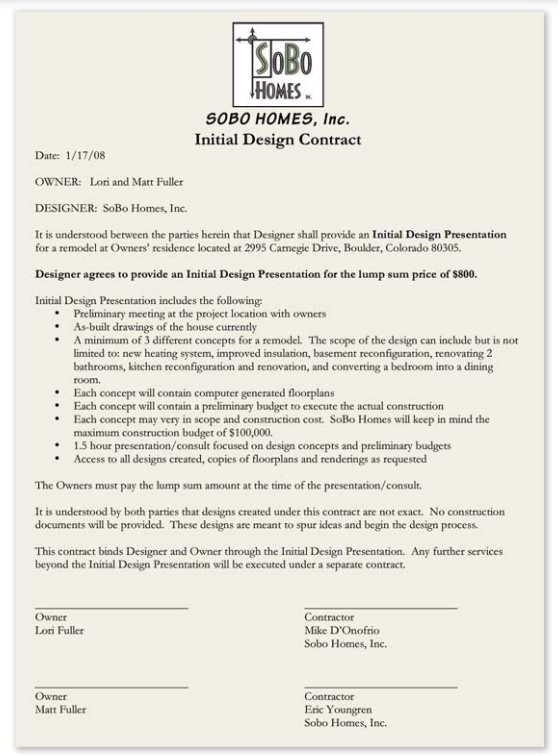
We’ve found that a formal initial design presentation helps us sell our company to potential clients and get them to commit to a longer-term (and hopefully profitable) relationship. Complete with detailed potential floor plans and budgets, the proposal is intended to convince prospects that we can design and build an incredible space for a price they can handle. But we don’t provide the presentation for free; instead, we ask clients to agree to pay for our design work by signing an initial design contract.
This simple contract is one of our most effective sales tools: It encourages prospects to jump on board for the long journey before they even really know us (and perhaps more important, before we really know them). For a modest investment — about $1,500, depending on the scope of the project — prospective clients receive several innovative custom designs as well as ballpark pricing. In return, the contract allows us to weed out people who want to drink coffee and talk about what they could do to their house — on our time.
Three Contracts for One Job
We divide the entire design/build process into three different contracts, each with its own scope of work, and each clearly defined:
• the initial design contract
• the design contract
• the construction contract
Each contract is independent of the ones before and after it. That way, if things go bad on either side of the relationship, there is an easy out.
Initial sales call. When we receive a call or a lead, both my partner and I try to meet with the prospects; that way, we can compare impressions afterward.
While we listen to their ideas, one of us takes notes. When appropriate, we also offer our own ideas. We’ve gotten over the fear of throwing out numbers during this meeting. A lot of people don’t know that a totally gutted and refinished bathroom or a killer front porch will cost at least $10,000, or that a 500-square-foot master suite complete with steam bath could cost as much as $220,000. Ballpark figures give potential clients a reality check and allow us to see if they are thinking in terms of 50s and 100s or in multiples of 1,000.
On that very first sales call, we try hard to make potential clients feel that we’ve listened to them and understood their objectives, and have a clear idea of their budget for the project. Listening well helps instill confidence that we have the capability to design and remodel their home based on what they want.
Following our meeting, we either e-mail or mail a packet containing the following:
• a custom cover letter (we don’t use a canned form) that summarizes some of the thoughts from our first meeting
• a reference list
• sample floor plans, 3-D renderings, and budgets from past projects to give prospects a clear idea of what they will be getting for their money
• the initial design contract
We make it clear that prospects will need to sign this simple contract and pay us a fixed sum of money before we can proceed.
It takes me an hour to an hour and a half to put the packet together, including the time spent revising our initial design contract template to fit the specific project, highlighting the scope of our proposed remodel, and checking our reference list to make sure the clients on it have done projects of a relevant scope. My partner and I each spend about two hours at the sales meeting itself, so in the worst case, we’ll invest five-and-a-half hours altogether in our presentation.
After a few days, we make a friendly follow-up call to see if the prospects received the packet. At this point, they’re facing an ultimatum: Sign our initial design contract or call another remodeling company. But the stakes are low. We’re asking for only around $1,500, an amount that won’t make or break our company. If potential clients can’t handle this small amount for initial design, it’s a strong warning sign they’re not serious.
Designs and Budgets
The initial design contract is an important first step, but it’s really just the tip of the iceberg; ultimately, it’s the construction project we want. So our motivation to create a quality initial design presentation is very high, and we’ll spend 25 to 30 hours preparing these initial designs and budgets. The $1,500 fee really just recoups the cost of our time.
We use Chief Architect to generate our designs. We focus on floor plans; in fact, depending on the scope of the remodel, we may not even generate exterior design ideas (siding, roof lines, and the like). Our primary objective is to use space efficiently and create the feel the clients want.
We try to produce a minimum of three independent floor plans, each with different configurations. We stress to the clients that these designs are conceptual, and we encourage them to take the things they like from each one.
We also try to put different components in each design. For example, design No. 1 may include money to retool the homeowners’ forced-air furnace, while design No. 2 might have an option to add air conditioning. In design No. 3, the furnace might be replaced with a high-efficiency boiler and radiant-heated floors.
The point is to make the information as modular as possible. We tell the clients to think of these decisions as a la carte choices, because in the end, most design decisions come down to money.
Budget. We prepare budgets after completing the designs (each design gets its own budget), starting from a template so as not to forget anything.
We try not to spend more than two hours on each budget; our approach is to plug in ballpark figures rather than exact numbers. For example, we might budget $1,000 for a glass shower door, or $11,000 for the electrical work on a large addition.
The idea is to give a reasonable range to the associated scope of the project. The hvac figure might be $2,800 for design No. 1, $7,500 for design No. 2, and $18,500 for design No. 3. The point is to let the clients see how design decisions can affect the bottom line — but in simplified form. Because detailed line-item budgets tend to confuse the average homeowner, we actually provide them with a simplified initial design budget. For accuracy, we generate our numbers item by item, then lump them together into broad categories, with notes to explain the consolidation.
One of the keys to our sales pitch is that we deliver a preliminary design and the preliminary budget at the same time. Most builders can’t do that because it’s impossible to price a product that isn’t clearly defined; most architects don’t accurately price projects because they’re not builders. As builders, we do have a good idea of what things cost, so we won’t include a 4.5-kw PV solar array in the design for a small addition if a client can’t spend more than $80,000.
Our intent is to build a budget with enough money to make the general design happen. For instance, we know that the initial budget for a standard second-story addition to a single-story house needs to be at least $200,000. We may not know every last detail, but we do know that as designers, we’d be able to reconcile the addition’s various components for that amount of money.
Final Decision
The whole point of our initial design contract and presentation is to get our clients to agree to a full design contract — and ultimately to the construction contract. For a large remodel-addition, the design contract might be in the vicinity of $10,000.
By now, we hope that clients recognize that we provide incredible value for their money. They’ve already gotten several floor-plan options (at a fraction of the cost of a full architectural design) and accurate ballpark estimates to execute those designs. They’ve seen that we have a handle on all the costs associated with a complicated remodeling project; they realize that they won’t have to spend $10,000 and many hours with a designer only to find out that the price of their project is drastically out of range.
Clients can also see that they have a huge amount of control over their budget. Providing designs and budgets early on helps establish the idea that scope and budget are negotiable, and that we are the best option for reconciling the two.
As I once heard someone say about remodeling, ultimately a decision will need to be made about what is most important — the final product or the final dollars spent. Some people simply secure a fixed amount of financing, while others have more flexibility and can splurge on whatever they wish. One of the advantages of being a design-builder is that we can efficiently help both kinds of clients get what they want.