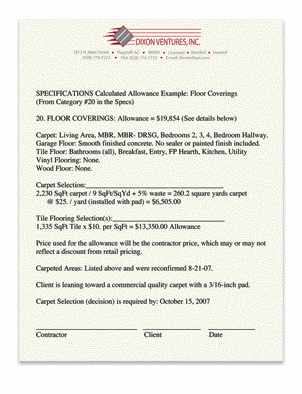
I don’t much like allowances, which let homeowners postpone decisions that really should be made before the project even breaks ground. After all, those same choices will still have to be made once construction has started — under pressure, to keep the schedule on track. But the reality is that some clients have a lot of trouble selecting finishes — floor coverings, electrical fixtures, tile, and the like — before the house has been framed and they can visualize the interior spaces. And in today’s consumer-driven marketplace, that makes allowances unavoidable.
The biggest headache with allowances is that each of the parties involved in the project — the owner, the architect, the designer, the contractor, the suppliers, and the trades — may have a different understanding of what the allowance includes and how it gets implemented and paid for. Consequently, the allowance process is not only frustrating and inefficient; it’s typically a money-loser, too. But it doesn’t have to be that way. Long ago, I learned that I could control the process with clearly defined procedures. By following these simple policies, which are described below, I’ve actually turned allowances into a profit center for my company. Limit Allowance Selections
The importance of this rule should be obvious. Homeowners need to limit their allowance items to a maximum of five selections. I don’t want to start a project with 15 open-ended issues hanging over me.
Use Only Regular Trade Partners
We limit allowance selections and purchases to approved subs and suppliers. Experience has taught me that I lose control of the process when I open the door to “outside” suppliers and vendors, as they tend to take their direction from the homeowners rather than following my company’s policies and procedures.
To understand the problems this can cause, imagine that you’ve agreed to let a homeowner select carpet from a supplier you’re unfamiliar with, only to find out that the chosen carpet is European, available solely in widths of 3 meters (instead of 12 feet), and a special order that won’t arrive for 20 weeks. What is your warranty liability on this product? Can you trust the vendor’s assurance that all seams will “disappear”? Can you live with that delivery restriction?
Quantify Allowance Choices
All prices quoted are the same ones Dixon Builders pays. I use these prices in my cost estimating the same way I use subcontractor quotes, by entering the allowance amount as a job-cost line item in the initial contract. Overhead and markup are added to the total of all job costs, not to individual line items. If the actual cost of any allowance ends up lower than the quoted cost in the contract, we refund the difference between the quoted and actual costs. We don’t refund overhead, sales tax, or any part of our markup.
Explain How You’ll Handle Variances
We make it clear from the beginning that when homeowners deviate from the contract and decide to upgrade the allowance selection, we add a management-processing fee of 28 percent to the extra cost. If they object to this, I point out that the upgrade will result in a more expensive finished product that we’ll have to warranty.
I also tell them that if they want to avoid the allowance overage fees, they shouldn’t increase allowance amounts after signing the contract.
Include an Allowance Summary
Our contracts include an allowance summary sheet (Figure 2). The summary notes each allowance, along with the dollar amount and the due date for the decision. The summary is not a substitute for the details we put in the specifications, but rather a summation of the allowance plan.
Document All Selections When an allowance selection is made, I document it in writing by using a standard change-order form that spells out all the facts, figures, model numbers, colors, and details of the allowance (Figure 3). The form acts as a final clarification of the selection and gives the owner a final chance to review it. I use this form even when there are no changes to the allowance amount, because it ensures that we are giving the owners exactly what they want.
This is also our last chance to resolve any open questions. Say, for example, that the owners have finalized all their plumbing fixture and finish selections, but several questions remain. Maybe they’ve chosen a dual-basin sink, but haven’t yet specified which basin will receive the disposal. They also may still need to clarify whether the fixture is drop-in or undermount, and where they want the soap dispenser. I review these questions with the owners and note their answers on the change order as a directive, so that the job superintendent and plumber know exactly what needs to happen.
The documentation really proves its worth when the owners insist on choosing products that we recommend against. For instance, we once did a job where there was a tile allowance for the mudroom, but when the time came to choose the tile, the owners decided they wanted laminate flooring instead — even though the laminate manufacturer advised against installing the flooring in a wet area. So when we wrote the allowance settlement change order, we spelled out the potential problems and noted that we could not warranty the installation. Six months after they moved in, the owners called my office and in a stern voice asked me to replace the laminate flooring with ceramic tile. Without the limitation on the change order, this definitely would have evolved into a warranty issue that my company would have been responsible for.
Professional Touch
The most solid endorsement I can give for these procedures is the enthusiasm of my customers. Many of them have had previous experience with building or remodeling and found allowances to be a huge source of misunderstanding. They recognize that my clear-cut policies work better than a haphazard approach, and they’re much more satisfied at the end of the project.
Dennis A. Dixon is a custom builder in Flagstaff, Ariz., and a regular speaker at JLC Live.
Figure 1. The author creates a separate document for each allowance that spells out the quality, quantity, and cost of the selection. The owners have a chance to make adjustments before signing off, which prevents them from claiming later that the allowance wasn’t what they wanted.
Figure 2. Once the individual allowances have been finalized, the author creates a summary sheet for the owners to review before signing the final contract.
Figure 3. When the due date for a product selection arrives, the author documents each allowance decision with a change-order form. Although he uses the change order for all selections, it really earns its keep when the selection varies from the allowance summary. In this example, the owners chose a flooring material that was more expensive than the allowance amount, and that the author couldn’t warranty.