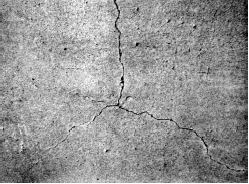
- Q. What causes a concrete slab to crack and how can it be prevented?
A.Don Marsh responds: Concrete cracking is caused by stresses due to drying shrinkage, temperature change, or applied loads.
Drying shrinkage. Drying shrinkage is an inherent and unavoidable property of concrete. During the setting and hardening stages, excess mixing water in the concrete evaporates, causing the concrete to dry from the surface inwards. Shrinkage begins near the surface, pulling at the moist inner portions of the concrete, which are restrained by friction on the sub-grade, reinforcing steel, and building connections. This restraint prevents the concrete from shrinking freely and uniformly, resulting in cracking.
While drying shrinkage and some cracking is inevitable, it can be reduced by specifying adequate compressive strength, minimizing the water content, spacing control joints properly, and adequately curing the concrete.
Compressive strengths are governed by local building codes. In general, basement walls require a minimum 2,500 psi concrete, while flatwork ranges from 3,000 to 4,000 psi. For residential work, recommended slumps range from 3 to 5 inches for flatwork, and 5 to 7 inches for basement walls. Once the concrete is ordered to a specified slump, don’t add more water at the site to speed the pour.
The purpose of control joints is to confine cracking to predetermined points in a slab, rather than letting them occur randomly. Control joints should be tooled or sawn to a depth of one quarter the slab thickness. Joints should be spaced at intervals not more than 30 times the slab thickness. Driveways wider than 10 feet require both transverse and longitudinal control joints.
Curing helps reduce shrinkage cracking and maintains slab strength.
Typically, curing involves keeping the concrete moist and covered for five to seven days, or applying a spray-on compound that forms a membrane on the surface.
Temperature changes. Extreme temperature changes immediately following, and up to a year after, slab placement can have the same adverse effects on concrete as drying shrinkage. Proper control joint spacing is the most effective method to guard against this.
Applied-load cracking. This occurs when the weight of an object on a slab stresses the concrete beyond its tensile strength. Such cracking often occurs, for example, when a heavy truck drives over a sidewalk designed only for pedestrian and light vehicular traffic. To prevent load-stress cracking, make sure a slab is built over a uniformly compacted, well-drained subgrade, and is thick enough to withstand the kind of use it will get. In residential concrete, 4 inches is the minimum thickness for walkways and patios. Garage slabs and driveways should be 5 to 6 inches thick if any heavy truck traffic is anticipated, otherwise 4 inches is adequate.
— Don Marsh is the media services representative for the Portland Cement Association in Skokie, Ill.
Q&A: Preventing Cracks in Concrete Slabs
Answers to the questions asked most often in the field
2 MIN READ