
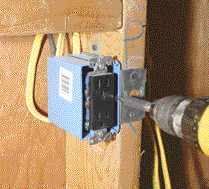
A couple of years ago, I ran across an unusual plastic electrical box at the local home center. It’s called the Adjust-A-Box and is made by Carlon (216/464-3400, www.carlon.com). What first attracted me was the product’s nailing plate, which lies over the exposed edge of the stud so you can fasten it head-on. But when I pulled the Adjust-A-Box out of the bin I noticed something even more unusual — a Phillips-head screw inside that allows you to adjust how far the box hangs out of the wall, even after it’s installed.
The remodeling company I work for specializes in natural stone counters and backsplashes. In the past, it was always a big problem when clients changed their minds about the splash material. But with these boxes, we can run the small appliance circuits and get the rough electrical inspection before we know exactly what the backsplash will be.
If the clients decide they want 3/8-inch tumbled marble tiles, we can turn the adjustment screw and move the box out to that thickness. If they reconsider and switch to 3/4-inch granite, we can crank it out some more. And if all of a sudden they get budget-conscious and return to a 4-inch splash over drywall, we just crank the box back in flush with the drywall.
The box adjusts from flush to more than 1 1/2 inches out from the stud. Since the adjustment screw is inside the box, adjustments can be made after finish work. This is especially handy for outlets inside of cabinets, because we often don’t know how far off the wall the back of the cabinet will be.
Also, when a wall is being tiled, we’ll crank the box farther out than it needs to be so that the tile setter can easily work right to the box: He can’t hang his tiles into the box, where they have to be cut, and there’s less chance he’ll stop short and force us to use an oversized face plate. Once the tile is done, we crank the box back in.
At around $2 for a single and $4 for a double, Adjust-A-Boxes are much pricier than regular boxes, so we use them only where we are likely to need them. I haven’t seen a triple- or four-gang version yet, but I’m hoping I will soon.
Rick McCamyis a project superintendent for Straight Line Imports in Martinez, Calif.
Pan Flashing for Stone Sills
by David Frane While visiting a local West Coast job site, I came across the window-sill waterproofing detail shown here. The contractor was building a wood-frame house that would be finished with traditional three-coat stucco. All the windows in the house would have exterior stone sills — each a potential leak spot. So the GC had his sheet-metal sub make soldered copper sill pans for the window openings. As an added precaution, he lined the bottoms of the rough openings with Vycor peel-and-stick membrane before fastening the pans to the building with copper nails. Stone is normally set on a bed of mortar. However, mortar won’t adhere to copper, so the builder first tacked soldered diamond lath onto the pan to give the mortar something to key into [1]. He then ran a temporary form across the front [2] and floated a level layer of mortar over the bottom of the pan.
When it’s time to install the sills, the mason will put his setting bed on the mortar [3]. The crew will complete the waterproofing by lapping additional strips of membrane onto the flanges of the pan from above. Building paper and stucco lath will cover the entire wall and tuck under the membrane that sticks out from under the sill [4].
Controlling the Daily Dust
by Bill Millard I run a small remodeling company in Garrett Park, Md. We take on small jobs — anything from repair work to painting to renovating a kitchen. Almost all of our jobs have one thing in common: Our customers live in the house while we work on it. So, along with having good people skills, my crew and I take dust control very seriously. And although the steps we take aren’t terribly costly or complicated, the extra effort doesn’t go unnoticed. Every month we turn down about $40,000 of word-of-mouth work; we’re currently booked well into 2006. Our first move on any new job is to drape everything, especially the upholstered furniture, with 1-mil plastic sheeting. We also cover beds, tables, clothes hanging in closets, and just about anything else that doesn’t move under its own power.
Next, we surround the work area with a floor-to-ceiling plastic curtain. This is made easy with the use of telescoping tension poles; we get ours from ZipWall (800/789-6633, www.zipwall.com). The curtains go up fast and come down easily at the end of the day, even if we’re returning the next day. The less clients notice our presence, the better the job goes.
The curtain wall alone won’t keep the dust contained; we also use a constantly running dust extractor to depressurize the enclosure. The unit itself sits outside because it’s noisy. We run 4-inch dust-collector hose through an open window and seal around it with insulation or rags to prevent drafts. Whenever we’re doing a dust-making task, like cutting drywall or concrete, a worker guides the hose as close to the cutting operation as possible to capture the worst of the dust and debris [1].
Of course, you can’t just blow the stuff all over the yard. We run the hose through a dust-separating lid mounted on a 35-gallon trash can. This pulls the bigger chunks and heavier particles out of the airstream (and protects the extractor’s impellers from damage). The fine dust still blows through, so we usually aim it into a handy bush [2]. If this isn’t possible or acceptable, we use a capture bag on the blower and put up with the slight loss of suction that comes with it [3].
For jobs that don’t require room containment, we use ordinary box fans and tape an inexpensive furnace filter over the draw side of the fan [4]. This simple rig, set up close to the work, captures a world of dust, as is obvious at the end of the job when we toss the filter.
As a final touch, we go through the whole house with a feather duster. One person dusts furniture, artwork, lamps, window sills — absolutely everything, including the motorcycle on display in one customer’s living room — while another follows with the 4-inch hose, sending the unsettled dust outdoors through the extractor [5].
This simple courtesy has won us an endless list of repeat customers.
Bill Millard runs a home repair and renovation service in Garrett Park, Md.


