

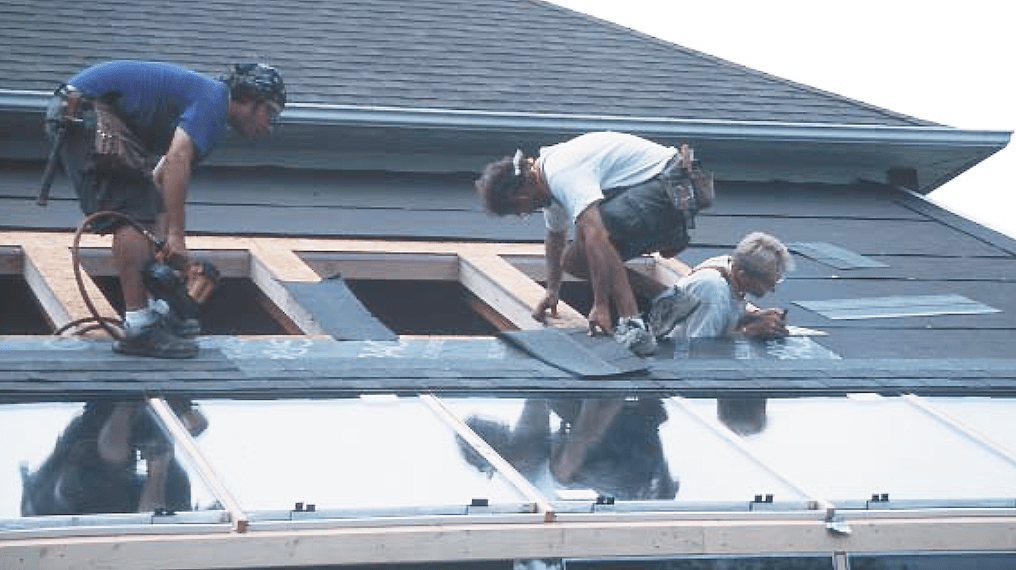
I design and build custom sunroom additions in Chittenden County, Vt. (see “Building a Custom Sunroom” 05/2000). Many of these rooms include skylights as a practical way of adding glazing overhead. I install around 20 skylights each year, so I need to be certain that I don’t get called back to fix leaks. So far, I’ve never had a leak, which I attribute primarily to closely following the manufacturer’s installation instructions.
Choosing a Skylight
When planning a sunroom, I usually work with the client to determine the right location for each skylight. I’ll make recommendations about what would look best and how to avoid glare within the room. In a sunroom that doubles as a TV room, for example, I might recommend optional shades.
Most customers appreciate the extra sunlight on a winter day but don’t realize that skylights can overheat a room in the summer. For that reason, I always steer clients toward a ventilating skylight. For simplicity, I prefer manual operation units rather than motorized, though there is no question that remote operation of motorized units are much more user friendly. Motorized units can be programmed to open and close on a schedule and will close automatically when it rains.
I prefer Velux skylights (www.velux-america.com), simply because they’ve never given me any trouble, I’m comfortable with their flashing system, and I have the installation instructions memorized. The VS model is my favorite; it provides good ventilation and comes in a wide variety of sizes. Although I’ve used other manufacturers with success in the past, the distribution wasn’t as extensive in my area, making their products harder to get and increasing lead times.
Square Framing First
During framing, I make an extra effort to get the openings perfectly sized and square. It makes setting the skylight – not to mention the trim – go more smoothly.
It’s important to maintain clearances between the skylight opening and and critical areas such as that ridge, valleys, roof-wall intersections and any changes in roof slope. For asphalt-shingled roofs, a minimum of 12 inches on the side and 18 inches on the top and bottom of the opening is typically required by manufacturers (though these may vary; remember to follow the manufacturer’s installation requirements as these serve as the code standard). For tile and metal roofing, the minimum is typically 24 inches to critical area on the top and bottom of the opening.
I leave the units boxed for transport and on the job site to lessen the chance of damage and keep all the parts together. A few days before the scheduled installation, we remove the manufacturer labels and prefinish the frames and sash. Prefinishing is neater and faster than working from a ladder after the units are installed. I’m seldom asked to paint the skylights, because the engineered beams that form the structural frame of our sunrooms are naturally attractive, and my customers usually want to continue the look of natural wood to the trim and millwork. We typically use a couple of coats of water-based polyurethane. It provides good protection from humidity and condensation and cleans up easily.
Setting the Unit
In preparation for the skylight installation, the roof is sheathed and covered with an underlayment. I hold the underlayment back from the openings about 6 to 8 inches, so a waterproof peel-and-stick underlayment can adhere to the roof deck. Up to this point, I’ve temporarily covered the openings with plywood to keep rain out of the room. Before bringing the skylights out onto the roof, I shingle up close to the openings. On hot days, I’ll stop shingling a little lower on the roof so the shingles don’t get scuffed while the skylights are being installed.
I start the skylight installation by first bending out the L-shaped mounting brackets and removing the cladding and sash, making the unit lighter and easier to handle. I pass the frame through the roof to a helper and stand inside to center it in the opening. Centering ganged skylights is especially important, because trim and narrow sections of drywall will show up the discrepancy inside if the roof windows aren’t spaced equally.
I’ve improvised a simple tool to help with centering: A speed square clamped to a combination square with a set of locking pliers makes it easy to check the reveals quickly and get them just right (see photo at left).
I rest the units on a temporary cleat nailed to the roof, which makes positioning easier and safer. It also keeps multiple units in a straight line and prevents expensive skylights from sliding to an untimely demise.
Once I’m certain the skylight is centered, we nail through the mounting brackets in two opposite corners, using the heavy-duty ring-shank nails included with the skylight. We try to get them into the roof framing, but the annular rings resist pull-out even if they’re driven only into the roof sheathing. Next I reinstall the sash to check operation and ensure that the unit’s frame is square and will remain so. With the unit in its final position and the sash operates without binding, we fasten through the other brackets, locking the skylight in place.
When we have all the skylights secured in their final position, I remove the cleat that helped with placement and we cut 10-inch-wide strips of self-adhering eaves membrane for a secondary water barrier. This is the last defense against water infiltration, and the manufacturer requires it. We generally use Grace Ice and Water Shield because it’s readily available and it sticks better than other products I’ve tried.
We start at the bottom, attaching the membrane to the skylight and smoothing it onto the roof. The sides are next, with the areas between adjacent skylights the biggest challenge. With all hands on deck, we take positions at top, bottom, and middle and try to keep the membrane from sticking to itself and making a mess. The piece is cut so that it extends about 6 inches beyond the skylight, top and bottom. We adhere the membrane to one skylight and smooth it down toward the roof and back up onto the other skylight .
Finally, we install the top piece of membrane. It laps over the side pieces and is stuck to the roof sheathing under the felt. We use a hammer stapler to better secure the membrane to the skylight, stapling as close to the membrane’s top edge as possible. This isn’t as critical in warm temperatures, but I had one occasion where the membrane separated from the skylight and had to be redone. Since then, I always staple the membrane as extra insurance.
After the membrane is installed, we continue shingling up the roof to the bottom edge of the skylight. We know we have shingled far enough when the sill flashing, the bottom piece of flashing, covers up some of the shingles’ 5-inch exposure. Special nails are provided for attaching the flashing: They’re 3/4 inch long so they won’t poke through the frame, and they’re noncorrosive to the aluminum.
We shingle up the sides, weaving the step flashing into the courses. The manufacturer specifies at least a 3 1/2-inch overlap on every piece, and the pieces are nailed near the top on the downhill edge. The last piece of step flashing is slit so it can bend around the top corner.
The small section of roofing between ganged units gets a U-shaped piece of flashing rather than step flashing. We bend our own in the shop out of high-quality bronze aluminum trim coil; if you don’t have a brake, the manufacturer offers a pre-bent U-shaped flashing as well. We make our own flashing because I like to have flexibility in spacing the units. The U-shaped metal is held in place by the cladding when it’s reinstalled. Next, we install the head flashing over the step flashing and shingles, but we don’t install the screws. We put a strip of eaves membrane over the head flashing and under the felt.
Shingling is easier now because we no longer have to cut and fit around the skylights, but it’s important to leave a 2 3/8- to 4-inch space between the top of the skylight and the shingles. That space prevents roofing nails from punching holes in the head flashing and allows water and debris to get around the skylight unimpeded.
To finish out the job, we reinstall the cladding that was taken off when the sash was removed. Those pieces, held in place by screws, give the skylight its finished look and act as counter-flashing for the U-flashing and step flashing. We start at the bottom, continue up the sides, and finish with the top piece.


