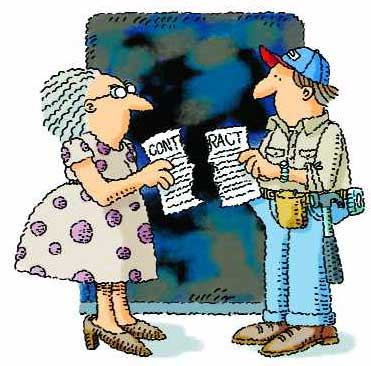
Just as it sounds, “breach of contract” means that someone has not done what he contractually promised to do. But a breach of contract does not automatically mean that the contract is dead — that is, unenforceable.
A Material Breach
To kill the contract before the project has been completed, there must be a “material” breach of contract. In other words, the breach is so serious that, in effect, there just isn’t a contract anymore. There’s nothing to enforce, because the contract has been so damaged it’s beyond fixing — even if your standards for fixing it aren’t very high. At this point, all you can do is pick up your tools and go home to sort out who owes what.
The “beyond fixing” part is important: Not every failure to do what you promised — or for your customer to do what he promised — is such a big deal that the contract is irrevocably destroyed. Only a material breach can kill a contract.
A less than material failure to perform might give the injured party some other kind of remedy, but it can’t kill the contract. The thrust of contract law is to enforce valid contracts even if there are some bumpy spots along the way.
Minor Errors
For example, suppose a contractor does a kitchen remodel that includes a tile floor. He does a good job installing the tile, but the grouting is poorly done.
Does this mean the contract is so breached that the contractor does not have the right to fix the problem and complete the rest of the job? Or does the contractor have the right to leave the tile the way it is and continue working on other parts of the project? Does it mean that the customer can tell the contractor to get off the job and not come back, and then sue him for breach of contract for not doing the job correctly?
While the contractor’s failure to perform is a breach of contract, he still has the right to fix it (“cure” is the legal term). But even if he doesn’t fix it, the customer’s only remedies are to haggle over the final payment or sue for breach of warranty after the project is finished.
The contract is still in force, because sloppy grouting is simply not that big a deal. The bad grout job is not a material breach of contract because the problem can be fixed. Maybe it can’t be fixed in a way that will make the customer want to call that contractor for his next remodeling project, and it may not be fixed in a way that will allow the contractor to collect every nickel of the contract price, but it’s fixable enough to keep the contract alive.
Serious Mistakes
But suppose, through a monumental misreading of the plans, the contractor neglects to install electric heating elements under the tile floor. This would be a material breach of contract.
The contractor still has the right to tear out the tile and install the missing heat or to work out a settlement with the customer, but if he doesn’t repair the mistake in a reasonable amount of time or get the customer to agree that the floors are fine the way they are, the customer could throw the contractor off the project and get someone else to complete the work.
If the customer wanted to, he also could sue the contractor for breach of contract, and would probably win.
The thrust of contract law is to enforce valid contracts even if there are some bumpy spots along the way. |
When Clients Breach
It works the other way around, too. Suppose the customer regularly fails to make progress payments when the contract stipulates, but does eventually make them. Can the contractor just get fed up and walk off the job? No, because the customer did finally make those payments and the contractor did accept them.
But what if, one of the times that the customer was late, the contractor was so fed up that he refused to accept the late payment and walked off the job? Are that customer’s habitually late payments such a material breach of contract that the contractor can simply quit, contract or no contract?
Probably not, because the customer was ready and willing to make his payment. He had made all the past due payments, and the contractor (in this example, anyway) had no reason to believe that the customer would not continue to make those payments.
Some states, like Arizona, have passed right-to-payment laws that greatly simplify the whole issue of who has exactly what right to do what. In these states, the contractor can suspend work or even terminate the contract — after giving notice — when payments are late. But even where such laws exist, once the late payments — and the expenses caused by them — have been taken care of by the customer, the contractor has no further rights to stop work.
Remedies for the GC
Does that mean the contractor has absolutely no remedy if the customer paid the correct amount, but paid late?
Not at all: If, for example, the contractor has to pay late charges or fails to get his usual discount from suppliers, he is entitled to back-charge the customer for those expenses. He can probably collect for some other kinds of damages, too, but he may not walk off the job, because the customer has fixed this breach of contract by paying.
It’s worth noting that any suit deriving from a breach of contract is a “contract suit” rather than a “tort suit” — meaning the lawsuit is about money, not about a physical injury or negligence. Punitive damages are not allowed in contract suits, so the prevailing party is limited to collecting actual economic damages. This type of case usually hinges on whether the contract breach was material, which is why I advise clients not to walk off the job or initiate legal proceedings unless the breach is unequivocally material and they can prove it in court.
Once in court, neither the contractor nor the customer gets to decide if the contract has been breached or the breach is material. If the dispute goes that far, the decision will be made by a judge, a jury, or an arbitrator.
has practiced and taught law for more than 25 years and is the author of The Contractor’s Plain-English Legal Guide (www.craftsman-books.com).