The other night, my husband and I watched a television show about contractors in California who are walking away from unfinished houses.
But few contractors will walk away from an unfinished job voluntarily. That’s definitely not part of their business plan. So why would it happen?
We think we know. My husband has been retired from the construction business for several years, but both he and I will never forget a period in the ’80s when lumber prices were skyrocketing. It got to the point where all of his contracts were money-losers. For a while, staying in business literally cost him money.
Today’s Higher Level of Risk
If the construction business falls back into that situation, it could be even worse this time around.
Just do the math. A 5 percent cost overrun on a $100,000 job is $5,000. You could probably manage that without going out of business.
But a 5 percent cost overrun on a million dollars is $50,000 — not nearly as manageable. And some of those California houses on the television show were multimillion-dollar projects.
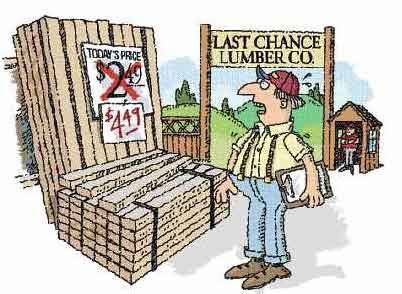
The fact is, costs are going up, no question about it. Financing costs have already increased. Any increase in energy prices will have an impact on the cost of materials everywhere, as will any major hurricanes and floods.
So the critical question is this: Can you write your contract to offset rising costs?
Yes, you can.
Work Cost-Plus
You could, for example, write a cost-plus contract, in which the customers simply agree to pay whatever the cost of labor and materials is, plus a fixed dollar amount or a percentage of the costs as profit. If costs go up during the course of the job, it’s the customers’ problem.
But customers aren’t always willing to sign such an open-ended contract. Before they sign on the dotted line, most of them want to know exactly what the project will cost them.
Pad the Estimate
Another option would be to build enough money into your bid to protect yourself if costs rise. The good part about that approach is that if costs don’t rise, you’ll make more money than you had expected to.
The bad part is that your bids will be high and you could lose a lot of jobs.
Use an Escalation Clause
Perhaps the soundest solution would be to put an escalation clause into your contract. That’s a clause that allows you to increase the contract price or bid if certain things happen. What those certain things are depends on how you write the clause.
Usually escalation clauses are triggered by increases in material prices or labor costs that exceed by a certain percentage what prices were when the contract or the bid was written.
I have heard of projects where the cost of the entire contract was tied to something like the U.S. Consumer Price Index, but odds are you won’t get clients to agree to such an open-ended arrangement. More likely, you’ll have to limit the clause to certain items — materials like concrete, steel beams, and rebar, for example, or framing lumber and asphalt roofing.
In each case you will need to spell out a number of details. First, you will need to state (in the contract or an addendum to it) what the materials cost at the time of the estimate. Those prices will be the basis for whatever happens later on.
Customers tend to be more comfortable when they understand exactly what they’re paying for; with an escalation clause, they can see that an additional cost is not a capricious increase. |
Second, you will need to specify by how much the prices of these materials need to increase for the escalation clause to kick in. Since customers may feel that you are trying to cheat them if you refuse to accept any risk for rising prices, it’s best to set a threshold below which you will pay the higher cost — typically a 2 or 3 percent increase for a particular item.
Finally, you will need to specify where the new price will come from. You could get a quote from a supplier, but if I were a customer I’d be concerned that the contractor and supplier (who work together all the time) might inflate the price.
A better approach might be to explain in the clause that the contract price will be adjusted according to a published price index. If the price index for lumber goes up 10 percent, for instance, the contract cost for lumber will also go up 10 percent.
How to Sell the Clause To Customers
There are several reasons an escalation clause is a good idea, and you should use them when you explain to your customers why the clause works to their advantage.
For one, an increased contract cost would be less expensive than driving you out of business would be. Think those homeowners in California are better off with their disappearing contractors? Of course not.
However, you might be uncomfortable making such an argument; some customers may prefer to do business with someone who doesn’t talk about such harsh realities.
A more acceptable explanation may be that your bid will be lower if you don’t have to build in extra money for unexpected cost increases.
Also, customers tend to be more comfortable when they can see exactly what they’re paying for, even if it is a cost increase. They can see that the additional cost is not a capricious increase, or simply an attempt to make more money.
Price Jumps Aren’t Unforeseen Conditions
You may believe that you’re already protected from unforeseen price increases because you have a clause in your contract that allows you to charge more if you run into “unforeseen conditions.”
But that kind of clause works only for genuinely unforeseen conditions — for example, if you were to start excavating and discovered the world’s largest rock. (Okay, maybe just the state’s largest rock; either way, it’s not a pleasant memory. I won’t even talk about the Indian burial mound that turned up on another site.)
The point is, no one could have foreseen while preparing his bid that he would find a rock of massive proportions right where he was trying to dig out a foundation.
However, the courts say that you can foresee rising prices, because they’re part of the ordinary risk of doing business. If that risk isn’t okay with you, then you will have to address it — either by charging more or by using language that’s very specific about increased costs.
If you find yourself stuck because you don’t have an escalation clause, there are some legal arguments you might be able to fall back on, depending on why the prices went up. The reason for the increase would need to be something the parties to a contract wouldn’t ordinarily have considered at the time they negotiated — war, an embargo, floods, forest fires.
To make such an argument fly, though, you’ll need a lawyer — and that will cost you a great deal more than it would have cost to have hired one in the first place to write that escalation clause.
Quenda Behler Story, author of The Contractor’s Plain-English Legal Guide, has practiced and taught law for more than 25 years.