A short time ago I got a call from a builder with whom I’ve worked for many years. He usually seeks legal advice before jumping into something new, but this time he was a bit slow to check in. The builder had terminated a homeowner’s renovation contract before the work was complete and was being sued for $200,000 in damages.
According to the builder, the job was tough from the start. There was no architect, and the homeowner scrutinized subcontractors’ work and questioned the job foreman’s judgments. There were six change orders in the first four weeks of work, all caused by the owner’s indecision. The owner complained and interfered so much that the subcontracted carpenter quit the job. The builder didn’t have another carpenter to turn to and, with progress stalled, he terminated the contract because he felt the owner had stepped over the line. He tried to reach an agreement on payments by asking for about half the job’s value, since work was roughly half done, but was rebuffed by the owner. Instead, he got an aggressive lawsuit that called the builder’s work “shoddy and unprofessional.”
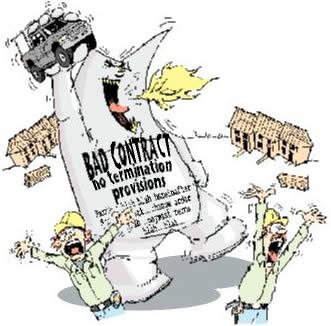
“Help,” the contractor pleaded, “All I did was try to get out of a bad deal.” When we met to talk, I learned my client had made a series of errors that began before he even met the homeowner. His standard form contract had no termination provisions and didn’t allow him to collect his profits or his legal fees if things went wrong. He tried to reach a settlement without legal guidance and had unwittingly driven a wedge between the parties. Consequently, he was facing expensive court proceedings and judgment by a hostile jury. After all, he was a contractor, and contractors often do not fare well in court.
Start With a Well-Written Contract
Whether it’s due to a difficult homeowner, a major illness, or a customer’s sudden job loss, most contractors will have to terminate a contract at some point in their careers. If a contractor doesn’t plan for this in advance, he will almost certainly lose his anticipated profit and may not be paid for the work that’s already done. He is likely to face expensive legal fees and the possibility of an adverse judgment in court. The best way to avoid these negative outcomes is to use a good contract and get advice from a competent lawyer.
Contract law requires the parties to an agreement to abide in good faith with the terms of the deal. Various legal theories might be used to void an agreement (impossibility of performance, for example, or fraud), but they rarely come into play. The parties are bound by the deal they make and a judge’s role in any dispute is to interpret the contract and enforce its terms.
One way to avoid this type of financial disaster is by using a good written contract. The contract should cover all foreseeable events. Most builders use form contracts that they adapt to each customer or job. You can buy standard forms from a variety of on-line contract drafting services or have one written by your attorney.
Use Specific Termination Provisions
Whatever approach you take, be sure to include termination provisions that are clear and concise. If the terms aren’t clear, disputes are more likely to arise about the parties’ obligations under the contract. The only thing worse than having no termination clause is having one that muddies issues even further. For example, the contract could state that the builder can walk away from the job if he’s not paid “within 48 hours of submitting his invoice.” This would be better than saying the builder can quit if not paid after completing certain work to “the owner’s reasonable satisfaction.”
While it’s impossible to foresee every potential circumstance, builders can anticipate many of them. Contracts should describe conditions that allow the builder to walk away — a failure to make timely payment, stoppage of work caused by the owner’s conduct, and death or disability of the contractor should all be included. If one of these events occurs, the contract should provide notice procedures and define financial consequences. The terms should be as clear and specific as possible.
Concerning owner conduct, a contract might require owners to stay away from the job site while subcontractors are there and report any perceived issues directly to the contractor alone. Violations of a provision like this might be dealt with via a written notice to the owner that the contractor will be forced to leave the job if interference with work progress continues. Should an owner cause the job to end, the agreement might require payment of the builder’s profit on completed work. The amount due can be calculated through a progress payment scheme whereby certain amounts are due as specific benchmarks are reached. If a phase of the project is partially completed on termination, the contract can provide for reimbursement based on time and materials expended on that portion of the work.
Perhaps even more important is to cover circumstances that allow the homeowner to back out of the job due to a builder’s supposed poor work. Contracts should require owners to give the builder advance notice and an opportunity to cure before they can terminate the contract for this reason. Because owners are not normally expert at judging work in progress, contracts might require them to offer specific support for any alleged deficiencies and instructions on what should be done to remedy any problems. The architect, if there is one, might be useful for this purpose. It’s hard to set a specific time frame for “curing” a perceived problem, so writing that the contractor must begin to address the problem within, say, seven days makes sense. The contract can then provide that any problems be fixed within a reasonable time.
Provide for Dispute Resolution
Fighting things out in court is difficult and expensive, especially if there are issues of fact that require expert testimony. A building contract can help lessen the financial load by providing for the arbitration of disputes. This process is less expensive and much faster than courtroom litigation. A typical arbitration clause provides for the submission of disputes to an entity such as the American Arbitration Association, which can appoint a neutral arbitrator and provide rules to govern the procedure.
Other components of dispute resolution to consider are the payment of legal fees and the identities of the parties to litigation. A contract can include language that requires the party in breach to pay all fees and costs incurred by the non-breaching party in an enforcement action. This type of clause can head off lawsuits by making unreasonable parties think twice about the consequences of their conduct. And if the contract allows suit only against a corporate entity (which may have limited assets) and not against the builder who owns it, a homeowner may be more amenable to working out a deal. This is how any dispute over contract termination should be resolved.