[Editor’s note: We are saddened to learn that Gordon F. Tully passed on March 10, 2021. Our heart’s go out to his wife, Ellen, and the many friends he met along the way. He was an extremely thoughtful and talented teacher championing good design not only for aesthetics but also performance and affordability. His website achitully.com provides a full view into the depth and breadth of his knowledge and insight. Here in JLC, Tully leaves with us a legacy of his teaching, which we are grateful to be able to share and honored to preserve. This article is one example. For more, see the sidebar below, or (for all his articles) click on his byline above. ]
Choosing the right style as a prototype is the key to building a handsome and affordable home that has a small “environmental footprint.”
Is Vinyl Siding Green?
A small sample of the more than 100 articles contributed to JLC (and its precursor NEB) by Gordon F. Tully:
Wind-Smart Design
In a blowing rain, it's the details that count.
Making Windows Fit
Clear guidelines for making windows compatible with the other design elements of a house.
Designing Low-Cost Homes
Tips for making low-cost homes look better without busting the budget.
Roof Pitch and Building Form, Part 1
Gordon Tully's debut article in the Jan/1986 issue of New England Builder.
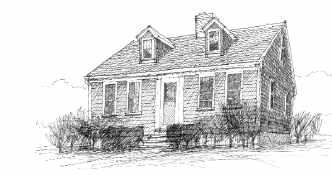
Here in my adopted city of Norwalk, Conn., there are hundreds of little Cape Cods built in the mid-20th century — one-story houses with a steeply pitched roof springing from the top of the front and rear walls, and a door centered in the front wall. If you add a story and reduce the roof pitch, you get a colonial. If you leave off the room to one side of the front door, you get a “half Cape.”
To pull more light into the second floor and decorate the vast unadorned front roof, fancier versions add dormers. This looks good, but you really get more bang for the buck if you build one big shed dormer. Since sheds are considered ugly, they always go on the back of the house. It’s important to hold the shed in from the building’s gable ends to maintain the basic integrity of the roof.
The “hunchback” affair shown below is a cheap and dirty solution that doesn’t follow this rule, and the result is quite ugly. Nevertheless, the approach is tempting, because you get more space by spending less money.
Some builders try to disguise the stylistic solecism by “painting” the Cape roof on the gable end with a piece of contrasting trim (below). The idea is on the right track, but it doesn’t work because the result is two-dimensional.
However, the same stylistic sleight of hand, if done in a style that features roof overhangs, works splendidly. Start with a simple two-story box with a 6/12 roof (the one I own, circa 1929, is almost a 24-foot cube). Establish a generous rake overhang at the ridge, then tack on what looks like the lower part of a gambrel roof, carrying the extended overhang down the side. Continue the main roof with a shallower rake overhang (or none at all), and voilà! You have a snappy-looking gambrel colonial.
he tacked-on elements are relatively cheap, because you can frame them any way you like and they don’t add corners or offsets to the basic box underneath. The ones in the example (below) are about as fancy as they get, with neat hipped roofs over the rake overhang returns.
The Challenge of Narrow Lots
These prototypes sit longwise to the street, which implies a wide lot. Add a one- or two-car garage at one end, and the lot gets even wider. But if we’re serious about conserving resources, we need narrow-lot developments, which reduce the resources spent on transportation and street infrastructure. And since building up density is such an essential tool for conserving resources, we also need to fill in the gaps in existing streetscapes with narrow-lot home designs.
That’s easy to say but hard to achieve in U.S. communities, where the car is king. A front-facing attached garage on a wide lot looks fine; on a narrow one, it creates the infamous “snout house”. This example has a one-car garage and can be salvaged; a snout house with a two-car garage is beyond hope. The garage pushes the living spaces to the rear, which makes it necessary to set the front door and front room as far back as possible. In solving this problem, the builder of this home caught a bad case of “gable-itis.” He also skimped on the roof overhang and trim details.
The first step in fixing his design is to bring the two windows together over the garage, to avoid the grotesque face created by the two eye windows and gap-toothed garage door. You also need a porch over the entry, and some horizontals to get rid of the middle gable. Finally, add back the missing trim, and you have done about all you can.
Front garages create inefficient and poorly lighted floor plans, and homes with attached garages are often contaminated with carbon monoxide from idling cars and from chemicals stored in the garage. We can solve both problems by prohibiting attached garages at the front of narrow-lot designs.
Tackling the Cost of Style
With the car out back where it belongs, you can tap into many stylistic prototypes from the 19th and 20th centuries to inspire a narrow-lot design: Craftsman and bungalow, Prairie School and Shingle, Bay Area and vernacular farmhouse, to name some used up north. The trick is to simplify the detailing, but not too much.
Let’s start with one of my favorite prototypes, the “story-and-a-half” houses so common in the Northeast. You see them everywhere: Look for eaves set halfway up the second-floor wall. When dormers are present, they interrupt the eaves — a really nice effect. The spaces on the second floor are intimate and varied because they are partly under the eaves.
The structure may be derived from the Greek Revival style, where the first-floor girt frame extends past the second floor to create a wide entablature. This stub wall also creates usable space on the second floor, which otherwise lacks headroom due to the low roof pitch demanded by the style.
That same construction (with a steeper roof) is used in the story-and-a-half homes. The side windows are narrow, and dormers are set over the windows below so that as many studs as possible cantilever to resist the roof thrust. This example from West Falmouth, Mass., lacks dormers, but it has porches on two sides and a wing out of sight at the rear.
The style can yield a handsome and economical house without a lot of trim. Here is a sketch of an accessible home (bottom) that illustrates what you can do. It shows a shed dormer, a shed roof over the entrance, and a shed-roofed bay attached to the front. (I am a fan of hanging bays from the wall instead of building an expensive foundation.)
With contemporary platform framing, it’s best to carry the roof on a ridge beam to eliminate the thrust. This gives you complete freedom to locate windows and dormers where they work best with the furniture. A taut design without overhangs may get you in the magazines, but overhangs really help keep a building dry, with or without gutters and leaders. The main complication with the roof is the double cantilever at the corners (I recommend using a simple bracket to avoid rake outriggers).
Homes need enough detail to make them authentic. We need to build affordably, but if we just say no to wide lots, we will save more than enough to justify a little decoration.