There you are, just trying to make an honest living as a contractor, when all of a sudden somebody you’re doing business with declares bankruptcy. How will this affect you?
Answering that question is difficult — but I can guarantee you the news will not be good. Exactly what happens to you depends on the kind of bankruptcy and whether you are a secured creditor.
How Bankruptcy Works
To declare bankruptcy, an individual, company, or corporation files papers with a federal bankruptcy court. The court appoints a trustee and notifies the creditors that a bankruptcy is taking place. The trustee’s job is to collect “nonexempt” assets from the debtor, arrange for their sale, and use the proceeds to pay creditors. (A nonexempt asset is one that can be attached — or seized — during bankruptcy.)
Exempt assets. The rules vary from state to state, but in most cases personal assets (such as clothing), work tools, and vehicles are exempt from attachment. Many states have homestead exemptions that protect all or part of the debtor’s equity in his home.
Secured creditors. An asset used as collateral to secure a loan is typically exempt from bankruptcy because the lender has a lien on it; the same may be true for a home that secures a mortgage, an auto that secures an auto loan, or any property with a lien on it. A secured creditor, lender, or lien-holder can get at these assets by repossessing or foreclosing on them, but a bankruptcy trustee usually can’t.
The trustee can attach and liquidate any assets that are not exempt. However, by the time someone files for bankruptcy, there will be few if any nonexempt assets left to seize.
Types of Bankruptcy
There are three kinds of bankruptcy: Chapter 7, Chapter 11, and Chapter 13. From the creditor’s point of view, Chapter 11 and 13 are preferable to Chapter 7 because they make it harder for debtors to escape their debts.
Chapter 7. In a Chapter 7 bankruptcy, the bankrupt individual, company, or corporation is saying, “Sorry, I can’t pay.” The debtor’s assets are liquidated by the trustee and the proceeds are used to pay the creditors, who may receive all or part of what the bankrupt party owes them. Once the process is complete, the debts are “discharged,” which means they legally cease to exist, even if the creditor received only pennies on the dollar.
An individual who files Chapter 7 will still be around when the process ends; but when a company files Chapter 7, it goes out of business and is effectively “dead.”
Chapter 11. A Chapter 11 bankruptcy is filed by a business that hopes to survive. The idea is to give the company some breathing room while it comes up with a court-approved plan to pay its debts. Once the papers have been filed, the court tells creditors to step back and leave the company alone.
In the end, some of the company’s debts may be partially discharged, but until then, creditors are barred from taking steps against the debtor without the court’s permission.
Chapter 13. Although Chapter 13 is similar to Chapter 11, it applies to individuals rather than companies or corporations. It is a personal-debt reorganization that involves temporary protection from creditors while the bankrupt person tries to get his financial act together. The upshot is usually a court-mandated payback scheme and partial discharge of the debts.
When a Vendor Declares Bankruptcy
Let’s start with a rather unpleasant example: You’re doing a whole-house remodel and the stone fabricator requires a $5,000 deposit so that he can buy material and begin making granite countertops for the kitchen and baths. You write him a check for $5,000, and he uses it to buy some granite slabs — but before he begins work on the counters he declares Chapter 7 bankruptcy.
You paid for the materials, but they’re not yours. Can you go to his shop, pick them up, and take them to another fabricator? No. Even if the fabricator gives you permission to take those slabs, you can’t. Moreover, this is true even if the countertops are finished and the debtor was ready to deliver them. If you were to take them, a U.S. marshal could come after you to get them back.
How is this possible? You paid for the stuff! Well, yes, you did, but you didn’t take delivery — so, barring some complication, that material still belongs to the debtor. It’s a nonexempt asset that can be sold to somebody else to raise money to pay off creditors.
The meager good news is that you are a creditor, there’s no question about that. You paid the fabricator money and he didn’t deliver, so he owes you $5,000.
Can you expect a check in the mail? Not very soon, and not for the full amount. Why? Because you’re just an unsecured creditor, which means you are last in line to collect and you will probably be doing well to collect 10 cents on the dollar.
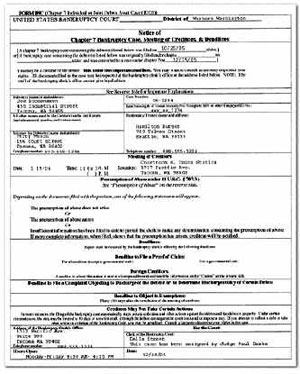
If someone who owes you money files for bankruptcy, you’ll receive a notification form that looks something like this document. To protect your ability to collect, follow up by filing the correct documents with the court.
The rest of the bad news is that if your customer advanced you the money to pay the deposit, then you owe him either $5,000 or granite countertops. (Maybe you can buy yours at the bankruptcy auction.)
When a Customer Declares Bankruptcy
Let’s consider a different example now, one that’s not quite as awful to contemplate: You just submitted the bill for final payment on a construction job, but before you can collect, the customer declares Chapter 7. Are you simply out of luck? Maybe. All you can collect of the debt is what the trustee in bankruptcy gives you from the bankrupt party’s assets. That debt is history.
But even though it has legally ceased to exist, all is not lost. The good news is that if you have protected your lien rights, you will probably still be able to eventually enforce a lien. A lien on the property turns you into a secured creditor: You can’t collect the debt, but you can foreclose on the property and get paid that way.
Tougher rules for individual debtors. However, let’s say your customer isn’t a corporation. Personal bankruptcy is a somewhat different ball game than it used to be, thanks to the new bankruptcy act. If your customer is a consumer — as opposed to an incorporated business — he may not be eligible for Chapter 7 bankruptcy. The new act has a “means test” intended to determine which individuals are “worthy” of relief through Chapter 7.
The means test is calculated by comparing the debtor’s average income for the past six months with the median income for households of the same size in the debtor’s state of residence. The debtor’s income must be less than or equal to the state median income, or he won’t be allowed to declare Chapter 7 and must instead go into a Chapter 13 reorganization.
How is this better for the contractor? In Chapter 13, the debt is not usually discharged, so the debtor will have to pay the contractor with future income.
What to Do
What kind of advice do I have for you? The first thing you need to do if you get a bankruptcy notice is decide whether the debt is large enough to pursue. Collecting a debt costs time and money; in some cases it may be cheaper to let it go or file your creditor’s claim and rely on whatever the trustee can do for you.
If the amount is large, though, call your lawyer right away. Don’t delay, because there are deadlines involved and bankruptcy and lien laws are complicated.
As a contractor, the main thing you want to do is protect your lien rights, because they turn you into a secured creditor. If you lose your lien rights — something that happens frequently in bankruptcies — you become an unsecured creditor and have to get in line with everyone else. Protecting your lien rights is very technical stuff; you’re going to need professional help to do it.