
Living in New England, one comes to appreciate the simple charm of colonial architecture. It’s a style that has always appealed to me, and I’m not alone. Many home buyers drive the streets and back roads looking for an older home to buy and remodel. But even in New England, there simply aren’t enough of them to satisfy the market. When a buyer is lucky enough to find an appealing house, bringing it up to modern standards of safety, energy efficiency, and function can be a formidable task. Few home buyers have the resources or ambition to tackle such a project.
To meet this demand, my company, Connor Building, builds reproduction colonials — classic-looking homes that people assume are 200 years old. With their correct proportions and classic details, they have little in common with the generic two-story “colonials” found in subdivisions everywhere.
I started building these homes in and around Middlebury, Vt., about 20 years ago and for the past few years my company has been panelizing and shipping them across the country. When we build locally, we manufacture the panels and act as the general contractor, handling all aspects of the process from excavation to move-in. When house packages are going more than 50 miles from home, we ship the panels to the site by truck and have a local builder erect the house. Besides the wall panels, we produce siding and trim, including custom door and window pediments. In most cases, we even build and ship the kitchen cabinets.
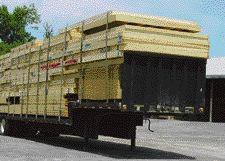
Depending on the size of the house, two, three, or four loads of wall panels travel by truck from the shop to the job site (top left). The plywood-sheathed panels are arranged in orderly stacks, with those needed first on top (top right). The author’s crew erects the panels if the project is located nearby (middle); homes shipped to more distant sites are erected by a local builder. A detailed floor plan maps out the locations of individual panels, which are carefully labeled before leaving the assembly table. Precutting joists, rafters, and other framing members simplifies accurate multiple cuts. These shaped rafter tails (bottom left) form a perfect base for a soffit, a frieze board, and a run of crown molding; projecting ends of the joists will be cut off before the trim goes on. Final miters at the ends of trim members are cut on site, but the accuracy of the underlying framing ensures that everything fits together as planned (bottom right).
Advantages of Panelizing
When I started out as a home builder, I soon realized that carpenters, especially those most skilled, spend a lot of their day doing many things besides building — answering questions from subs, pulling out and putting away tools, fighting mud and bad weather, to name a few. To me, it made sense to take these guys out of the field and let them do what they’re good at, in a more productive, controlled environment.
Panelizing homes in a shop has a number of benefits beyond the obvious ones of protection from the weather and better quality control. For one thing, my market isn’t limited by how far we’re willing to travel: Panelizing and packaging my homes means I can sell them anywhere. Because other builders are typically assembling the homes in the field, my staff gets to do the fun stuff, like building cabinets and making millwork. They don’t have to drive an hour each way to a job site, and during Vermont’s brutal winters they’re working inside. Most employees seem to like the arrangement; many have worked for the company for more than 10 years, and some for more than 20.


