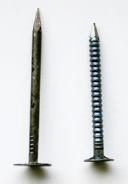
Q: I can’t find the blued ring-shank drywall nails I started hanging drywall with 30 years ago. All that seems to be available are cheap and flimsy drywall nails that bend too easily when I nail them in, rust as soon as I apply mud, and leave my hands covered with black ink. Why don’t they make drywall nails like they used to?
A: JLC editor Andrew Wormer responds: According to John Kurz of the International Staple, Nail, and Tool Association (ISANTA), the pro market for drywall nails has largely dried up, as most drywall contractors now use screws instead of nails to install gypsum board and accessories like corner bead. Screws have greater holding power than nails and aren’t as likely to pop with structural movement or when framing lumber shrinks; also, the IRC requires more nails than screws when installing drywall. Says Galway, N.Y., drywall contractor Myron Ferguson, “Ten or 15 years ago, we used nails around the perimeter of each sheet, nailing the drywall up as fast as we could and then coming back later with screw guns to finish off the centers. But as screw guns improved and we realized how much less screws pop than nails, we eventually stopped using nails altogether.”
Because drywallers like Ferguson use screws almost exclusively, Kurz suggests that some retailers may be stocking cheaper drywall nails targeted to DIYers, and it’s possible that some of them don’t actually meet code. The 2009 IRC calls for drywall nails to meet ASTM C514 specifications, and while there aren’t any specific requirements for corrosion resistance, there are for shank diameter, head diameter, and length. When used with 1/2-inch drywall, for example, ring-shanked nails should have a minimum diameter of 0.098 inch and a minimum length of 1 1/4 inches (table R702.3.5, 2009 IRC).
I found code-compliant drywall nails from Grip Rite (grip-rite.com, 800/676-7777) at the two major home centers in my area and at a local hardware store (see photo above); similar nails are available online from sources like National Nail (nationalnail.com, 800/521-1115). The annular ring nails have a sturdy 12 1/2-gauge shank and a blued finish, which is a thin methyl oxide coating designed less for corrosion resistance than to help the nail hold more securely. The smooth-shank nails are cement coated, a finish that can rub off when the nails are handled.
Ferguson notes that in addition to being more closely spaced than screws, nails should be installed in pairs to avoid damaging the paper face and core of the drywall. He spaces the nails in each pair about 1 1/2 inches apart and hits each nail alternately until the face is dimpled and the heads are set just below the surface of the drywall.