
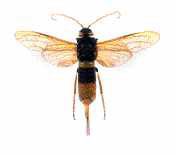
Q. We recently built a custom home in the Upper Peninsula of Michigan; construction began in the fall. During the warming months of spring, when the homeowners moved in, they began noticing perfect 1/4-inch-diameter holes in the drywall, as if someone had bored a hole with a drill bit. We discovered that the holes were being created from within the wall cavity by an insect chewing through the drywall. It was identified by the local extension service as a wood wasp.
We’ve found seven wasps in the 5,400-square-foot home, and all seven have emerged from the main floor’s exterior walls. The information I’ve found about life span, methods of control, degree of damage, and the like is somewhat contradictory. Even local pest-control experts disagree about what should be done about the wasps. Some recommend a whole-house fogging, while others advise letting them run their course. What’s the best course of action?
A. Terry Brennan of Camroden Associates in Westmoreland, N.Y., a consultant who specializes in mold and pest issues, responds: Wood wasps — also known as horntails — aren’t actually wasps at all, but received their name because of their resemblance to their stinging relatives in the Hymenoptera family.
Found throughout the United States and in other parts of the world, the various subspecies of wood wasps are all fairly distinctive looking; I believe your extension service has correctly identified the insects discovered in your clients’ home.
This is good news, because wood wasps don’t sting or bite people, and they can’t cause any significant structural damage with their chewing.
Furthermore, wood wasps do not colonize buildings. Most likely, lumber used in the home’s construction harbored a few larvae, which are usually found in trees that have some damage or have been recently felled.
A single horntail lays only a dozen or fewer eggs, inserting them one at a time into damaged or decaying softwood. After the eggs hatch, the larval stages of the insect might spend between two to five years boring short tunnels in the wood.
Once they’ve reached the adult stage, however, wood wasps bore an exit hole and leave, and won’t recolonize these holes. So if the insects you’re finding are the result of one female, there will be only a few. In any case, it would be unusual to find many more.
Because the insects aren’t harmful and are likely to be small in number, I advise against spraying or fogging. (In general, I avoid pesticide use whenever possible.) Let nature take its course.
Only if you end up with more than a dozen of these harmless insects, with no end in sight, would this mystery warrant further investigation.


