Though they’re a pain, drywall butt joints are a fact of life for most contractors. Avoiding them altogether is best, but there are few jobs where that’s possible — and on the smaller remodeling projects I do, they’re commonplace.
Usually, butt joints — where the non-factory-tapered edges of two boards meet — land over a stud or joist that both edges get screwed into. The main problem is that the framing is seldom flat. More often than not, the stud or joist is bowed and creates a hump that accentuates the joint. Also, on new construction, the framing is likely to shrink, cracking the joint. The final aggravation is that finishing a typical butt joint requires feathering the mud out by as much as a foot or more on either side, to hide the hump that the joint itself creates in the wall or ceiling.
So let’s just say I was happy to discover an amazing new tool — the ButtTaper (www.butttaper.com) — that creates a joint that’s as flat as a factory-tapered joint and remarkably easy to finish. Made of aluminum, it allows the user to create a taper on any section of drywall.
To use this tool, you have to treat the butt joint differently during the hanging process. Here’s how I handle a typical remodeling job, where new drywall has to be blended into existing.
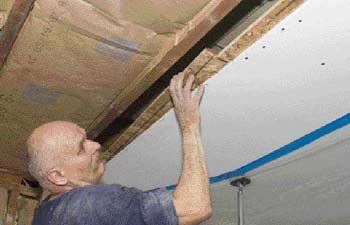
First, I cut back the existing joint so that the new edge lands in the middle of the joist bay. Next, I screw a 4-inch-wide rip of 1/2-inch or 3/4-inch OSB or plywood to the back of the existing piece for the length of the joint, then overlap the second sheet onto the OSB backer and screw it in place.
After that I wet or moisten the joint. The ButtTaper comes with a small pump-type spray bottle, but you can also wet the drywall with thinned joint compound. The wetter you make the edge, the easier it is to create the taper on the boards — but you still don’t need much water, which is nice if you happen to be working over a finished floor.
Once the joint is wet, I roll the ButtTaper along the joint to create a narrow taper on each board. This acts just like a factory taper, with one exception: If you use Durabond or a similar setting compound, no joint tape is needed. It’s the OSB backer that bonds the two sheets of drywall together, not the compound.
You can use ready-mix compound with the ButtTaper, but you have to use a special 1/2-inch paper tape and notched knife to bed the tape (both the tape and the knife are available from the manufacturer). Instead, I use setting compound, which is faster because it doesn’t require the tape.
The first coat of setting compound should be applied so that it completely fills and packs the bevel created by the ButtTaper. I also cover the fasteners, then wipe down the joint in one pass. Since the ButtTaper joint is very narrow, nearly any size knife will work. Which setting compound I choose depends on the size of the job. I typically use 45-minute compound for the first two coats; it’s often ready to recoat in as little as 30 minutes.
Setting compounds don’t shrink much, so the second coat doesn’t require a lot of compound to fill low spots and completely cover the screw heads. I use a 6-inch knife for this coat, treating the joint exactly like a factory-tapered joint.
I apply the third and final coat of mud — medium-weight ready-mix — with either a 10-inch or 12-inch knife. Where a new board meets an existing board, I may need to feather out the mud on one side of the joint to make the transition smoother. Where two pieces of new drywall meet, the third coat requires very little mud — just enough to touch up the second coat. As with a factory tapered joint, a ButtTaper joint doesn’t take much sanding, either — just a few quick passes with 200-grit paper. The final butt joint is completely flat, and only 6 to 8 inches wide.
The ButtTaper excels at patches, too. There’s no need to load on the compound, which helps contain the sanding mess.
While the ButtTaper is definitely a departure from the norm, it produces an end result that’s dramatically better than the alternatives. I’ve made it a standard part of my remodeling tool arsenal, and use it for every butt joint I make.
Greg DiBernardo owns Fine Home Improvements of Waldwick in Waldwick, N.J.