- Q. On a current kitchen remodel, my electrician placed one of the electrical boxes for the countertop outlets too low. I need to raise it about an inch to clear a stone backsplash. There’s enough stripped Type NM-B cable left in the box to do this without splicing, but because the plastic sheathing has been stripped from the cable and there’s no slack in the house wiring, doing so would leave an inch of unsheathed — but insulated — wiring exposed in the wall cavity behind the drywall. Is it okay to simply slip a section of plastic sheathing over the exposed wiring, perhaps using electrical tape or heat-shrink tubing to hold the sheath in place?
A.Joe Tedesco, licensed electrician, certified electrical inspector, and moderator of the jlconline.com electrical forum, responds: According to the latest version of the National Electrical Code, the insulating sheathing is supposed to extend into an electrical junction box at least 1/4 inch beyond the cable clamp (2005 NEC, 314.17[C]). Extending the sheathing, as you suggest, may be effective, but it would certainly need the approval of your local code official. Because heat-shrink tubing isn’t specifically designed or approved for this use, per NEC 110.3(B), I personally would not allow this solution.
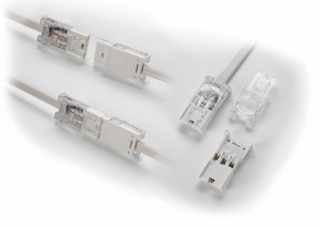
Nonmetallic-sheathed cable interconnectors can be used to permanently splice or tap 12- and 14-AWG Type NM-B sheathed cable without a junction box. Typically used to interconnect prefabricated, prewired modular structures, some of these devices are also approved for the repair or modification of existing house wiring.
If there is cabinetry under the counter, it might be possible to access the wire in the wall behind the cabinet and add a junction box that is accessible from inside the cabinet. Your electrician could then reroute the existing cable to this box and run a new length of cable to the new outlet location above the countertop.
Another option that might be approved by your inspector would be to splice on a short length of additional cable using a nonmetallic-sheathed cable interconnector (see photos, left). Molex (800/786-6539, www.molex.com) and Amp Netconnect (800/553-0938, www.ampnetconnect.com) offer a number of taps and splices designed and approved for commercial use and for modular and manufactured housing. Some of these are listed as meeting the requirements of 2005 NEC 334.40(B), which deals with taps and three-wire interconnectors in residential applications.
After making the splice, the connection would need to be open for inspection, but once approved it could be concealed behind the drywall. Of course, you should first contact your code official to make sure this would be acceptable.
Moving an Electrical Box
2 MIN READ