Hydronic, or hot water, heating has been standard for years in many parts of the U.S. It is seeing a surge in popularity at present, mainly because of the increasing use of radiant floor heating, which is known for providing even, comfortable heat. Yet contrary to popular belief, not every home in the free world needs hydronic heat to achieve this level of comfort.
Apples to Oranges
Hydronic heat is sometimes touted as more comfortable than forced-air heat. But since the typical hydronic system is significantly more expensive than the typical hot-air system — especially if cooling is included — this is an apples-to-oranges comparison. Customers willing to invest in a quality hot-air system, rather than a bare-bones package at the lowest price, will find that forced hot air can be as comfortable as hydronic heating. The least expensive forced-air system usually includes a single-stage furnace with a single-speed blower motor. The entire house is ducted as a single zone, and therefore has just one thermostat. If the system is sized by a contractor who uses a rule-of-thumb formula to estimate heat loss and heat gain, the homeowner can end up paying high energy bills for a noisy, inefficient system that provides uneven temperatures from room to room. A quality forced-air system would probably include a two-stage furnace with a variable-speed blower motor. The house would be separated into several zones with separate thermostats, and the air would be distributed through well-sealed, insulated ducts. In many cases, such an upgraded hot-air system will still cost less than a hydronic system.
Ask the Right Questions
One of the most important steps to designing a quality heating and cooling system is to take the time for a long talk with the homeowner. Don’t assume that you know what the customer wants and is willing to pay for. Most homeowners are not aware of all the available options. Here are some of the questions you need to ask:
What is your budget for this work?
This is a tough one to get answered. Often the answer is, “Gee, I really have no idea.” However, someone building a 2,500-square-foot home with a $7,000 budget is not looking at the same system as a person with a $12,000 budget.
What type of system do you have now, and what do you like and dislike about it? The answer to this question will tell you what the customers expect from their new system. Different customers have different priorities when it comes to efficiency, comfort, noise, and ease of operation.
Does anyone in the home have allergies? If the answer is yes, the customer may want to consider a high- performance air filter. There are three basic types of high-performance air filters: electrostatic air cleaners (about $100 to $150 installed), pleated media filters ($275 to $325), and electronic air cleaners (about $625 to $700).
What type of fuel is available at your site, and what fuel do you prefer? If a client has a phobia about gas or an aversion to oil or heat pumps, you should know about it before you design their system. Finally, you need to explain to the homeowner what your standard design temperatures are — for example, 70°F inside on a 0°F day, and 75°F inside on a 95°F day. Make sure you’re in agreement on these parameters up front, and if they have other ideas, incorporate them into your design, as long as their ideas are reasonable.
Choosing the Right Sub
Heating contractors vary in their attention to detail. Ask your prospective heating sub how load calculations and duct design are performed; the answers will help you evaluate the sub’s expertise.
Load calculations.
Does your heating contractor calculate accurate room-by-room heating and cooling loads? In order to perform these calculations, your sub needs to know the insulation values of the floor, walls and ceiling; the R-value of the windows; and the orientation and measurements of any skylights (see “Trouble-Free Forced Air Heat,” 12/98). Many heating contractors still use rule-of-thumb square foot formulas for calculating heating and cooling loads. But since glass-to-wall ratios can differ significantly from one floor plan to the next, “square-footing it” is a dangerous practice.
Duct design. Heating subs vary in their level of attention to duct design (see “Duct Design Basics,” 12/95). The standard duct design manual is Manual D — Residential Duct Systems from the Air Conditioning Contractors of America (ACCA, 1712 New Hampshire Ave. N.W., Washington, D.C. 20009; 202/483-9370; ). One basic duct design error is inadequate return ductwork. A system with multiple return grilles is preferable to a system with a single, central return grille. Another basic error is supply ductwork that is not matched to the output of the furnace. In extreme cases, undersized ductwork is unable to remove the furnace’s heat fast enough, causing the heat exchanger to overheat and crack. Supply air vents should be placed where they can deliver air along the exterior perimeter walls, where the greatest heat loss and gain occurs. Avoid low sidewall supplies, which can cause drafts and result in dissatisfied customers.
Two-Stage Equipment
The calculated loads will show the Btus per hour (Btu/h) required at peak load conditions (the coldest outdoor temperatures in winter and the hottest outdoor temperatures in summer). In most areas, peak conditions are reached only for a few hours in a typical season. So most of the time, a correctly selected unit is oversized for moderate conditions. That’s why it’s important to offer the customer a two-stage system.
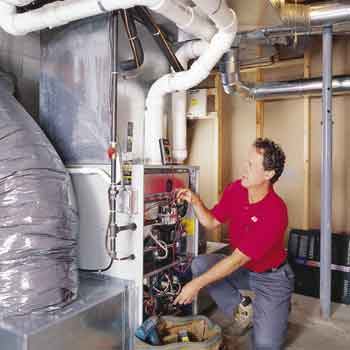
Figure 1. Two-stage gas furnaces, like this model from Goettl Air Conditioning, have two levels of Btu output and airflow. Since low stage operation is adequate to meet the heating demand most of the time, such units are quieter and more efficient than single-stage furnaces. |
Two-stage models are available in mid-efficiency and high-efficiency gas furnaces, as well as air-source and geothermal heat pumps (see Figure 1). These units offer “Btu staging” — for example, a two-stage gas furnace might have a 65,000 Btu/h input on low, and a 100,000 Btu/h input on high. If you burn oil, you probably will be limited to choosing a single-stage furnace. While gas burners can be equipped with a two-position gas valve, an oil burner is equipped with a unique nozzle that is optimized for a single firing rate. Two-stage oil pumps are usually not available for residential furnaces. In heating mode, two-stage units operate at low speed for 80% of the time. Two-stage units quietly deliver consistent indoor comfort through longer run cycles at lower speed than conventional single-speed systems. A typical furnace allows the air temperature in a space to fluctuate up to 4°F, while a two-stage system reduces the temperature fluctuation to less than 2°F, while improving air circulation at the same time. This has several benefits to the owner. First, two-stage units offer improved comfort, because of consistent temperatures throughout the zone. Second, two-stage units are extremely quiet, because their two-speed fans are usually operating at low speed. Last and most important, operating costs are lower, because the Btu per hour output is matched more closely to the actual load, and because the unit fires for longer cycles, reducing the start-up and shut-down cycles experienced with a single-speed system.
Variable-speed blower motors. A furnace with a variable-speed blower motor provides improved comfort and efficiency. A variable-speed motor, which is available for either a gas or oil furnace, slowly ramps up on the initial call for heat, so that the air-speed increase more closely follows the increase of heat available at the heat exchanger. Conversely, on the shut-down cycle, the fan will slowly ramp down, extracting the maximum Btus from the heat exchanger surface. In contrast, the blower in a standard furnace usually has a timed on/off control, which can cause an objectionable “cold blow” on start-up and shut-down. A variable-speed blower can also be set up to operate at very low “fan-only” speeds. The fan-only feature, which is controlled by a manual on/off switch at the thermostat, is especially important for systems with high-performance air filters, because the only time the air filter will work is when the air is moving through it. Fan-only operation may also be useful for a room that is not on a dedicated zone and is located far away from the thermostat. Constantly introducing new air into the room will bring the temperature more into line with the temperature in the rest of the home. The cost of running an efficient variable-speed blower on fan-only for a year is less than $20, while a standard motor running for the same year would cost more than $150 to operate.
Two-speed condenser. For the cooling side of the system, consider upgrading to a two-speed condenser. Homes with skylights and large window areas will often have very high heat gains on sunny days, dictating the size of the cooling unit. But on warm, humid days without a bright sun, the house will not have as much heat gain, and a single-speed condenser will not run long enough to remove the high humidity. A two-stage condenser (which usually includes both a two-stage compressor and a two-speed condenser fan motor) coupled with a variable-speed blower fan can remove up to 30 times more moisture than a standard fixed-speed system, because it will not be short-cycling as often. Some manufacturers use microprocessor technology and humidity sensors to control the cooling unit. One example is Carrier’s Thermidistat, which looks like any electronic thermostat, but is capable of displaying the outdoor temperature and indoor relative humidity. It will precisely operate the system based on desired indoor temperature and humidity set points. When this control is coupled with matching heat-pump components, it will regulate the variable-speed fan motor to maintain consistent air discharge temperatures. Such systems can provide a minimum air temperature delivery of 100°F, up to a maximum of over 120°F — about 20°F warmer than previous-generation equipment. Most users report higher comfort levels with these warmer air delivery temperatures.
Several Zones
Many contractors do not recommend or install zoning equipment, due to the mistaken belief that zoning is complicated. But if the homeowner’s lifestyle requires different temperature levels in different areas, zoning probably makes sense, especially in larger homes. Another reason to zone is to provide good temperature control in any area of the house with much greater heat loss (or gain) than other areas of the house. Typical examples are areas with many windows or rooms that are oriented toward a different direction than most of the other rooms in the house (Figure 2). During your initial meeting with the owner, look for such areas — for example, a sunroom or a finished area above a garage.
Figure 2. A room with an unusually large area of glass tends to have high heat loss at night and high heat gain on sunny days. Such a room is a good candidate for a separate zone. |
How do you decide whether an area needs its own furnace, or just a zone off the main unit? Assuming you have sufficient capacity, it is usually less expensive to install (and always less expensive to operate) a zone off of the main system than to install a separate dedicated unit. In some cases, though, the location of the zone or the building’s total heating and cooling loads may dictate a separate unit.