by Bryan Readling, P.E.
On May 4, 2003, a severe weather system produced strong tornadoes in eight states: Arkansas, Kansas, Mississippi, Missouri, Nebraska, Oklahoma, South Dakota, and Tennessee. Tornadoes in southwest Missouri were particularly severe, causing loss of life and property destruction along an eastward path from Pierce City to Battlefield. On May 7, my colleague Vince Ellebracht of APAThe Engineered Wood Association and I visited this area, took photos, made observations, and recorded what we saw.
Fact and Fiction
Too often, conventional wisdom says that tornado winds are simply too strong for traditional wood-frame construction. In fact, this is far from reality.
The National Weather Service classified the tornado along its path through Pierce City as F-3 on the Fujita scale (see table, below). About 90% of the roughly 1,000 tornadoes reported each year, however, are classified as F-0 through F-2. The wind forces associated with these less powerful tornadoes are similar to those of hurricanes at the coastline. So it’s reasonable to expect that a home built in compliance with hurricane code requirements could withstand full exposure to tornadoes classified up to F-2. And since tornado forces decrease dramatically within a short distance of the funnel, a well-built home would also be less vulnerable to winds on the outer regions of an F-3, F-4, or F-5 tornado.
| Fujita Scale of Tornado Intensity | |||||
F-Scale | Tornado Descrip- tion | Wind Speed (mph, 3-sec gust) | % of Occur-rences | Cumu-lative % | Description of Expected Damage |
| F-0 | Gale Tornado | 45-77 | 31.3 | 31.3 | Some damage to chimneys; tree branches are broken; pushes over shallow-rooted trees. |
| F-1 | Moderate Tornado | 78-118 | 36.7 | 68 | Peels surface off roofs; unanchored mobile homes are overturned; attached garages may be destroyed; some tree trunks are snapped. |
| F-2 | Significant Tornado | 119-163 | 21.9 | 89.9 | Considerable damage; roofs torn off frame houses; mobile homes destroyed; boxcars pushed over; large trees snapped or uprooted; debris becomes airborne. |
| F-3 | Severe Tornado | 164-210 | 7.2 | 97.1 | Roof and some walls are torn from structures; non-reinforced masonry buildings are destroyed; most trees in forest uprooted. |
| F-4 | Devastating Tornado | 211-262 | 2.6 | 99.7 | Well-constructed houses are destroyed; some structures are lifted from foundations and thrown some distance; cars are blown some distance. |
| F-5 | Incredible Tornado | 263+ | 0.3 | 100 | Strong frame houses are lifted from foundation; reinforced concrete structures are damaged; automobile-sized missiles become airborne; trees are completely debarked. |
While the Fujita scale is widely used, it has limitations: It fails to account for variations in construction quality, is difficult to apply consistently, and is not based on a systematic correlation of damage descriptions and wind speeds. An effort is now underway by scientists and engineers to improve the F-scale and make it more consistent and useful. | |||||
What we observed in southwest Missouri fit this pattern. The severe structural damage to homes that we saw could usually be linked to some sort of structural inadequacy, confirming our belief that wind-resistant details are well worth the effort in tornado-prone areas.
We concentrated our efforts in Battlefield, where we spent time in a small subdivision of single-family homes ranging from 2 to 15 years old. A few were still under construction.
Most of the severely damaged homes would likely have fared much better if the builders had paid attention to the structural continuity of the framing connections. In general, the failures appeared to stem from two main deficiencies: inadequate attachment of the roof framing to the supporting walls and inadequate lateral strength of garage walls.
Missing Connectors
Unfortunately, we saw no light-gauge metal connectors — rafter clips — on the severely damaged homes. We found many rafters, roof trusses, and sections of roof scattered on the ground, and we could see that toenails were the only means of attachment between the roof framing and the top plates. Toenails offer little resistance to the high-wind uplift forces from negative pressures on roof surfaces. Plus, once a breach occurs in the building, additional uplift loads are imposed from underneath. Toenails are not up to the task.
We saw one extreme example of the improper use of toenails at a local fire station. Here, open-web wood trusses spanning 50 feet were attached to the top of the walls with just three to five toenails, driven in such a way that they were only partially effective.
Garages Vulnerable
Most of the homes in the subdivision had attached two-car garages with no living space above. The garage doors tended to be constructed of lightweight metal and were no match for the wind pressures and flying debris accompanying the tornado.
Once a garage door goes, the opening allows the wind pressures to act on interior surfaces in combination with the pressures on the outside. This sudden combination of pressures resulted in rapid failures of garage walls and roofs, which then also caused damage to the walls and roof of the adjacent living spaces.
In addition to their vulnerability to breaching, garages are generally structurally weaker than the rest of the house, because the typically narrow return walls (parallel to and on each side of the garage door) are often incapable of resisting the lateral forces exerted by high winds. We saw many homes in which the narrow return walls of the garage had failed.
Connections between the garage walls and the concrete foundations were also weak. In several cases, we found the bottom plates of garage walls still attached to the concrete stem wall with the studs missing. Only the nails through the bottom plate and into the bottom of the studs remained. Properly lapped and fastened structural panel wall sheathing could have been an economical way to transfer the forces around the stud-to-plate joint and then into the foundation.
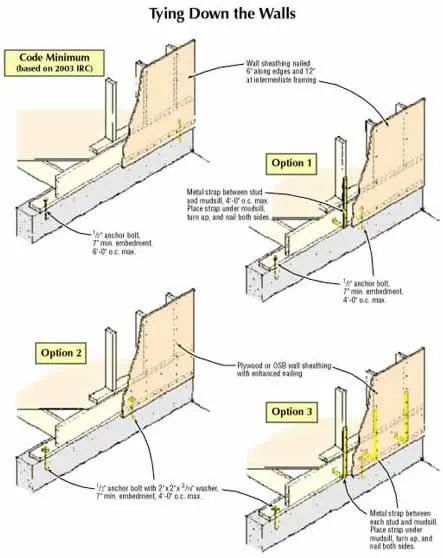
In other heavily damaged garages, the bottom plate was no longer attached to the foundation. In these cases, anchor bolts either split or pulled through the bottom plate. In most instances, standard round washers had been used between the nut and the plate instead of stronger plate washers (see illustration, below).
Providing strong connections between walls and foundation is key to resisting tornado uplift. While code minimum is a good starting place, Option 1 improves uplift resistance by adding more anchor bolts as well as hold-down straps. Option 2 is stronger still even without straps because of the simple substitution of large square washers on the anchors. Option 3 is the strongest. (Source: FEMA) |
Wall Sheathing
The type of wall sheathing used greatly affected how well house walls could sustain impact from wind-borne debris. Most of the homes in the subdivision we visited had non-structural sheathing — such as rigid foam board or non-structural fiberboard — and vinyl siding. The few homes we saw that had been built with plywood or OSB structural wall sheathing sustained less damage and far fewer breaches.
Recommendations
Several measures can dramatically and economically improve building performance in tornadoes:
• Fully sheathe houses. A house fully sheathed and properly fastened with wood structural panels (plywood or OSB) has better racking resistance, greater structural redundancy, and can better resist flying debris.
• Use metal connectors to tie roof framing to the top of walls. Uplift performance of straps or clips is better and more reliable than toenails (see illustration, below). A few more dollars spent on light-gauge metal connectors could make the difference between structural failure and good building performance.
Code minimum nailing of rafters or trusses to top plates is inadequate to resist strong uplift forces. Hold-down straps are critical. Option 1 shows straps between trusses and top plate and top plate and studs. In Option 2, where the trusses align with the studs, a single strap can create a strong connection between truss and stud. Note that the metal connectors shown here address uplift forces only: clips commonly used in seismic and high-wind zones for lateral strength are not shown. (Source: FEMA) |
• Properly fasten structural panel sheathing in accordance with local building code and manufacturer recommendations. Close adherence to a maximum 6-inch-on-center nail spacing at supported panel edges helps the framing behave as a unified boxlike structure. Reducing perimeter nail spacing from 6 inches to 4 inches increases wall racking strength by 50%; reducing the nail spacing from 6 inches to 3 inches doubles racking strength.
• Use proper sill anchorage. Check local building codes for correct bolt diameter and maximum bolt spacing and placement. Larger washers between the sill plate and the nut improve performance. In high-seismic regions, for example, 2x2x3/16-inch washers are required. These could be adopted in tornado-prone regions as well. FEMA also recommends greater use of anchor bolts, in addition to properly fastened structural panel wall sheathing.
• Use APA-designed portal framing when narrow return walls are desired at garages. Such framing details improve the bracing performance of narrow walls (see Practical Engineering, Building Strong Garage Door Walls, 4/04; www.apawood.org/bracing). Bryan Readling, P.E., is a structural engineer with APA’s Field Services Division in Davidson, N.C., specializing in wind damage and the use of engineered wood products and building structures to resist hurricanes and tornadoes. See page two for photos of the tornado damage in Missouri.