- Q. Can painted plywood be used as both the subfloor and finish floor over 24-inch on-center joists? What thickness would the plywood need to be? Would I need two layers?
A.Clayton DeKorne responds: According to Tom Kositsky, a technical representative for the American Plywood Association, you would not need two layers of plywood for any structural purpose, as long as you use APA-trademarked Sturd-I-Floor panels with a 24-inch on-center span rating. (A complete explanation of the APA ratings, and guidelines for the use and installation of plywood, can be found in the APA’s Residential and Commercial Design and Construction Guide. Single copies are available free from the APA, 7011 S. 19th St. W., Tacoma, WA 98466; 206/565-6600).
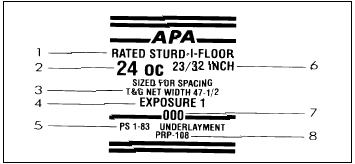
Sturd-I-Floor-rated panels are designed as combination subfloor and underlayment panels, usually intended to go under a carpet and pad. In general, a panel intended for use as “subfloor” is designed as a structural member, with a span rating (such as 16, 20, or 24 inches on-center) that is clearly marked on the grade stamp (see illustration, above). For subfloor, the panel plies are sized (not too thin) and selected from wood species with sufficient strength in bending and deflection. By contrast, a panel specifically designated as “underlayment” has a concentrated core (few voids), so it can sustain impact loads (say, from a couch dropped by the movers) and point loads (the weight of a person wearing high-heeled shoes, for example). As a combination panel, Sturd-I-Floor is designed to meet the different strength requirements for both these applications.
All APA-rated plywood includes an exposure classification. “Exposure 1” panels are made with a waterproof glue, which will weather temporary conditions during construction, but should not be used where it will be exposed permanently to the exterior.
As a permanent floor, painted plywood would leave a lot to be desired. (I can hear the callbacks already.) For starters, it would be hard to keep the deck clean, dry, and smooth during new construction. Blown-in rain and snow, ground-in mud, loose nails, dropped lumber, scooted ladders, and drywall mud would leave the deck wet, dinged, scraped, smeared, and dirty — all of which would compromise the quality of the paint surface. In addition, Sturd-I-Floor panels typically have C-grade face veneers that have been patched and sanded. The patches can be wood plugs or synthetic plastic, which might take paint unevenly or would show visibly under the paint. Also, the C-grade face veneer, though sanded, can splinter — not a desirable effect for a finish floor.
If homeowners are aware of these limitations, of course, they are tolerable, especially if the intention is to have a painted-plywood floor temporarily, until they can afford another finished floor material. If you’re intending the plywood as a permanent floor, you might want to consider laying 3/8- or 1/2-inch A/C plywood. The A-grade face will hold paint longer and will have fewer patches.
Clayton DeKorne is a senior editor for the Journal of Light Construction.
Q&A: Painted Plywood Floors
Frostproof Slab-on-Grade
2 MIN READ