Though it’s but a single element, a chimney can do much to enhance a house’s overall design. In its materials and form — how it rises and terminates — a successful chimney respects the context of the surrounding home.
Its location is important, too. Placed against an exterior wall, a chimney is visible from head to foot. In a central location, of course, only the top is on display.
Designers often choose exterior-wall chimneys — which tend to be tall and prominent — in response to specific site features or room layout, or simply to make a design statement.
Central chimneys are more common. Despite their more modest profile, they can serve as excellent accents.
In this article, we’ll look at several examples of each type of chimney.
Katie Hutchison is an architect and the owner of Earthlight Design in Salem, Mass.
Simple Stucco Chimney
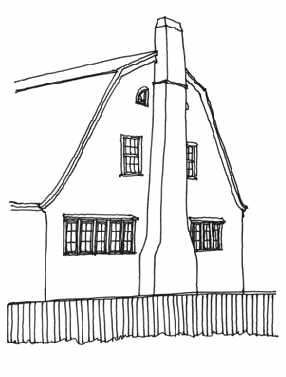
This centered end-wall chimney is made of smooth stucco. It tapers noticeably above the firebox, then continues to taper more gradually as it rises; a foot or so from the top, it narrows noticeably again.
Like the windows and house trim, the chimney is mostly white, except for a single band of black above the quarter-round windows and a black cap at the final taper. It’s a simple, elegant treatment that doesn’t overshadow the flanking window arrangements.
Exterior Rubble Fireplace and Chimney
This fireplace serves a porch. One obvious but overlooked advantage of exterior-wall locations is that fireplaces can be placed back to back, to be enjoyed both inside and out.
Rustic stone is a good material for an outdoor fireplace, especially on a house in a rugged natural setting, and it works well with heavy timber construction. The coursed rubble feels both primitive and ordered: Its monolithic appearance belies the intricacy of its careful coursing. Deeply raked joints mimic the look of dry-stacked stone. At mantel height, a few protruding rocks perform the mantel function with little fanfare.
The same coursing and raked joints continue up the chimney. At the top, a chimney cap built of stacked stone between stone slabs deflects rain while allowing chimney ventilation. It also provides a visual cap; had the stone cladding ended bluntly, the chimney would have felt unfinished, even truncated. Instead, the cap acts almost like a capital on a column, a celebration of the top.
Finely Detailed Brick Chimney
The slimmer, more ornate chimney in this example is primarily brick, with cut-stone accents. It ascends a wall richly layered with wood texture and details, flanked on the first level by clapboard base panels and on the second by solid windowlike panels. Between levels, brick corbeling and relief details highlight the chimney’s focal point, a carved date stone. This is also where the chimney changes widths, becoming narrower above the firebox. Stone trim punctuates the termination.
Central Chimneys
The four central chimneys shown here — all of them brick — illustrate four termination details. The first example is modest but well-formed. After rising to a double-course and then single-course shadow line, the chimney transitions over 12 corbeled courses to a final shadow course or two. The brick termination detail is not unlike the tapered stucco top shown on page 45.
The next example is more elaborate, with two heavy bands of corbeled brick providing shadow lines as the chimney exits the roof and again just before it reaches the chimney cap. Stacked bricks support the stone cap.
In the third example, corbeling near the top once again creates accent shadow lines. Here, however, a clay chimney pot adds a decorative flourish. Available in a variety of materials, chimney pots can control sparks and help keep wind, rain, and pests out of the chimney. Note that this chimney doesn’t display the usual step flashing; instead, it has a continuous line of counterflashing set in an angled reglet — a visually clean solution.
The last example is pretty chunky; it’s a huge chimney. It would have looked even chunkier, though, if the brick hadn’t been laid to create continuous vertical elements, which break up the chimney mass at the center of each face and keep the structure from looking overly immense.