
Making Paint Stick to Wood Siding & Trim
Here’s a plausible scenario: You’ve just completed a new custom home — the clients are ecstatic, the project looks great. With fresh paint on the outside, the house’s curb appeal promises to bring new client referrals. Then, within six months or a year, the phone call comes: “The paint is peeling; can you do something?” Premature paint failure on wood siding has become commonplace in recent years. The reasons cited are varied. Some blame paint quality, claiming that paints are not as durable since the lead content was banned. Others point to the declining quality of the wood siding itself. Still others argue that the high interior moisture levels in today’s tight houses cause water vapor to move through the exterior walls into the back of the siding, which eventually causes the paint to peel and blister. All of these arguments have some merit. There is often a complex combination of causes behind a particular paint failure. But paint failure is not inevitable: In most cases, if the job had been designed and executed properly in the first place, the failure could have been prevented. Success with painted siding starts with an understanding of how the siding you choose will perform under local weather conditions. Next, it’s necessary to match the finish to the siding — a given finish performs differently on different types of siding. In this article, I’ll look mainly at two areas: 1) the properties of wood that most affect paint durability; and 2) varieties of paints, stains, and other finishes, and how they perform on various types of siding. Although it’s not covered here, ventilation details are critical to good paint performance. This includes proper roof venting as well as using adequate indoor exhaust ventilation to remove excess moisture from the building. When the budget allows, vented siding, where an air space is created between the sheathing and siding, is unquestionably one of the best details for ensuring long-term paint performance (see “Rain Screen Siding Retrofit,” 4/98).
The Wood Makes a Difference
How wood siding performs varies not only from one wood species to another but within the same species. These natural variables, and the variables created during the manufacturing processes, have important influences on wood’s finishing properties and its durability.
Density.
The density of wood, or its “weight,” is one of the most important factors affecting paint life, for a simple reason: “Heavy” woods shrink and swell more than “light” woods (see Table 1).
Table 1 Paint-Holding Ability of Selected Softwoods |
||
Weight per cubic foot at 8% moisture content |
Paint-holding ability (I best, IV worst) |
|
Western red cedar |
22.4 |
|
Redwood I |
27.4 |
|
Eastern white pine |
24.2 |
II |
Ponderosa pine |
27.5 |
III |
Western hemlock |
28.7 |
III |
Spruce |
26.8 |
III |
Douglas fir |
31.0 |
IV |
Red pine |
30.8 |
IV |
Southern yellow pine |
38.2 |
IV |
Note: Lighter-weight woods shrink and swell less than denser woods, so tend to hold paint better. Besides being lower density, redwood and cedar have narrow bands of latewood compared with Southern yellow pine and Douglas fir, which are higher in density and have wide bands of latewood. |
||
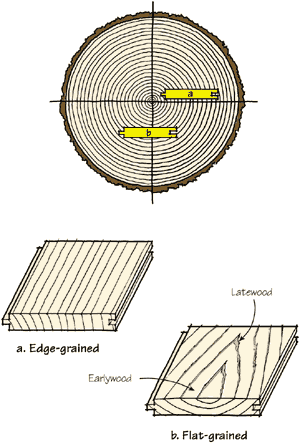
Excessive dimensional change constantly stresses a film-forming finish, such as paint or a solid-color stain, and may result in early failure. Finishes that don’t form a film, such as penetrating stains, are not affected by these dimensional changes. Flat-grain vs. edge-grain. Softwood lumber is referred to as either flat-grained or edge-grained (plainsawn or quartersawn in hardwoods). Most standard lumber grades contain a high percentage of flat grain. Flat-grained lumber shrinks and swells more than edge-grained lumber (see Figure 1), so edge-grained lumber will usually hold paint better than flat-grained material.
Some bevel sidings are produced in both a flat-grained standard grade and an edge-grained premium grade (sometimes called vertical grain).
Earlywood and latewood.
Another reason that edge-grained siding holds paint better is that edge-grained wood has narrower bands of latewood. Earlywood and latewood form in two distinct bands within an annual growth ring. Latewood is denser, harder, smoother, and darker than earlywood. Although new paint or solid-color stain will adhere well to both earlywood and latewood, old alkyd paints and solid-color stains that have become brittle with age and weathering will peel first from the smooth, hard surface of the latewood.
Heartwood & sapwood.
Mature trees have a darker central column of wood called heartwood, surrounded by a lighter cylinder of wood called sapwood. Heartwood is formed as the individual cells die and are impregnated with extractives, pitch, oil, and other extraneous materials. These natural materials give the heartwood of some species, such as redwood, cedar, and cypress, a natural resistance to decay and insects as well as an attractive color. Extractives, however, can sometimes cause discoloration problems when the heartwood is finished with paints or solid-color stains. Because the extractives are water soluble, they can dissolve when water is present in the wood and be transported to the wood surface. When the solution of extractives reaches the painted surface, the water evaporates, and the extractives remain, showing through as a reddish-brown mark. Sapwood is not decay resistant, but also does not normally cause discoloration problems through paints or solid-color stains. Knots and other irregularities, such as bark, splits, pitch pockets, and insect damage, also affect paint adhesion. Knots are mainly exposed end grain. End-grain wood absorbs more finish than flat- and edge-grained lumber, which will affect the appearance of paint. In pine, knots often contain a high percentage of resin, which may cause the paint over the knot to discolor. Furthermore, large knots usually check and crack, and can leave a noticeable split in the wood surface. Good painting practices can eliminate or control brown stain over knots. First apply a primer recommended for blocking the extractives in the knot, then follow with two top coats. Some manufacturers recommend orange shellac for controlling knot bleed.
Wood Properties You Can Control
So far, we’ve been talking about properties of wood that vary from species to species and grade to grade. But once you’ve selected and bought wood siding or trim, there are a few variables under your control that will affect the life of the finish. Moisture content is critical in determining the service life of paint. The best time to paint wood is when its average moisture content is about the same as that expected to prevail once the wood is put in service (Table 2).
Table 2. Optimal Moisture Content for Wood Siding & Trim |
||
Moisture content |
||
Geographical area |
Average |
Individual pieces |
Most areas of United States |
12% |
9-14% |
Dry southwestern areas |
9% |
7-12% |
Warm, humid coastal areas |
>12% |
9-20% |
Note: It’s best to paint exterior wood when its moisture content is within the prevailing range for the region. Source: Williams, Knaebe & Feist, Finishes for Exterior Wood. |
||
Wood above 20% moisture content should never be painted, as the paint will most likely peel.
Surface roughness.
Paint lasts longer on smooth, edge-grained surfaces than on smooth, flat-grained ones. However, paint will last longest on roughsawn or rough-sanded wood, whether the wood is edge-grained or flat-grained. Sand smooth siding with 60-grit paper before painting. Avoid weathering before painting. Much research has been done that indicates that whenever wood is to be painted, stained, or finished in any manner, weathering of the unprotected wood before finishing may be detrimental to the service life of the finish. The USDA Forest Service’s Forest Products Laboratory in Madison, Wisc., recommends that any dry, unprotected wood should not be allowed to weather for more than two weeks before it is protected with some finish that will prevent photodegradation and water damage.
Choosing a Finish
Wood finishes range from opaque, film-forming paints and solid stains to penetrating semi-transparent stains, which impart a rustic appearance and allow some wood grain to show through, to clear finishes, which accentuate the grain and natural beauty of the wood. The choice of finish should be made at the same time that the siding treatment is chosen. For example, while an expensive all-acrylic latex paint may perform well on a clear grade of siding, it may not be the best choice for a roughsawn, knotty grade. Here’s a rundown of the available types of products, with comments on their suitability for various types of sidings ().
Paints
Paints form a film, and provide the most protection against weathering and wetting. It’s possible to get up to ten years from a top-quality paint applied as two top coats over a primer coat.
Oil-based vs. latex.
The most durable house paints are the all-acrylic latex paints. Although oil-based paint films usually provide the best protection from liquid water and water vapor, they are not necessarily the most durable, because they become brittle over time. No matter how well sealed, wood still moves with seasonal humidity changes, thus stressing and eventually cracking the brittle paint film. On the other hand, latex paints, particularly the acrylic paints, remain more flexible with age. Even though latex paints allow more water vapor to pass through, they hold up better by swelling and shrinking with the wood.
Gloss.
Paints are available in different degrees of gloss, including flat, matte, semigloss, and gloss. Generally, high-gloss paints contain more paint resin and less pigment, and will perform better and last longer than the low-gloss or flat paints. Flat paints tend to pick up dirt and absorb water more readily than do the high-gloss paints. Because of this, mildew growth is often greater on the flat paints.
Back-prime.
Paints do not penetrate the wood deeply, but form a film on the surface. This film can blister or peel if the wood is wetted or if water vapor from inside the house moves through the exterior wall into the siding because of the absence of a vapor barrier. It’s important to back-prime the siding with one coat of primer or a paintable water-repellent preservative before installation. This helps reduce wetting up the back of the siding. Carefully coating butt ends and cut ends is also important.
Solid-Color Stains
Solid-color stains (also called hiding, heavy-bodied, or opaque stains) are essentially thin paints, not true stains. Solid-color stains have a higher concentration of pigment than semitransparent penetrating stains, but a somewhat lower concentration of pigment than standard paints. As a result, solid-color stains obscure the natural wood color and grain, while the wood’s surface texture is retained. They are often the finish of choice on textured or roughsawn siding products. They can also be applied over existing paints and solid-color stains, and normally leave a flat finish appearance. Like paints, solid-color stains protect wood against UV degradation. Lifetimes of three to six years can be expected for two-coat applications.
Water-Repellent Preservatives
A penetrating water-repellent preservative may be used as a natural wood finish. This type of finish contains a preservative (a fungicide), a small amount of wax (or similar water repellent), a resin or drying oil, and a solvent such as turpentine, mineral spirits, or paraffinic oil. Some may be lightly pigmented, and waterborne formulations are also available. The unpigmented finishes provide minimal protection for wood and may last only one to three years depending on exposure. Water-repellent finishes reduce warping and checking, prevent water staining at the edges and ends of wood siding, and help control mildew growth. Wood treated with preservative is easily refinished and usually requires minimal surface prep. Paintable water-repellent preservatives (such as DAP’s Woodlife II) are also an excellent treatment for bare wood before priming and painting or in areas where old paint has peeled, exposing bare wood. This pretreatment keeps rain or dew from penetrating the wood, especially at joints and on end grain, thus decreasing the shrinking and swelling of the wood. As a result, less stress is placed on the paint film, and its service life is extended. While these treatments protect against liquid water, they do not protect wood from water vapor.
Oils
There are many penetrating oil-based and alkyd-based finishes available, most using linseed or tung oil. However, these oils may serve as a food source for mildew if applied to wood in the absence of a mildewcide. The oils will also perform better if a water repellent is included in the formulation. All these oil systems will protect wood, but their average lifetime may only be one to three years.
Semi-Transparent Stains
Semi-transparent penetrating stains are pigmented water-repellent preservatives with higher resin or binder content. Lifetimes may vary from three to six years, depending on wood surface texture and quantity of stain applied. The solvent-borne stains (oil or alkyd-based) penetrate the wood surface to a degree, are porous, and do not form a surface film like paint. Thus, they do not totally hide the wood grain and will not trap moisture that may encourage decay. As a result, the stains will not blister or peel even if moisture penetrates the wood. The better solvent-borne penetrating stains contain a fungicide (preservative or mildewcide), ultraviolet radiation stabilizer or absorber, and a water repellent. Latex-based (waterborne) stains are also available, but do not penetrate the wood surface as do their oil-based counterparts. Newer latex formulations are being developed that may provide some penetrating characteristics.
You Get What You Pay For
When buying paint and other exterior wood finishes, it is best to use the top-of-the-line product of a supplier you know and trust. For example, the top-of-the-line and most expensive latex house paint of most manufacturers is usually the all-acrylic latex type.
Consider a factory finish.
Many wood siding products are available either factory-primed or factory-finished (primed and top-coated). Factory finishing offers many advantages. Because of the controlled environment, it’s easier to apply the correct amount of finish and to have it dry and cure under optimal conditions.
Bill Feist is a former wood finishes researcher with the Forest Products Laboratory in Madison, Wis., and co-author of Finishes for Exterior Wood. This article was adapted with permission from Wood Design & Building magazine. For subscription information, call 888/438-7771 or visit www.wood.ca.


