
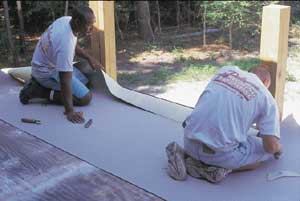
This slip-resistant membrane provides a finished deck surface while protecting the living space below
by Sheldon Swartzentruber
My company’s main business is commercial roofing. Because of our expertise in making flat roofs watertight, however, homebuilders often ask us to cover exterior decks over residential living space. For years we used a single-ply roofing membrane called Hypalon, but we weren’t always happy with the results. Roofing membrane is not intended for foot traffic, and on jobs where the contractor left the membrane exposed, the homeowners complained that the surface was slippery when wet. Covering the roofing with conventional deck boards solves that problem, but it more than doubles the cost of the job. Typically, the decking must be designed to be removed in sections, allowing for repair of the membrane and for cleaning of leaves and other debris that might cause premature wear. Given single-ply’s shortcomings, I was always looking for a better way. Then I discovered Duradek, a PVC-based material that is waterproof and comes in rolls like membrane roofing, but is designed to serve as a non-skid wear surface for foot traffic. The material can be glued to virtually any clean, dry substrate, and comes in a variety of textures and colors (see “Weatherproof Sheet Flooring” on page 2). The fire retardant material resists mildew and UV radiation, and is easy to maintain. In the seven years since I started installing Duradek in the area of Delaware where I live and work, I’ve never had a complaint about the final product. Past projects include plenty of sites on or near the beach that are exposed to bright sunlight and extreme heat, salt spray, hurricane-force winds, and winter freeze-thaw cycles. On top of the manufacturer’s 15- or 20-year material warranty, I offer a five-year workmanship warranty. The few repairs I’ve been asked to make have been for small punctures, cigarette burns, and similar blemishes caused by normal wear and tear. The manufacturer requires all installers to be factory trained and certified, and the work requires some specialty tools, like heat guns, that few carpenters carry in their toolboxes. The installation techniques, however, are reasonably easy to master, and are similar to those needed to install vinyl flooring or single-ply roof membranes.
Surface Prep
Duradek is completely waterproof, so deck joists need not be pressure treated. We typically arrive on site after the GC has framed and sheathed the deck. If our specs have been followed, the deck sheathing will be a single layer of 3/4-inch tongue-and-groove fir or pine plywood. The material needs to be dry before we can lay the Duradek, so scheduling is crucial. On a small job, the sheathing may be laid in the morning, so we can do our work the same afternoon; on a larger job, we may arrive the morning after the framing is finished. A sudden rainstorm would cause us to postpone our work till the deck had a chance to dry thoroughly. We’ll often use our hot-air guns to take care of any light moisture that may have accumulated on the deck. The first step is to fix any imperfections in the deck sheathing. Ideally, the GC will glue and screw the sheathing to the joists, countersinking the screw heads, but we can also work with plywood that has been nailed or stapled in place. First, we knock down the edges of the plywood joints and butt seams with a grinder, floor drum sander or edger using a light-grit paper (see Figure 1). Often, the sanding is enough to remove any dew or light surface moisture as well.
Figure 1. Prep work begins with setting nails and sanding all joints and edges in the tongue-and-groove plywood (above). Trowel-on floor filler is used to smooth any imperfections and to bridge any gaps in the seams and butt joints (left). |
To prevent them from telegraphing through the finish surface, we hit all joints and nail or staple heads with a silica-based floor filler similar to that used for indoor sheet vinyl. We also cut out and fill any delaminations, loose “football” plugs, and other defects in the sheathing. Once the filler dries, we hit it lightly with the drum sander, then with palm sanders and fine grit paper (Figure 2). After sweeping down the deck, we finish up with a leaf blower to get rid of small wood chips, asphalt shingle granules, and other debris that could be trapped under the Duradek and telegraph through.
Figure 2. The crew smooths the dried patching compound using a light-grit paper in a palm sander (above). A once-over with a broom and a leaf blower clears the deck of any wood chips, roofing granules, and other debris that could get trapped under the membrane (left). |
Edge Treatment
At the perimeter of the deck, we ease the corner of the face board with a router and a 1/4-inch round-over bit. When the router won’t fit and bumps up against a post, we ease the edge with a sander. There are two ways to treat the edge. If the carpenters have not left a clean, tight joint between the plywood and the face board, we cap the corner with a custom-bent metal drip-edge (Figure 3). We try to avoid this detail, however, because the metal can telegraph through the surface of the Duradek. We prefer to have the sheathing meet the face board perfectly, in which case we use a flat metal strip with a kickout bend along the bottom edge. This is applied vertically to the face board with the top edge aligned just below the rounded-over corner. The metal still telegraphs through, but it’s out of the line of sight.
Figure 3. At the perimeter, the membrane is glued over a custom-bent metal drip-edge (left). To create a finished edge, the membrane is tucked under the kickout and capped with a vinyl trim strip (above |
Whichever flashing method we use, the Duradek membrane is glued over the metal and tucked under the kickout. A continuous vinyl trim piece holds it in place and makes for a clean finished edge.


