
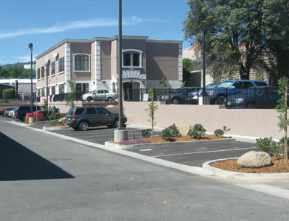
You’ve no doubt heard of using ICFs for walls and foundations, but did you know they work just as well for retaining walls? Chris Hurst of Zeropowerhouse Construction in Sonora, Calif., has used ICFs to build a number of retaining walls, including the 500-foot one around this multilevel parking lot (1). The project architect considered concrete block and cast-in-place concrete but chose ICFs because it was faster — a critical factor in light of the impending California rainy season and the potential for serious erosion at the site.
The footing included steel reinforcing, a keyway, and vertical rebar dowels 16 inches on-center (2, 3). It took Hurst’s five-man crew four days to stack the ICFs (4), install reinforcing, brace the walls, and pump the concrete — a six-sack mix with pea-gravel aggregate (5).
The crew gave the concrete a few days to cure, then backfilled over a drainage system of filter-fabric, gravel, and perforated drain pipe. The pipe ran to daylight at the ends and at several penetrations through the walls.
After the parking lot was paved, the wall was finished with two-coat stucco over wire lath (6). The cost to build this wall — including the stucco — was about the same as it would have been with block or poured concrete. Material costs were higher, but labor and time were less. — David Frane
Overhead Lift Trailer
Larry Schmitt, whose company installs standby generators in Northern California, needed a way to haul equipment to the site and maneuver it into place. Inspiration hit when he saw the trailer that a local precast plant used to deliver septic tanks. He bought a flatbed trailer of his own and attached a welded steel frame to it; with this setup, he could lift generators with chain hoists, then roll them to the outboard end of the I-beam above and lower them into place.
The beam extends 5 feet beyond the end of the trailer; it’s hinged about a foot back from the rear frame so that it can be folded forward during transport. Before rolling the 2,000-pound generator shown here to the end of the beam, the electricians will put blocks under the back end of the trailer to keep it from tipping.
Schmitt tows the trailer to the site in the usual way, but once there he disconnects it, turns the truck around, and hooks it to a towing ball he’s installed on the front of the truck. It’s easier for him to see what he’s doing with the truck facing forward, and with the front wheels close to the trailer it takes only a small steering movement to swing the end of the boom a great distance. — D.F.
No-Sweat Plumbing
I’m a master plumber with many years’ experience sweating copper. Nevertheless, I’ve come to rely more and more on my Ridgid compact pressing tool (1) for repair and remodeling work.
The cordless tool crimps 1/2-, 3/4-, and 1-inch fittings around standard type K, L, or M copper tubing in about two seconds — with none of the fire risk associated with sweat fittings. Another advantage of the tool is that I don’t have to clear the pipe of water the way I would with sweat fittings. You could even crimp on a new shutoff valve with a full stream of water coming out of the pipe — not that I’d recommend doing so.
The gasketed fittings (2) cost around four times the price of ordinary copper fittings, but the reduced labor easily makes up for the additional expense. The tool itself sells for around $1,700. A larger version can join copper fittings of up to 4 inches. Ridgid also makes crimp fittings for natural gas and propane lines.
The job shown here (3) was in an office that had lost its hot-water supply. I found that the water-heater tank had split because there was no pressure-reducing valve in the incoming supply line. Ordinarily, installing a valve would be an easy fix, but in this case the main shutoff and meter were tucked behind a small access panel surrounded by wood framing. Sweat connections would have required that we disable the fire alarm, turn off the sprinklers, and protect the framing from fire with heat shields and wet rags. But by using crimp fittings, I was able to finish the job in a couple of hours with minimal fuss.
Shawn Gokey is a master plumber with Climate Systems in Williston, Vt.


