Few things say “home” more than a crackling fireplace. The warmth and glow of the hearth have nearly universal appeal. But like it or not, the fireplace often has to share the room with a TV. This poses a challenge to the designer — how to situate the fireplace and TV so that the fireplace receives greater emphasis, yet both can be enjoyed.
The example shown here illustrates a common set of circumstances — a family room with a centrally located standard fireplace. The scale of the room is intimate. Time will be spent focused on the fire or TV and circulation will fall to the perimeter. A flush hearth allows for comfortable seating nearby, while allowing space to stand next to the fire.
In each scenario, the fireplace and TV are relatively near one another to allow one seating arrangement to serve both. In a larger space with room for two seating arrangements and central circulation, the fireplace and TV might be accommodated on opposite walls or at least farther apart. Here, we’ll address the typical moderately scaled residence, which will likely have room for only one seating arrangement.
Corner Hearth
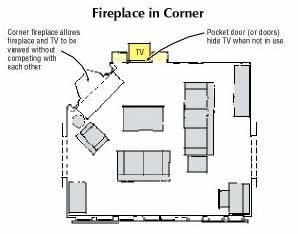
Probably the most satisfactory solution has the fireplace in the corner. This allows for an efficient plan in which both the fireplace and the TV can be comfortably viewed without competing against each other. The fireplace can be appreciated as the heart and focus of the space. When appropriate, a hidden pocket door can be closed to conceal the TV, so that all attention is directed to the fireplace.
With the fireplace in the corner, the space can easily accommodate seated guests and peripheral furniture like a sideboard, desk, and trunk. (In general, sketching a furniture plan is a good way to test a fireplace location.)
TV on Same Wall, Built In
In this scenario, the TV is placed in a cabinet adjoining the fireplace. This design is reminiscent of the cabinets or shelves next to the hearth in early American homes, where prized possessions were stored or displayed.
Using an 8-inch-deep chimney breast allows the fireplace to be the primary focus along the wall, while the TV is set back slightly. To balance the TV placement, another built-in of the same width is placed on the other side of the fireplace. As with the other schemes, slide-away pocket doors can hide the TV when it’s not in use (since it may not be considered a prized possession).
Though viewers look in generally the same direction when looking at this fireplace or TV, it’s somewhat easier to enjoy this fireplace than the TV since the TV is off to one side. This scheme still accommodates some perimeter furniture, which allows for a diversity of activity in the family room.
TV on Perpendicular Wall
Placing the TV on the wall perpendicular to the fireplace allows both of them more independence (Figure 3). Here, of all the illustrated schemes, the fireplace is in the least competition with the TV. Moving the cased openings farther back along the side walls allows for a larger single sitting area, though there isn’t room to accommodate miscellaneous perimeter furnishings. The result is a more static arrangement. Since the distance between the TV and the couch opposite is considerable, this scheme may benefit from a slightly larger TV than the other schemes. Or, conversely, this placement might be used when the homeowner wants to accommodate a large-screen TV in a room with a fireplace.
Gas Fireplace with TV Above
The zero-clearance rear-exit direct-vent gas fireplace is not for everyone. Though somewhat aesthetically challenged, it serves a function. It’s versatile enough to allow a TV cabinet directly above, a virtual impossibility with a wood-burning fireplace. With the TV stacked above the fireplace, there is only one direction of focus for fire and TV viewers.
As with the other schemes, the TV cabinet can be outfitted with cabinet doors to conceal the TV when appropriate. Here, six seated guests can enjoy both fire and TV. There is room for peripheral furniture as well.
The drawback? The TV has won. It dictates the type of fireplace used. Fireplace purists will not approve of this outcome. Some homeowners may prefer this layout, but elect to swap the zero-clearance unit for a standard masonry fireplace and jettison the TV to another room.
Katie Hutchisonis an architect and owner of Earthlight Design in Salem, Mass.