
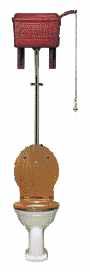
It sounds like a straightforward trivia question: Was the flush toilet invented by a Victorian Englishman named Thomas Crapper, and is his name the source of the slang expression for that invention? The simple answer is no. Or rather, no and yes. Crapper was indeed a real person, and his story is a fascinating example of how misinformation can assume a life of its own once it appears in print.
Most of the confusion about Crapper is the fault of a New Zealand-born author named Wallace Reyburn, who wrote Flushed With Pride: The Story of Thomas Crapper in 1969. An odd semifactual biography, it falsely claimed that Crapper invented the flush toilet (in reality, the first flush-mechanism patents were issued in the mid-1770s, some 60 years before his birth) and that his work earned him a knighthood from Queen Victoria.
As the title suggests, Reyburn’s book was also loaded with wordplay and toilet humor. Reyburn himself died in 2001, so we can only guess at what his intentions were; the evidence suggests he was less interested in ridiculing Crapper than in poking fun at a certain academic approach to writing about history.
To complicate matters, Reyburn later came out with a second historical biography, Bust-Up: The Uplifting Tale of Otto Titzling and the Development of the Bra. Unlike the Crapper bio, Bust-Up was pure spoof, populated by such outlandish characters as buxom opera singer Swanhilda Olafson, for whom Titzling supposedly created the first supportive undergarment in 1912; Danish assistant Hans Delving; and conniving Frenchman Phillip de Brassiere, who stole the patent rights to Titzling’s invention. Titzling was so obviously fictional, skeptics began questioning the existence of Crapper as well. To this day, many print and electronic references to Crapper insist, incorrectly, that Reyburn created him from whole cloth.
As for the real Thomas Crapper, the company he founded in 1861 is, remarkably enough, still in business. Although sold and stripped of its assets in 1966, Thomas Crapper & Co. was revived in 1998 and now manufactures authentic reproductions of Crapper’s original wares, selling them over the Internet from its Stratford-upon-Avon office.
According to the firm’s managing director, Simon Kirby, Crapper entered the plumbing business as a 14-year-old apprentice, retired in 1904, died on January 27, 1910, and is buried in Elmers End Cemetery in Beckenham, Kent. Primarily a manufacturer and installer, Crapper did hold at least nine fixture-related patents. But in Kirby’s view, his most enduring contribution to the bathroom-fixtures industry had to do with his approach to sales.
For much of the Victorian era, plumbing fixtures were not spoken of in public, much less exposed to public view. Breaking with tradition, Crapper boldly displayed his products behind plate glass in the busy Chelsea district of London, where the sight of so much exposed, gleaming porcelain reportedly caused some onlookers to feel faint.
In other words, although Crapper didn’t invent the toilet, he may well be the father of the modern plumbing-fixture showroom.
Nevertheless, it is his name — rather than any particular accomplishment — that has secured his place in history, despite the fact that “Crapper” wouldn’t have seemed funny to the company’s original customers.
“Crap” originated as an Old English word for grain chaff — and was later extended to include brewery dregs, residue from rendering fat, and other unpleasant waste products — but, as Kirby notes, the term fell out of use in England sometime during the 1600s.
Fortunately, however, early colonists had already transplanted it to this side of the Atlantic, where it took root and flourished. This set the stage for an etymological punch line a couple of centuries later, when American soldiers stationed in England during World War I (who would have been familiar with the word “crap” but not “crapper”) found toilet fixtures emblazoned with the Crapper brand name to be indescribably funny.
Some people still think they’re funny.


