
Installing an Ornamental Tile Floor,
continued
Drop cloths. Although good
builders seldom ignore these basic steps, I quite often find
that they've dropped the ball during drywall finishing by
failing to protect the floor from paint overspray. This
guarantees a tile bond that is only as strong as the paint on
the floor. In such cases, I can't proceed until the floor is
sanded clean.
Isolation membrane. On this
job, I used a slightly different subfloor system. For added
insurance against cracking and other potential problems, the
owners asked me to install the tile over an isolation or
uncoupling membrane called Ditra Mat (Schlüter Systems,
800/472-4588, www.schluter.com). This plastic sheet
material has a waffle-like grid with undercut cavities that
lock onto the dried cement in dovetail fashion; its other side
is covered with a fleece-like material. The 1/8-inch-thick
membrane is easy to install and allows most tile to finish
flush with abutting 3/4-inch wood flooring.
According to the manufacturer, Ditra can provide a crack-free
installation when applied directly over a single layer of
3/4-inch tongue-and-groove plywood decking on joists spaced up
to 19.2 inches apart. The American Tile Association approves
this approach for ceramic tile, although stone tile will still
require a double-layer 1 1/8-inch substrate. (To be
conservative, we used a double-layer 1 1/8-inch substrate
beneath the Ditra Mat even though we were using ceramic tile,
not stone.) Ditra Mat can also be used in place of backerboard
under tile countertops (see
"Tiling Over a
Laminate Countertop," 3/03).
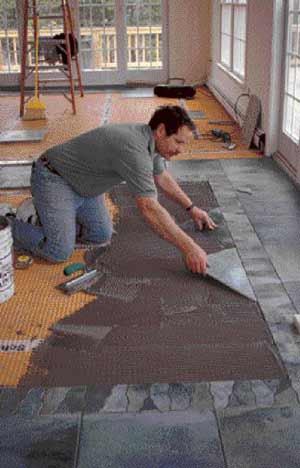
To install the membrane, I used a 3/16x1/4-inch V-notched
trowel to spread a high-grade latex-modified thinset (Tec
FullFlex, Tec Specialty Products, 800/832-9002,
www.tecspecialty.com) mixed rather loosely
to aid distribution. I snapped parallel lines at 40-inch
intervals — about the width of the mat — to
guide spreading the thinset. After laying the membrane, I used
a 75-pound linoleum roller to drive out air pockets and voids
and embed the fleece side of the mat in the thinset.
Planning the Layout
A distinguishing feature of the second-story installation was
the "rug pattern" planned for the central area of the
great-room floor. An 18x18-inch rectangular tile border edged
by a 6-inch decorative tile band would frame an inside field of
the same 18x18-inch tiles laid diagonally. A pair of patio
doors in the middle of the room's front wall served as a focal
point for the pattern, so I centered the border tile and field
pattern on the mullion between the doors. On this job, the
baseboard hadn't yet been installed, but the door casings
landed directly on the underlayment. I cut the trim to allow
the tile to slip underneath, using a tile and a piece of
corrugated cardboard to space the blade of my Bosch 1640VS
undercut saw off the floor (Figure 2).
Figure 2.Rather than cutting tile around door
casings, the author cuts a clearance gap beneath with an
undercut saw guided by a simple tile-and-cardboard
gauge.
Getting square. The first
and most important step was to check the room for square and
parallel. I did this by snapping a centerline down the room's
long axis, then snapping a second line at 90 degrees to the
first, using my folding layout triangle aSQUARE (C.H. Hanson,
800/827-3398, www.asquaretools.com; $50) to check the
angle (Figure 3). If the room is a little out of square or
parallel, it's not a big deal. Working the tile pattern from a
centerline allows any discrepancies to play out inconspicuously
along the walls.
Figure 3.
After covering the subfloor with a
plastic uncoupling membrane, the author squares up the layout
for an ornamental rug pattern (top). Full-sized tiles are
dry-fitted in both directions from a line centered on the door
mullion, followed by a 6-inch decorative tile band (above
left). A diagonal half-tile border sets up the diagonal field
tiles in the pattern area (above right).
Cutting and dry-fitting. I
checked my measurements for the rug layout by dry-fitting
single rows of tile in both directions, working out from the
centerline, using the proper joint spacing — in this
case, 3/16 inch. To give the rug pattern a look of planned
symmetry, I wanted to complete the edges of the diagonally laid
field tile with full half-tiles. This layout dictated the run
of the surrounding decorative band. The interlocking zigzag
decorative border tile came ready to install and included
special pieces to complete inside and outside corners.
Theoretically, the pattern could be laid to complete the full
band without having to make any cuts. However, the field tile
layout stretched the decorative band layout, resulting in an
undersized gap, too small to fit a full decorative tile. The
owners were adamant about maintaining uniform grout lines, so I
couldn't make up the difference by slightly spreading the
overall layout. The irregular shape of the proprietary corner
tile also ruled out any clever mitering tricks. Instead, I
downsized a couple of tiles adjacent to the corner tile and
split the difference between slightly reduced, recut
pieces.
Cutting a zigzag line through ceramic tile is a job for a ring
saw — mine is made by the Gemini Saw Company
(310/891-0288, www.geminisaw.com). The saw is vaguely
similar to a band saw, but the ring-shaped, diamond-coated wire
blade cuts in all directions and revolves through a water bath
(Figure 4).
Figure 4.By expanding the border dimension of the
rug pattern, the author created a space in the decorative tile
layout too large for a single tile to fill yet too small for a
full tile. Laying the cut-down tile at the border's corner
effectively disguises the adjustment. A diamond-coated blade in
a ring saw permits fast and accurate irregular
cuts.
Scroll cuts are simple to make with a ring saw; any shape or
radius can be cut, greatly simplifying custom inlay work.
I cut the field tile with an electric wet saw equipped with a
diamond blade (Figure 5). It's possible to trim the tiles with
a snap cutter, but when cutting large, 18x18-inch tile, a water
saw produces less waste. The machine I use, a Tile Master XL
High Production Tile Saw (Felker Tile Saws, 800/938-7925,
www.felkertilesaws.com), allows me to cut
larger tile on the diagonal in a single pass, rather than
having to cut halfway and then flip the tile to complete the
cut. When cutting on the diagonal, I draw a guideline on the
tile with a permanent marker and a straightedge, from corner to
corner. This helps to keep the cuts accurate as I "freehand"
them through the saw blade.
Figure 5.After drawing an accurate diagonal line
on the tile, the author makes freehand cuts on a
diamond-blade-equipped wet saw.


