
Installing an Ornamental Tile Floor, continued
Installing the Tile
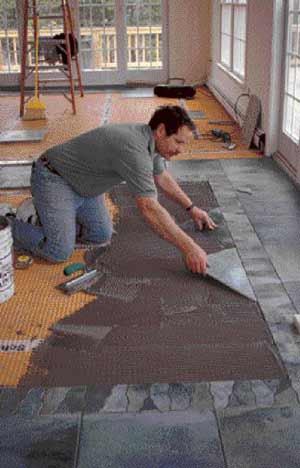
Before spreading thinset for the tile, I snapped control lines
on the mat to ensure that the tile courses would remain
straight. Thinset should be spread in one direction to
eliminate voids and heavy deposits and allow the tile to lie
flat. I try not to mix more thinset than I'll use in one hour
and spread no more than about 20 square feet at a time to
ensure that it stays fresh and tacky (Figure 6).
Figure 6.Combing the thinset adhesive in one
direction with a notched trowel distributes the adhesive evenly
and allows the tile to lie flat. Limiting thinset application
to no more than 20 square feet at a time prevents the cement
from drying prematurely.
Checking the bond. To ensure
straight grout lines, I always keep the edge of the tile right
on the edge of the chalk line. I stand back and eyeball the
floor from a distance from time to time to look for tiles that
I may have pushed out of line while cleaning up the thinset
squeeze-out. As I install each tile, I press it into the
thinset and give it a good 1/2-inch slide to ensure complete
contact with the cement.
It's a good idea to lift a set tile once in a while to make
sure you're getting a complete bond (Figure 7). I do this by
sliding a trowel under the tile and lifting it slowly to break
the suction. This requires care when the tile is laid over
Ditra Mat, because the suction can pull the mat free from its
fabric backing.
Figure 7.To prevent cracking, at least 95% of each
tile should be contacting the thinset. The only way to check
this is to pry up an occasional tile and look — but be
careful not to crack the tile or dislodge the isolation
membrane in the process.
The tile should have at least 95% thinset coverage. Voids in
the bond, or thinset missing under one of the corners, may
cause the tile to crack. Replacing cracked tile is a
labor-intensive task that can be avoided if you take the proper
precautions. The larger the tile, the more important it is to
have perfect thinset coverage.
Expansion joints. An uninterrupted field of floor tile
should include an expansion joint at least every 20 to 24
linear feet. On this job, the rug-pattern border offered the
best opportunity, because it cut all the way across the room,
while the field tile ran diagonally on either side of the
border. I installed a prefabricated expansion joint, also made
by Schlüter (Figure 8). This plastic strip is made to
mimic a grout joint and comes in a variety of colors. Its
attached webbing extends 1 inch under the tile in either
direction. The expansion joint effectively divides the tile
field into separate areas, reducing cumulative stress.


Figure 8.Large, uninterrupted expanses of tile
should be divided into smaller sections with expansion joints
to avoid stress cracks. The author uses a proprietary plastic
strip that's available in a variety of colors for a good match
with the grout (left). Another strip, placed in front of the
metal door sill, protects the adjoining grout and tile from
damage caused by thermal expansion (right).
To play it safe, I also installed expansion strips against the
aluminum sills of the patio doors. I've often found cracked
grout at these junctions, caused by metal expansion and
contraction.
I maintained a 1/4-inch gap between the tile and walls around
the perimeter of the room. It's important to clear this gap of
any debris during grouting. The remaining gap is covered by
baseboard.
Grouting and Finishing
Because this job involved such a large area, we began grouting
one section before we'd finished laying the tile on the other
side of the room. We completed the rug area first, then
continued laying the diagonal field on either side. To ensure
that the pattern would be consistent on both sides of the rug
border, we pulled a chalk line across the rug diagonals (Figure
9).
Figure 9.A line snapped across the points of the
completed rug pattern permits accurate layout of the field
areas to either side (left). Full half-diagonals initiate the
general area installation (right).
My helper, Chuck Young, grouted the floor with Mapei's Ker 200
series polymer-modified gray grout (Mapei, 800/426-3734,
www.mapei.com). The key to efficiently
grouting a large area is to make the joints as regular and even
as possible and to clean the floor well as you go. Because
grout that sets up on the surface of the tile becomes difficult
to clean off, it's also important to avoid spreading grout over
too wide an area — no more than you can clean off within
an hour (Figure 10).
Figure 10.To prevent dried grout from sticking to
the tile, spread only as much grout as can easily be cleaned
within an hour (above). Clean water and regular rinsing with a
sponge make for efficient cleanup. As the grout haze dries on
the tile surface, the author and crew polish it away with soft
rags and paper towels (right).
Before grouting, I give some thought to the temperature of the
room. Ideally, it should be a comfortable 65°F to 70°F.
In a room with a lot of windows, direct, baking sunlight can
cause the grout to dry too quickly. To avoid that, I'll wait
until the sun moves off that section of the floor.
By the time Chuck finished spreading the grout, the first
section was ready for a wash with clean water and a sponge,
regularly rinsed and squeezed out. Using too much water can
weaken the cement-based grout. As we completed each area, Chuck
polished the floor with a clean paper towel or a rag to take
off the dried grout haze. We took care of the small amount of
cleaning that remained with a mildly acidic tile cleaner.
The following week, we returned to seal the grout and tile. We
coated the entire surface with MiraSeal 511 Impregnator
(Miracle Sealants, 800/350-1901,
www.miraclesealants.com) using an ordinary
pump-up spray applicator, then thoroughly ragged the floor to
remove the excess. Proper ventilation is important when using
this or any sealer; off-gassing from the uncured product should
be considered a health hazard.
Tom Meehanis a tile installer in Harwich,
Mass.


