
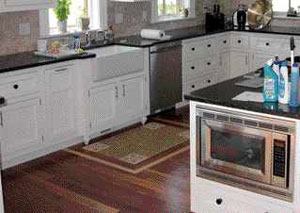
I’ve always admired the look of wood flooring in the kitchen, but over time the area in front of the sink can get worn, or may even cup from water exposure.
I came up with a solution that I first tried in my own home with great success — a tile “rug” set flush with the wood floor (1, 2). It’s become one of our signature details and has inspired many favorable comments.
Before installing the flooring, I lay out the rug area using an inside dimension based on tile size. I prefer rectangles because they mimic the shape of a throw rug.
I picture-frame the rectangle with either the same flooring material or a combination of wood species. Countersunk screws secure the frame, and bung plugs hide the screws. Variations are endless: On one recent job, we picture-framed the tile with a border of cherry and bird’s-eye maple (3).
Next I fill in the tile substrate. Typically, the minimum subfloor thickness under tile is 1 inch, but since the rug area is so small, I don’t bother with thickness buildups. I’ve found that 1/4-inch backerboard works nicely, depending on tile thickness, and I’ve also used Schluter’s Ditra — the orange plastic membrane with a grid pattern. The Ditra gives a cushioning effect; the last time we used it, the customers asked whether there was a cork layer under the tile.
On an upcoming job, a customer has asked us to install an electric radiant-heat mat under the tile.
We’ve also retrofitted the rug into an existing floor, using a site-made template, a plunge router, and a sharp chisel. Scoring the flooring first with a utility knife helps with chip-out.
Most customers prefer a natural-stone mosaic. After setting the stone tile, I protect it with a high-quality sealer, Impregnator Pro from StoneTech (www.stonetechpro.com).
Trevor Kurz is a custom home builder on Cape Cod, Mass.
Getting a Fair Shake With Blown-in Cellulose
by Klint Kinney Once an attic is stuffed with blown-in cellulose, it can be difficult to tell if you’ve got adequate depth — and thus adequate R-value — after the material has settled.
In the past, we always had to use some kind of measuring device, like a framing square or a site-made measuring jig, to make sure we were getting the proper amount of insulation.
Now, before we set our roof trusses, we simply mark them with spray paint 16 inches up from the bottom chord (1). Since the trusses arrive banded together, we can do this quickly before we break the units apart.
When we set the trusses, the paint becomes a bench mark for the settled depth of the blown-in insulation (2). This method makes it a lot easier to ensure that the customers get what they paid for (3, 4).
Klint Kinney is a builder in Huron, S.D.


