
by Matthew Wendorff Hardwood floors are increasingly popular in kitchens and bathrooms. But kitchens and bathrooms mean water, and water spells trouble for wood.
A recent remodel for a client who insisted on a hardwood floor in her kitchen had all my alarms ringing. I couldn’t convince her to change her mind, so I reluctantly began the installation, doing everything I could think of to ensure a successful outcome.
I acclimated the flooring for four weeks before installation; put on stain and two coats of finish before the trim and cabinets went in; then put on another two coats of finish after the appliances were installed. The client moved into the space, and within a week she called to tell me that the floor in front of the refrigerator was swelling.
“Absolutely cannot be,” I thought. But sure enough, on inspection I discovered that the floor had developed a pronounced cup, enough to lift the 600-pound, 48-inch side-by-side refrigerator. I removed the appliance’s front panel and found a standing puddle beneath the unit. I checked all ice and water lines for leaks but found none.
As it turned out, there’s a feature on these built-in refrigerators, called an evaporation pan, that catches the drip from the defrost cycle. Apparently, rough forklift handling in the warehouse had cracked the pan and bent the drying fan, causing the unit to malfunction.
Fortunately, the damage was limited to the area under and around the refrigerator. Even so, the repair meant weaving in 20 square feet of new flooring, and resanding and refinishing (four coats) the entire 2,000-square-foot kitchen floor.
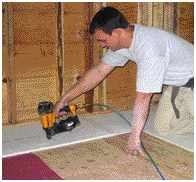
Having learned the hard way, I decided not to install wood flooring beneath the refrigerator, where it wouldn’t show, but instead layered 1/2-inch and 1/4-inch cement tile backer in the appliance bay, creating a surface flush with the 3/4-inch hardwood floor in front. If the evaporation pan or the ice line ever fails in the future, the tile backer will provide a first line of defense against damage.
I now routinely install backerboard beneath the cabinets under sinks, dishwashers, beverage centers, and laundry areas — basically under any area where nearby hardwood flooring could be exposed to the damaging effects of standing water.
Matthew Wendorff is a builder in Morris Plains, N.J.
An Old Nailing Trick
Powder-actuated fasteners are fine for making permanent connections, but what do you do when you need to temporarily fasten something to concrete? A carpenter on contractor Dallen Loder’s crew used an old trick to attach a 2×4 cleat to an existing concrete slab at a job in Manteca, Calif.
He drilled a 1/4-inch hole through the cleat and into the slab (bottom), then used a hammer to drive two 16-penny duplex nails into it (top). Since they were wedged into the hole, the nails held.
To remove the cleat, he just pulled the nails.
This method is fast, doesn’t require specialized fasteners like Tapcons, and won’t crater the surface the way powder-actuated fasteners do when you pull them out. — David Frane
Recip Blade Compass
by Tim Uhler
When installing siding or soffits, you frequently have to cut circular openings for pipes, vents, and electrical boxes.
In the past, I marked these cuts by tracing or swinging a circle with a tape. (I was reluctant to use a compass because that would mean adding a rarely used tool to my pouch.)
Last year, one of the guys on our crew came up with the idea of using a recip saw blade as a compass. Scribing a circle is a simple matter of slipping a nail through the hole in the blade, putting a pencil between the teeth, and swinging the arc.
I normally keep a spare recip blade in my pouch anyway, so now I can use it to scribe circles without carrying an extra tool.
Tim Uhler is a lead framer for Pioneer Builders in Port Orchard, Wash., and a JLC contributing editor.


