- Q. Everything I’ve read about bamboo flooring repeats the “fact” that its hardness exceeds that of oak or maple. I installed 1,200 square feet on a remodel recently and found that it dents quite easily. In fact, I just replaced several pieces for the customer — some in the kitchen and some where the attic pull-down stair lands (which now has padded feet). Maybe there are different varieties and hardnesses? If so, how can you tell the various products apart?
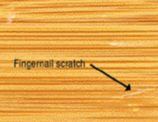
A. My personal experience with bamboo flooring has been mixed. Granted, bamboo is one of the most important plants in the world, having a wide range of uses. It grows fast, regenerates without replanting, and requires no fertilizer. It reaches a mature height of 100 feet in just five years, making it an appealing renewable resource. Most commonly used in Asia, it has lately become fashionable in the West as a flooring material. But while many manufacturers promise superior hardness, the reality is that the hardness of bamboo flooring is highly variable. Some bamboo floors I’ve seen dent and scratch fairly easily, with as little as a fingernail, for example (see photo, below). Red oak doesn’t do that. On the other hand, the superior hardness that is routinely promised can also be found.
There are several reasons for this inconsistent performance. The properties of bamboo depend on the season when it’s harvested, the environment in which it was grown, the amount of rain and sun it has received, and its age when harvested. Immature two-year-old bamboo is weak and typically sold at a discount in the open market. Bamboo harvested at five years is better and more expensive. So, as a starting point, it’s not a good idea to buy the cheapest product. Also, there are more than 700 species of bamboo, so the potential for variability among flooring products is great.
Another cause of inconsistency is the way that bamboo lays down cells as it grows. It’s denser toward the outside of the shoot and softer toward the inside. So the density of the flooring depends on where the actual fiber comes from. A good manufacturer understands this and arranges the fiber accordingly.
In the cross section (see photo, below), you can see that small strips are cut from a bamboo stem, then laminated together to manufacture the flooring. You can even see where one of the laminated pieces was taken from the softer, inside surface of the bamboo stem. This is the strip located directly under the scratch in the top photo.
My best advice is find a reputable manufacturer and distributor who have a solid track record and will stand behind the product. Ask how they test for and assure hardness values for the product. Request technical literature that explains how the product was made from harvesting through lamination and finishing. The literature should be convincing. If hardness is critical, choose a natural color: Natural colors are significantly harder than the “carbonized” darker colors, which are produced by pressure-steaming the wood, resulting in a significant drop (~25%) in hardness.
Unfortunately, the introduction of bamboo flooring is recent, so to date there is no governing association like the National Oak Flooring Manufacturers Association providing oversight and quality control.
Paul Fisette is director of Building Materials and Wood Technology at the University of Massachusetts at Amherst and a contributing editor to The Journal of Light Construction
Bamboo Floor Not as Hard as Claimed?
3 MIN READ