- Q. I’m planning on installing laminate flooring on the first floor of my North Carolina house, which is built on a ventilated crawlspace. But I’m concerned that the laminate finish will trap moisture and eventually lead to rot damage in the subfloor and framing. Is laminate flooring a bad choice for this type of house? If so, what alternative would you recommend?
A.Larry Elkin, a forensic mechanical engineer with Applied Building Sciences near Charleston, S.C., and author of several articles about floor moisture problems in humid climates, responds: Under the right conditions, any type of flooring that has a relatively impermeable surface — including laminate flooring, sheet goods, ceramic tile, and even wood flooring with a thick polyurethane finish — can act as a cold-side vapor retarder and lead to the situation you describe.
The problem seems to be more common in colder houses, particularly when the air conditioning is ducted through toe-kick registers rather than through wall or ceiling ducts. We’ve found fan-shaped patterns of rot damage in front of these registers, right where very cool supply air blows across the floor surface; this is caused by condensation, which has the potential to develop in this location for several months of the year in warm, humid climates. However, toe-kick registers are not needed to create this condensation problem. Any home that is very cool and has excessive crawlspace moisture is subject to rot.
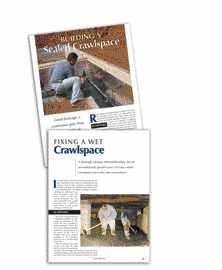
JLC has published several good articles about drying and sealing crawlspaces (see “Fixing a Wet Crawlspace,” 8/04; “Building a Sealed Crawlspace,” 10/03; and “Crawlspace Ventilation Update,” 8/99). These articles describe strategies for reducing crawlspace moisture to levels that will not likely impact the performance of the interior flooring.
But before sealing up the crawlspace, you should consult with local building-code officials, who may need to be convinced a sealed crawlspace is an acceptable (or superior) alternative to a traditional, vented crawlspace; and with a pest-control expert, who may have concerns about inspection and treatment of the crawlspace. These details are best worked out before the project begins.
Finally, be careful about constructing a sealed crawlspace in a flood-prone area. Besides allowing airflow, crawlspace vents are often installed to equalize hydrostatic forces across the foundation, so vent closures must be designed to break away under flood-induced forces. An alternative may be to seal the floor assembly at the bottom of the floor joists.
Residential
Best Flooring for a Humid Climate
2 MIN READ