
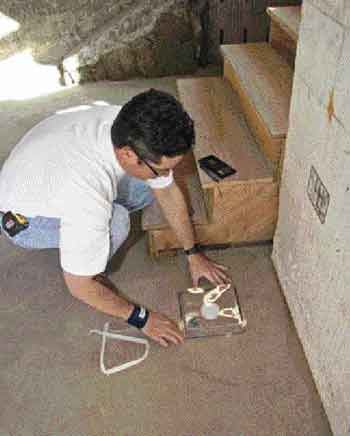
Early in my trade career, I worked as an installer for a flooring company. Now that I’m a contractor, I no longer install flooring every day — but I still do the installation myself on some jobs.
It always pays to be extra careful when doing this kind of work, because flooring failures are among the leading causes of insurance claims filed by contractors. Many of those failures are due to installing floors over damp substrates. One of the main lessons I learned during my days as an installer was how important it is to check the substrate for moisture before laying the floor, especially when it’s a concrete slab.
Just about every type of floor covering is negatively affected by excess moisture. A damp substrate can cause wood and laminate floors to cup or buckle, carpets to grow mold or mildew, and sheet materials like vinyl and linoleum to blister or come loose. Also, many of the adhesives, patching materials, and leveling compounds used under flooring will fail if installed on overly damp substrates.
Site Conditions
I was taught to inspect the site to make sure that the conditions were right for a successful installation. Most installers will check to see that there is proper drainage outside the building and a suitable temperature and relative humidity inside, and that new wood flooring is at the correct moisture content. But many fail to properly check the moisture condition of the substrate.
An old rule of thumb is to wait at least 60 days after concrete is placed before installing an impermeable floor covering. But that recommendation may not be conservative enough. Only under ideal conditions — a mix with a low water-to-cement ratio; low humidity; warm air temperature; protection from the weather — is a slab likely to get dry enough in just 60 days.
Familiar Test Methods
The only way to really know if a slab is dry enough for flooring is to test it.
Polyethylene sheet test. Many contractors and flooring installers still use the old polyethylene sheet test, which involves taping a sheet of plastic to the slab, waiting 16 hours, and then checking to see if condensation has formed under the sheet, in which case the concrete beneath will have turned dark.
If condensation has formed, the slab is definitely too damp for flooring. But even if it hasn’t, the slab may not be dry enough. The only thing the test has established is that it might be dry enough.
Electronic meters. There are much better methods than the polyethylene sheet test for determining the amount of moisture in slabs, including some that rely on electronic meters. These devices — which cost $400 and up — measure the relative humidity or moisture content of the concrete. Some are placed on the surface and measure the moisture from there. Others must be connected to probes placed in holes drilled in the slab. In new construction, special humidity probes can be cast into the concrete.
Meters allow you to quickly test moisture content, but interpreting the results can be difficult because flooring specs don’t always refer to moisture content.
Calcium Chloride Test
I prefer to use the calcium chloride test, which is referred to in flooring specs as ASTM F 1869-04, “Standard Test Method for Measuring Moisture Vapor Emission Rate of Concrete Subfloor Using Anhydrous Calcium Chloride.” This test measures the moisture vapor emission rate (MVER), or the rate at which water vapor is coming out through the surface of the slab.
I like the calcium chloride test because it works with both new and existing slabs and doesn’t damage the surface or require expensive equipment.
How it works. The calcium chloride test is performed by placing an open container of dry anhydrous calcium chloride (a white granular material) on the slab, covering it with an airtight dome, and then, after a specified period of time, comparing the calcium chloride’s before and after weight.
If moisture was present in the slab, some of it will have escaped into the dome and been absorbed by the calcium chloride, making it heavier. The MVER is calculated by plugging this weight gain into a formula. Once I have the MVER, I can determine whether I need to take corrective action before installing the floor.
What it costs. If you were a chemist you could put the test together on your own, but for the rest of us, purchasing a commercially made testing kit makes more sense. A kit consists of a shallow dish (like a petri dish), a premeasured quantity of calcium chloride, and a dome that can be sealed to the slab. Individual kits cost about $12 apiece and can be purchased online or at any flooring distributor. A number of companies make these test kits (see list), but I’m most familiar with the ones made by Vaprecision; its kits are in the photos used in this story.
In addition to the test kits, you will need a scale that reads accurately down to one-tenth of a gram. Vaprecision sells one for $125, but less expensive models are available elsewhere.
Performing the Test
To comply with ASTM F 1869-04, you must perform a minimum of three tests for the first 1,000 square feet of slab and an additional one for every 1,000 square feet after that. Be sure when doing multiple tests that you hit the areas you suspect of harboring excess moisture.
Before any testing is done, the surrounding room must be brought to the temperature and relative humidity that will exist when the building is occupied. These conditions must be achieved at least 48 hours before testing and must be maintained while the test is under way. Otherwise the results will not be accurate.
The areas of the slab that are to be tested must be clean, so if adhesives, sealers, or patching materials are present, scrape or grind them away.
When the slab is clean, weigh the prepackaged container of calcium chloride and record this “starting weight” on the form provided by the manufacturer. Then unseal the container by peeling off the tape; open it; and place the container, its top, and the tape on the prepared section of slab. Cover them with the provided plastic dome.
The dome must be tightly sealed to the surface — nothing should be able to enter it except through the concrete. The dome (or domes, if you’re doing more than one test) should be left in place for the specified period of time; Vaprecision recommends 60 to 72 hours.
When it’s time, remove the dome and reweigh all three items: the container, its top, and the original piece of sealing tape. This will be the “ending weight.” Be sure to use the same scale that you used to measure the starting weight.
The ending weight will be slightly higher than the starting weight because the calcium chloride will have absorbed any moisture that was present in the dome and any moisture vapor that entered through the slab. To calculate the MVER, you take the difference between the starting and ending weight and insert it into the formula provided by the manufacturer of the test. The result will be the number of pounds of vapor emitted per 1,000 square feet of slab per 24 hours.
Maximum Allowable MVER
Variations of the calcium chloride test have been around since the 1950s, so specifications for flooring products nearly always include a reference to the maximum allowable MVER. If the specified level of vapor emission is exceeded and the flooring product fails, the warranty will be void and the installer or the GC will be on the hook for the necessary repairs. This applies to all types of flooring as well as to the adhesives and patching materials used in the installation.
In most cases the goal is for the slab to emit 3 pounds or less of moisture vapor per 1,000 square feet (of slab area) per 24 hours. Always check the specifications for the particular product you plan to install. Most engineered and laminate flooring can be installed over dry concrete — as can most solid-wood flooring, if there is a plywood substrate between it and the slab. However, solid-wood flooring should never be installed below grade — even if the MVER of the slab is within specification.
Whenever I install flooring over a slab, I perform calcium chloride tests and give a copy of the results and of the installation specifications to the client. I keep copies for myself just in case.
Future problems. Since the calcium chloride test measures the MVER at a particular point in time, a test result below 3 pounds per 1,000 square feet per 24 hours does not guarantee that there won’t be problems at some later date.
If the conditions change — a water pipe breaks next to the building, a perimeter drain clogs, or heavy rains saturate the soil — vapor transmission could increase to the point where the installation fails.
Remediation
A properly poured and cured slab kept at normal living conditions shouldn’t have an excessively high rate of vapor transmission. Certain provisions (such as subslab drainage and vapor retarders) can be made only before the concrete is placed; once it’s in place there are a limited number of ways a contractor or flooring installer can reduce moisture vapor emission.
The best method is to keep water away by sloping the soil away from the building and installing gutters and perimeter drains. In areas where people irrigate their lawns, homeowners should be told how important it is that they not overwater or spray the foundation with sprinklers.
Sealing the surface. After conditions outside the house have been corrected, there are a few steps the contractor can take inside to lower the MVER. An older method is to use a cheap sheet vinyl as a vapor retarder: The vinyl is glued to the concrete and then the real floor covering is installed over it. However, if enough moisture is coming out of the slab, it could cause the vinyl adhesive to fail.
A newer method is to seal the surface of the slab with a product designed to reduce vapor emission. Many such products are available, but I’m most familiar with Bostik’s MVP4 (978/777-0100, www.bostik-us.com), a moisture-cured urethane membrane applied by trowel. Once the membrane has cured, certain types of wood flooring can be applied over it with a compatible Bostik adhesive. Bostik doesn’t specify by how much MVP4 will reduce vapor transmission, so after it’s been applied the slab should be retested.
Another option is to use an epoxy barrier coating like Taylor 1410 Platinum MAC System (800/397-4583, www.wftaylor.
com). This material is applied to the surface by brushing or rolling; according to the maker it can reduce the MVER from 10 pounds to 3 pounds per 1,000 square feet per 24 hours.
I prefer using these sealing products to laying plastic over the slab (as many laminate-flooring companies suggest doing). On several occasions I’ve pulled up a laminate floor installed in this manner and found mold and moisture between the slab and plastic.
Contractors will sometimes install plywood subflooring over sleepers attached to the slab. Any water vapor that comes out of the slab will make its way into the plywood — and eventually into the flooring — so it’s a good idea to install a continuous vapor retarder (a coating or lapped plastic sheeting) over the concrete before installing sleepers. But it’s best not to do this until the slab and sleepers have had time to dry.
Dave Northup is a contractor in Homer, Alaska.
| Vapor-Test Kit Makers |
American Moisture Test, 866/670-9700, www.dometest.com Sealflex Industries, 714/708-0850, www.sealflex.com Taylor Tools, 303/371-7667, www.taylorflooringtools.com Vaprecision, 800/449-6194, www.vaportest.com |


