
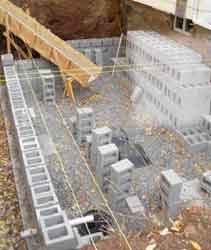
When our custom construction company builds additions, concrete block is our foundation of choice. All of the plans we bid on (most of which include full basements) specify block rather than poured foundations. And to keep our lives simple, we don’t subcontract the work — we do it ourselves.
Such was the case with a two-story addition that we began building last year. Measuring approximately 15 feet by 26 feet, the addition expanded the home’s existing kitchen, added a new entry and family room on the first floor, and created space for a new master bedroom suite above. With easy outside access through a bulkhead door and 8 inches more headroom than the existing basement, the new basement gave the homeowner a place to set up a long-anticipated woodworking shop.
Blockwork doesn’t require a large capital investment — just a few masonry tools and a mixer (we bought our electric mixer online at a substantial discount because of a slightly bent wheel). We don’t need to own, rent, or store forms, and we never have to worry about a blowout.
We feel more comfortable building 8-foot-high basement walls with block than we do forming walls 8 feet high; doing all of the blockwork ourselves gives us more control over our schedule and the quality of our work.
Layout and Excavation
After laying out the addition according to the drawings and spray painting the ground to mark the approximate outside edge of the footings, we began our excavation. Digging 3 feet beyond the layout lines helped provide the room we’d need later for laying the foundation drain, parging, and waterproofing.
To protect a large nearby oak, we consulted a municipal forester, who recommended cushioning the tree’s root system with a 4-inch layer of woodchips and saw-cutting all exposed roots 1 inch or larger in diameter (rather than ripping them out with the backhoe). We also did our best to distribute the backfill around the property to avoid burdening the root system with too much weight in any one place.
We established the exact depth of the dig by measuring the height of the existing basement from the floor to the underside of the sill, which came to 84 inches. Then we added 8 inches for additional basement headroom, 4 inches for the new slab, and 4 inches to allow for the underslab stone.
This put the bottom of the dig 100 inches below our benchmark, the underside of the existing sill.
Once the excavator reached the existing footing, we used that as our reference point for the rest of the dig, verifying the depth with a laser level as we went.
Then it began to rain; over the next eight days, 10 inches came down. Fortunately, we were prepared — we’d extended the two leaders that served the gutters above the excavation to drain beyond the hole. The soil drained well, but we still lost three weeks to the rain and to clearing minor cave-ins.
Pouring the Footings
When things had dried out a bit, we returned to the job and set up our batter boards and string lines to represent the outside edges of the new 12-inch block foundation walls.
To create a brick ledge, the top two courses would be built with 8-inch block, so we also measured 4 inches inside the lines and ran parallel string lines to represent the last two courses of the narrower block.
With the lines in place, we plumbed down into the excavated hole with a plumb bob and marked the outside edges of the foundation on the soil. Using these markings, we laid out the 24-inch-wide footings, which extended 6 inches out from either side of the 12-inch-wide foundation wall.
The bottom of the footings needed to be 8 inches lower than the excavated hole (or 24 inches below the top of the existing footing), so we hand-dug an 8-inch-deep by 30-inch-wide trench in which to form our 12-inch-high by 24-inch-wide footing. This left 4 inches of footing above the excavated surface, which would accommodate the 4-inch layer of 3/4-inch-diameter stone we’d lay down before pouring the basement slab.
Besides providing a necessary base for the slab, the stone created a mud-free surface to work off during foundation blockwork.
We ripped 12-inch-wide strips of 5/8-inch plywood for the form walls, and used 30-inch-long form pins to secure them. As we installed the form walls, we used a spirit level and our transit to keep the top of the forms at the correct elevation.
To meet code, we used “chairs” to carry the footing rebar, keeping the rebar 3 inches inside the forms. (Rebar driven into the ground or extending outside concrete is subject to corroding, wicks water, and generally weakens the structure.) For footings, we usually run two lines of parallel rebar throughout and space perpendicular pieces every 12 inches, tied off with wire.
As we proceeded, we took the precaution of capping the pins. Since caps are cheap and take only a few minutes to install, we’ve gotten in the habit of always capping both the pins and the rebar. Not only does this make for a safer site — it scores points with inspectors on what is typically their first visit to the project.
For the footing pour, we constructed a plywood chute to carry the concrete into the hole. While the truck’s own chute and extensions could reach the hole, they stopped 7 feet above our footings; more concrete would end up on the ground than in our wheelbarrows. With two men running wheelbarrows from the truck to the chute, two men running wheelbarrows in the hole, and one man working the 3,000-psi concrete into the forms, the plywood chute allowed for a very organized and rather calm pour.
Later on, we also used it to slide the stone and block into the hole.
Laying the Blocks
After we’d had a little fun sliding close to 600 blocks down the chute for stacking, we set up our mixer, brought in sand and Type S mortar, and got down to business laying block. Once again, we dropped a plumb bob from the lines above, this time marking the foundation corners on the new footings. Then we snapped chalk lines between the corners to represent the outside edge of the block foundation.


