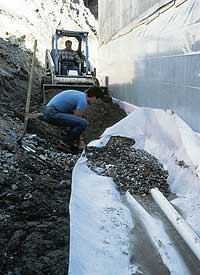
by Brent Anderson, P.E.
As a concrete contractor, I have a vested interest in how well the water on site is controlled. Underground water and runoff from rain and snow pose a threat both to the structural integrity of the foundations I build and to below-grade interior living space. Wet basements and cracked foundations are difficult to fix after the fact, but good perimeter drainage, both at grade and down at the footings, is a cheap and easy way to prevent problems. If you follow these rules of thumb for perimeter grading and drain tile, you’ll sleep easy knowing that the water control systems you buried today won’t bubble up into a callback tomorrow.
Surface Runoff
Although some wind-driven rain strikes the siding and drains onto the ground, most surface runoff comes from the roof, and the amount of runoff varies according to the size and style of the roof. A gable roof deposits all runoff onto the ground under the eaves, with little runoff at the gable ends; a hip roof distributes the runoff more evenly on all sides (see Figure 1).
Gable Roof Runoff | Figure 1. Both of these roofs cover approximately 2,500 square feet. The gable roof deposits runoff along two sides of the house; the hip roof spreads the runoff more or less evenly along all sides. Main roof valleys and dormers concentrate the runoff into smaller areas on the ground. |
Hip roof Runoff | |
Roof Runoff | |||
(from 2500 sq. ft. roof) | |||
Rainfall | Rainfall | Volume | Volume |
Amount | Rate | (cubic ft.) | (cubic ft.) |
1 in. | per hr. | 200 | 1500 |
1 in. | per day | 200 | 1500 |
2 in. | per hr. | 400 | 3000 |
2 in. | per day | 400 | 300 |
Note: Every inch of rain, whether it falls during a one-hour downpour or an all-day rain, deposits 1,500 gallons of water onto the ground around a typical 2,500-square-foot roof surface. During a winter rainstorm, every foot of melting snow on the roof adds an additional 1,500 gallons. | |||
In addition, valleys at main roof intersections and dormers can concentrate runoff into a relatively small area on the ground. In cold climates, runoff increases significantly during spring rainstorms when higher temperatures and rain combine to melt snow on both the roof and the ground, adding to the total amount of surface water that must be drained away from the foundation.