
by Lee McGinley
I first discovered shallow-grade frost- protected foundations in 1976, while designing a home for the FmHA market. The lead carpenter working with me on the project suggested that I try this “new Scandinavian system,” which he had used twice with success. I was further encouraged when the FmHA county administrator agreed to approve a mortgage for construction using the foundation system. The house sold quickly, and I have been a proponent of the system ever since.
With a , it isn’t necessary to place footings below the frostline. Instead, high-density rigid foam insulation placed around the perimeter of the slab holds the heat of the earth and prevents the foundation from heaving (see “Frost-Protected Shallow Foundations,” 9/96). A bed of compacted gravel below the foam provides a free-draining base, further protecting against frost action.
Over the years, I’ve experimented with various methods to form up the slab, secure the foam to the concrete, and protect the foam from harmful UV rays. I was looking for techniques that could be accomplished quickly in the field, and were relatively foolproof. This article describes my latest refinements. The details described here are for my climatic zone in the Northeast. Before designing an FPS foundation, get a copy of the Design Guide for Frost-Protected Foundations ($29 from the NAHB Research Center, 400 Prince Georges Blvd., Upper Marlboro, MD 20774; 800/638-8556).
Getting to Work
First, the excavator scrapes the topsoil and digs the perimeter trench, sculpting the sides to form a thickened edge and allowing for a 12-inch base of compacted stone or sand.
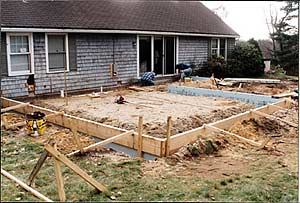
Next, we form the slab with 2x12s, using wooden stakes and braces to hold the forms in place and keep them steady. In our zone, we attach 1-1/2-inch-thick extruded polystyrene insulation to the inside of the 2x12s, securing it to the forms with roofing tins and 8d nails or 2-1/2-inch Plasti-Caps. We nail every 12 inches or so, keeping the nails within a few inches of the top surface of the foam so that we can cut them off later with a recip saw. We use the full 2-foot width of the rigid foam, because this allows us to maintain the proper elevation above grade and gives us enough material below grade against which to backfill.
Insulated formwork.Two-by-twelve form boards are lined with 1-1/2-inch-thick extruded polystyrene insulation board. The author digs the footing trench a full 24 inches deep (right) to make use of the full width of the foam board insulation. Be sure when you order foam for an FPS slab that you specify a high-density board suitable for use under a slab. We use Dow Styrofoam brand, but several other brands are available.


