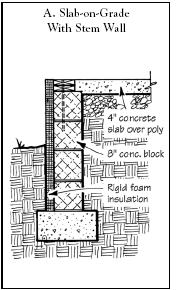
- Q. We have termites in a timber-frame house whose slab-on-grade foundation is insulated with rigid foam (Illustration A). I understand that some exterminators will not guarantee treatments on homes with exterior foundation insulation. What is the best way to detail a foundation to help keep termites out?
A.Stephen Smulski responds: Pest-control professionals are right not to make promises when faced with an insulated foundation, because it’s impossible to inspect inside and behind the insulation.
A 1/32-inch gap is all termites need to sneak into a house. To eliminate these gaps, begin by choosing a foundation type and materials that present the fewest possible entryways.
Of all foundation types, slabs-on-grade are the most vulnerable. In your design, for example, termites can slip through the foundation/slab joint, inside the hollow concrete blocks, or between the insulation and foundation (Illustration A). Monolithic slabs, where grade beam and slab are cast in one pour, lack joints and therefore present fewer entry routes than slabs supported on foundation walls. Likewise, a cast concrete stem wall, with its solid center and reinforcement to minimize cracking, is better than a hollow block wall. However, block walls can be made more termite-resistant by capping them with reinforced concrete or solid blocks, or by plugging the hollows in the top course with mortar.
Making any foundation termite-resistant requires treating the soil under the slab and surrounding the foundation with a termiticide.
Treating the soil under the slab, of course, is best done before the slab is cast, and treating the surrounding soil should be done during finish grading.
Termites prefer wetter soils, so make sure water is directed away from the foundation by properly sloping finish grades, and by using gutters and downspouts. Also, keep the below-slab drainage pad higher than the outside soil by elevating the slab surface at least 8 inches above the finish grade. Reinforce the slab to minimize cracking, and design utilities so that the slab penetrations are minimized or eliminated. All penetrations and joints should be sealed with roofing-grade coal-tar pitch. Also, make sure that all wood (read “termite food”), such as stumps, grade stakes, formwork, and scraps, is removed and disposed of off site, and not buried during backfilling.
When detailing the insulation, you may have to sacrifice some energy efficiency in return for being able to properly inspect for termites. The details in Illustrations B and C show two ways to leave the foundation exposed for inspection and also reduce the number of possible entries. The metal shields shown in these details should be thought of as only one part of a home’s anti-termite defenses. They’re seldom fabricated and installed as tightly and as carefully as is really necessary.
Dr. Stephen Smulski is a wood scientist and president of Wood Science Specialists in Shutesbury, Mass. His article “A Builder’s Guide to Wood-Destroying Insects” appeared in September 1992.
Q&A: Protecting Insulated Foundations From Termites
2 MIN READ