- Q. What is a reasonable degree of accuracy to expect from foundation and framing subcontractors?
A.Carl Hagstrom responds: I had a foundation sub who always claimed that his work was within 1/4 inch. After talking to other builders in my area, I realized that he meant his work was always within 1/4 inch of being close enough. While I’m unaware of any universally accepted standards for foundation and framing tolerances, the Handbook of Construction Tolerances by David Kent (McGraw-Hill) lists hundreds of suggested tolerances for various phases of construction.
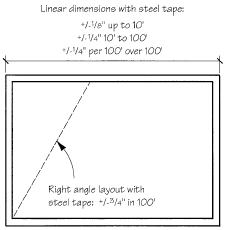
According to the Handbook , horizontal building layout (including the foundation) involves both dimensional accuracy and squareness. For measurements less than 10 feet, the tolerance is 1/8 inch; between 10 and 100 feet, it’s 1/4 inch (see illustration, below). For squareness, the tolerance for the dimension of the 5-leg in a 3-4-5 triangle measured with a steel tape is 3/4 inch in 100 feet. Use the same ratio for diagonals of less than 100 feet. For example, when measuring a 50-foot diagonal, the acceptable tolerance would be 3/8 inch (one-half the tolerance for the 100-foot diagonal).
Foundations walls should be level within 1/4 inch in 10 feet, while the entire foundation should be level within 1/2 inch.
The Handbook states that there is no single accepted tolerance for rough framing, although a tolerance of 1/4 inch in 10 feet is frequently used and is acceptable. The second edition of Standards for the Professional Remodeler (NAHB Remodelors Council, available from the NAHB Bookstore at 800/223-2665) requires that walls and floors be plumb and level within 1/4 inch in 32 inches. This seems overly generous when you consider that it would allow an 8-foot wall to be up to 3/4 inch out of plumb.
In residential construction, acceptable tolerances are often talked about but seldom specified. Document the accuracy you expect and give a copy to your subs before they bid the job. That way, everyone will understand what’s “close enough.”
Q&A: Foundation and Framing Tolerances
2 MIN READ