- Q. We are pouring a foundation for a full-basement addition in an area with a high seasonal water table. What is the best way to detail the joint between an existing foundation and the new foundation to prevent water from leaking in?
A.Carl Hagstrom responds: There are plenty of ways to detail such a joint. I recommend using a backer rod and urethane caulk. If possible, it’s best to apply this after the concrete has had about six months to cure and shrink back. But this is just a band-aid, not a lasting solution to the problem. You have to deal with draining the water first. Then you can worry about sealing the joint to keep out radon gas, if necessary.
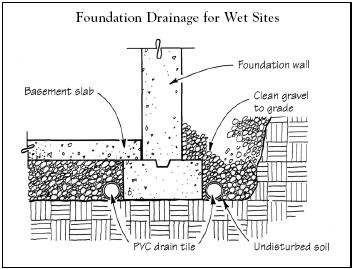
Here in northeastern Pennsylvania we have high seasonal water tables, so on all foundations we pour, we have to use an interior perimeter drain to deal with the water. Most builders think in terms of an exterior drain. But if you have a high water table, the water will rise inside the foundation. Unless you have an interior drain, the footings essentially act like a dam, preventing the water from reaching the exterior drain and forcing it to rise through the slab.
We typically form and pour our footings and lay drain line around the inside and outside perimeters (see illustration, below). The drains must run to daylight or to a sump pump connected to a storm drain.
Apply a standard asphalt-based foundation coating to the exterior of the foundation, then backfill with plenty of gravel. Water is predictable stuff. It will take the path of least resistance and usually goes just one way — down. This means if you backfill the outside of the foundation with enough gravel and provide a daylight drain, the water shouldn’t rise along the foundation wall and won’t have enough pressure to leak in through the joint.
Carl Hagstrom, a mason and builder for 20 years, owns Hagstrom Contracting in Montrose, Pa.
Q&A: Sealing a Foundation Cold Joint
2 MIN READ