
Q. How do you lay out shingle siding so the courses break evenly above and below windows? And what’s the best way to secure the row of shingles below a window so the nails aren’t exposed?
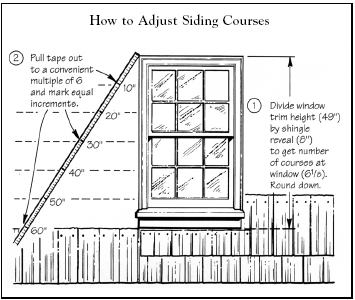
A. Sal Alfano responds: Follow this procedure to lay out shingle siding so the courses break on the same line as the window trim: First, measure the window height and add the width of any trim you might have, then divide by the shingle reveal. Most of the time, you won’t have an even number of courses, and you’ll have to adjust the shingle reveal slightly. To do that, ignore the fraction and choose the closest whole number; this will be the number of even courses that will fit between the window trim. Then pull your tape measure out to an even multiple of that number of courses, run it at a diagonal next to your window (see Figure 1), and tick off each multiple. These marks will be your course lines.
Let’s take an example: Say your window height, including the head trim and apron, is 49 inches and your average shingle reveal is 8 inches. Since 49 ÷ 8 = 6 1/8, you will have six courses (ignoring the fraction). To find the exact width of each reveal, pull the tape out to some large multiple of six, say 60 inches, and run it at a diagonal from the point that will be the corner of the window head trim to a level line extended from the bottom of the soon-to-be-installed window apron. Mark the sheathing at 10, 20, 30, 40, 50, and 60 inches. You’ve now got even course lines that will break on the window trim.
Repeat this procedure for the space between first- and second-floor windows, for the space between the trim for the second-floor windows, etc. Then, so you don’t have to tick off all these different numbers all over the house, transfer the tick marks to a couple of long pieces of lumber, making two story poles. You can then leapfrog these as you work your way around the building.
As for concealing the nails, the only way I’ve found to do this is with a piece of trim. Since the trim on the sides and at the top of the window won’t necessarily lay over the siding, but the apron trim will, I usually rip the apron at an angle (if it’s narrow) or notch it (if it’s wide), as shown in the illustration, below.


