- Q. Should an exterior perimeter drain be connected to an interior drain and sump pit?
A.Henry Spies responds: It’s not a good idea to bring exterior water into the structure. Whenever possible, a ” daylight” footing drain should be installed.
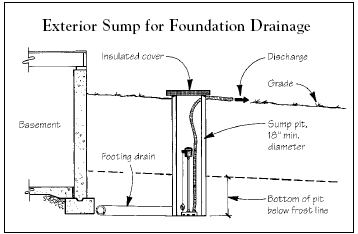
If a daylight drain is not feasible, I’d recommend installing a sump pit on the exterior of the house. Locate the bottom of the pit well below the frostline (which is where the perimeter tile along the footing should be), and top it off with an insulated cover to prevent freezing (see illustration, next page). The pit should be at least 18 inches in diameter to allow room to install and service the pump.
Since it’s easier to install a sump and pump in the basement than in an outdoor pit, many builders do bring the exterior footing tile inside the foundation. If an exterior drain is connected to an interior sump, some form of backup pump should be installed. This can be a second line-voltage pump and a generator, or a battery-powered pump.
For houses on a municipal water supply, my favorite is a water-powered jet pump. The power can be off longer than a battery-power pump will run, but municipal water pressure seldom fails. The jet pump has no moving parts, but it does use about as much water as it pumps and is limited to about 7 gallons per minute. This is not a serious limitation for a backup system, and it is less expensive than a battery-powered pump. One such pump is the Home Guard (distributed by HiLo Industries, P.O. Box 16056, Louisville, KY 40256; 502/778-0234).
Keep in mind that if the exterior footing drain is installed properly, there should be no need for an interior perimeter drain. If there is a spring under the floor or the water table is higher than the basement floor, a full basement should be avoided.
Henry Spies is a building consultant formerly with the Small Homes Council-Building Research Council of the University of Illinois.
Q&A: Sump for Foundation Drain
Polybutylene Piping: Time Bomb?
2 MIN READ