
Soils in the Hope, Kan., area where I live and work are tough on foundations. While the expansive clay soils aren’t as bad as in some parts of the country, they still cause bulges and cracks in many foundations. In the 35-plus years I’ve been a contractor, I’ve worked on more than a dozen of these damaged foundations. Every job is different, so we use several techniques, depending on the situation.
One of the most effective methods I know is to tie a bulging wall to a mass of reinforced concrete outside the foundation. Rods are run through the foundation wall and embedded in some form of concrete deadman placed below the frost line and outside the building. The deadman’s weight and surface area work like a boat anchor to counteract the pressure exerted by the heavy soil. When we don’t have room for the deadman method, we sometimes pour a new heavily reinforced wall inside the existing foundation. Both methods work and have advantages. On one recent job, we used both.
On one section of the house, the original foundation — poured without any steel and weakened by age — had bowed about 2 inches toward the inside. I decided to repair and reinforce this area with the deadman method. The plan was to connect the bulging foundation to a new porch footing with steel rods. The weight of the new porch foundation would provide plenty of extra mass to resist the heavy soil.
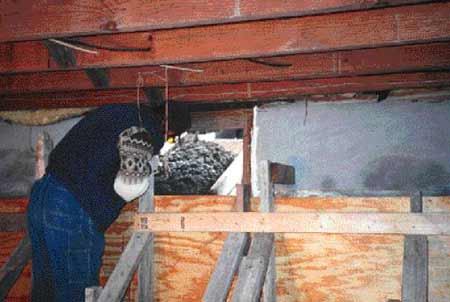
A second section of the foundation lacked anything as heavy as a porch foundation to connect to, but it did have a convenient window for getting concrete inside. In that section, we decided to pour a heavily reinforced wall inside the existing foundation for additional strength.
To make sure that both plans were workable and that the existing foundation was otherwise suitable for supporting a two-story house, we consulted with an engineer and arranged a site visit. After getting the engineer’s approval, we started the job.
Getting Down to Demolition
The first section of foundation was below an existing concrete porch. I was concerned that removing the existing porch slab would damage the house or siding as the pieces were broken up. To prevent damage, we used a gas-powered cutoff saw with a diamond blade to cut the slab close to the house.
Once most of the pieces had been broken up and hauled away, we removed the smaller pieces, using a little more finesse than the improvised ram attached to my subcontractor’s backhoe.
When the porch was gone, I had the excavator scrape away the soil from the damaged foundation and trench below the frost line for the new porch footing. I wanted to keep the bearing capacity of the soil, so we were careful not to over-dig.
Tying Off
Using a rotary hammer, we drilled through the foundation wall in four spots, about 7 feet on-center. I inserted lengths of 3/4-inch threaded rod and bolted them to 30-inch pieces of heavy-duty steel channel. The channel would act like a huge washer, and the threaded rod would make it easy to bring the assembly under tension once the footings and foundation were in place. With the threaded rod running through the wall to the exterior, I had a local welder attach it to lengths of hot-rolled steel that were hooked around the rebar, reinforcing the new porch footing.


