
by Dennis Smith and Peter Zoni
During a recent remodel of a local building, the contractor rented a gas-powered cutoff saw and attempted to cut a new opening through an 8-inch-thick concrete-block interior wall. After about an hour’s hard labor, he’d managed to outline the opening to a 1-inch depth and hack out a shallow recess where the structural steel lintel would be installed. The dust generated in the process reduced visibility to near-zero and coated every surface. The job was made even more daunting by the discovery that the blocks had been solid-filled during construction. At this point, contractor and client agreed that the situation called for stronger measures and called us.
Diamonds Are a Guy’s Best Friend
Diamond abrasives and concrete sawing have witnessed a technological leap in their manufacture over the past five years. The design and performance of industrial diamonds have been dramatically improved, and diamond tool prices have come down. Concrete sawing is now so economical that some tract builders are actually pouring their foundations with blank walls, allowing the homeowners to decide later where they want their window and door openings.
Our company, Concrete Services of Cape Cod, has been wet-sawing, coring, and altering concrete structures for six years. The diamond abrasive saw blades we use yield neat, accurate cuts with a smooth, terrazzo-like surface (see Figure 1). Correcting errors in the height of a pour or sawing back a misplaced jog in a stepped foundation are all in a day’s work. Foundation contractors make their share of small errors, too, like forgetting to allow for wood trimmers in a rough opening or not dropping the footing across a garage entry.
Figure 1. Crisp edges and a smooth, terrazzo-like surface are characteristic of wet-sawn concrete. |
But our bread-and-butter is cutting access openings between new crawlspace foundation additions and existing foundations, and opening up walls to expand a foundation or add an exterior bulkhead entry.
We can schedule a couple of openings per day if the distance between jobs isn’t too great. The main on-site requirement is a garden hose connection. Concrete sawing calls for plenty of water to cool the blade and flush out the cut.
Track-Mounted Saw
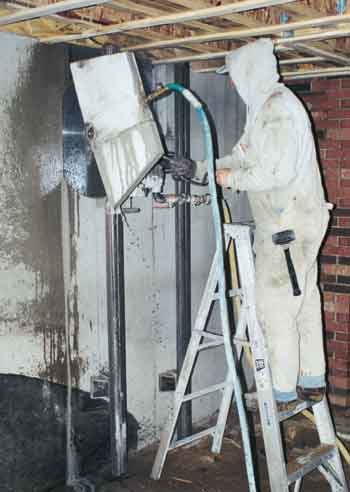
The tool of choice for many of these cuts is our Cushion Cut diamond wall saw, which is available in hydraulic, electric, and pneumatic models (Figure 2). Our pneumatically driven saw operates at a low 90 to 100 psi, but requires the high-volume output of a heavy-duty 185 hp, trailer-mounted compressor. We can handle cuts up to 18 inches deep using this tool, but we aren’t usually called on to saw anything thicker than 8 to 10 inches. Although the saw itself is rated for blade diameters from 24 to 42 inches, the largest diameter requires a lower-rpm, higher-torque motor than the one we use. Our workhorse — a 24-inch-diameter blade that costs about $600 — is good for handling aged concrete, hard aggregate, and moderate steel reinforcement.
The Cushion Cut diamond wall saw can handle 24- to 42-inch-diameter blades and cuts up to 18 inches deep. It takes about three passes to cut through an 8-inch wall. |
Embedded rebar doesn’t pose a problem, unless a horizontal rod coincides with the line of cut. That tends to deflect the blade from its intended path and cause excessive wear, so we’ll occasionally have to relocate a cut slightly. The manufacturer rates our 24-inch saw blade for a life span of 5,000 inch/feet, or 625 linear feet of 8-inch-thick wall. Although the brazed sawing segments (Figure 3) can be replaced when worn, it makes more sense to buy new blades — the blade blank is the cheapest part. On rare occasions, a segment will get knocked out during use and go zinging off the walls just like a ricocheting bullet, so the work can be dangerous at times. Anyone working in the vicinity should definitely wear safety glasses.
Figure 3. Various combinations of metal hardness and diamond friability produce industrial diamond saw teeth, called segments, suitable for different types of aggregate and concrete hardness. Blade design ensures that water is thrown into the cut by centrifugal force. |
The noise of sawing isn’t something you’re likely to tolerate without good hearing protection. In fact, OSHA requires you to provide hearing protection for noise levels of 115 dB and higher, and we’re at least that loud.


