Download PDF version (1339.1k) Log In or Register to view the full article as a PDF document.

Image

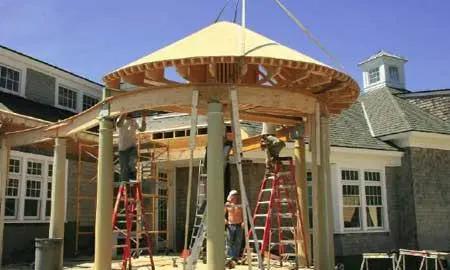
My business, Narragansett Housewrights, provides custom millwork and architectural components to builders here in southern Rhode Island. Last year, my best customer, Baud Builders, gave me the job of building a screened pavilion for a shingle-style waterfront home. The pavilion swept out in a curving wing from a corner of the building, terminating in a conical roof supported on a semicircular colonnade.

I only take on projects that I can build in the shop and deliver to the site in sections for assembly. If I had built this one according to the architect’s framing plan, it wouldn’t have been transportable (see Figure 1). So I came up with an alternative method that I believed would also cut the build time by half. We bid the job accordingly, and after much discussion got approval from the architect and engineer to proceed.

Image
Image

Image
Image

Image
Image

Figure 1. The roof framing consists of five modules assembled on site, beginning with the half cone (top left). The four major modules all bear on the perimeter architrave beam and a steel moment frame at the cone’s midsection. The fifth, nonstructural module (bottom right) completes the top and back of the cone.

Custom Trusses

I typically skip shop drawings and begin instead by making a simple model, in this case a section of the conical roof (Figure 2). This gives me a fast, simple way to view the critical components at full scale in three dimensions. Basically, I cut short pieces of each element in the structure and stick them together with hot-melt glue.

Image

Figure 2. Full-dimension components, quickly glued with hot-melt adhesive, provide a reliable, accurate way to check a proposed assembly. Note the crown molding and the plastic soffit vent material.

I envisioned the overall framing as four independent truss-framed modules joined together in the finished assembly: a half-cone, two sloping side modules, and a flat-topped center section. My trusses are nothing more than 2-by members connected with plywood gussets.

I designed the conical module around a series of identical triangular trusses fixed in a radial pattern around a central “hub.” The roof sections connecting the cone to the main house use a similar system of trusses arrayed along their respective framing lines.

The trusses’ tails bear on a curving architrave, a custom-made structural beam supported on six 4x6 posts concealed within hollow architectural columns. One of these columns was pre-existing and provided a point of departure for the new layout.

Moment frame. Two of the architectural columns surround steel posts, part of a welded moment frame needed to resist wind-racking and uplift. The roof modules fully encase the horizontal steel member, a W8x21 hot-dipped-galvanized I-beam.

Templated construction. To make sure that site and shop layout remained consistent with each other, I cut two identical sets of plywood templates to outline the architrave and pinpoint all the column locations. I brought the templates to the job site and laid them out on the masonry deck, then took lots of triangulated measurements off the building (Figure 3). I recorded these directly on the templates. Back at the shop, I used the triangulations to snap accurate layout lines on the floor so that I could position the templates exactly as they were on site. Meanwhile, one set of templates remained at the job site for locating and pouring the new column bases.

Image

Figure 3. Identical plywood layout templates ensured a perfect match between site and shop efforts. The square cutouts pinpoint column centers.

Curvy architrave. I made the architrave in three segments — the first with a 28-foot radius, the second a semicircle with an 8-foot radius, and the third a straight length of LVL. To make the curved beams, I glue-laminated 11 layers of 3/8-inch plywood underlayment bent around shop-built forms. I used Excel One, a spreadable polyurethane adhesive (800/779-3935, excelglue.com), and a boatload of bar clamps. The adhesive sets up in about five hours.

Because plywood doesn’t bend with smooth, perfect uniformity, the laminated beam had a somewhat irregular face. To compensate, I used a router on a long trammel arm to cut slightly wider, perfectly accurate top plates from 3/4-inch MDO (medium-density overlay) plywood. We centered the plates on top of the beam segments and glued and screwed them in place. Later, after on-site assembly, I gauged the Azek fascia off the plates’ edges and shimmed the inner and outer pieces in perfect parallel.

Conical framing. I began framing the semicircular conical section by building a hub, a 2-foot-diameter half-cylinder made of staves cut from an LVL beam (Figure 4). It’s glued together with West System epoxy (866/937-8797, westsystem.com); for added mechanical strength, I bound the staves with four perforated steel straps. The staves — which are 1 3/4 inches wide on their outer face — provide faceted surfaces for attaching the 2-by trusses.

Image

Image
Image

Figure 4. The cylindrical hub at the core of the conical roof section is made from staves of resawn laminated veneer lumber (top). Each stave corresponds to a truss in a radial array (bottom left). The trusses are attached to the hub with structural screws. Intermediate lookout blocks provide firm backing for a cellular PVC fascia (bottom right).

We set the trusses on the semicircular architrave and screwed them to the hub from the back, using 4-inch Timberlok screws (800/518-3569, fastenmaster.com), one each into the top and bottom chords.

The truss tails landed at about 20 inches on-center. To create more solid backing for the curved fascia, we glued and screwed lookout blocks on 6-inch centers to a length of 1-by cedar, then nailed this assembly to the truss tails, effectively tying them together.

We then sheathed the back of the half-cone with a single layer of 3/8-inch plywood, cutting holes between the webs for access and air circulation. We added cleats on top of the plywood to catch the lower-pitched abutting roof sections. (It would have eliminated compound valleys and simplified construction if the cone and the connecting roof were the same pitch, but I lost that argument.) I left the top of the cone flat, about a foot short of the peak, to be filled in after the adjoining sections were framed and sheathed.


Flanking sections. We framed the side sections using matching sets of triangular trusses, tacked to the architrave and supported on temporary legs on the inside. We tied the bottom chords together with a running 2x4, then sheathed the inside vertical face with five layers of 3/8-inch plywood, glued and stapled (Figure 5). The laps between layers are offset and all the joints are centered over the framing. We followed by screwing through the plywood into each truss with 3-inch Timberlok screws. The layered plywood unifies the trusses and becomes a laminated structural beam that carries the inside edge and center module of the truss assembly. One end bears on the steel I-beam and the other end is notched to bear on the top plate of the house.

Image

Figure 5. A worker installs bevel-edged blocking between the trusses to provide nailing for the roof sheathing at the top edge, where the roof line transitions to a flat midsection. Here, the trusses have received the first of five layers of 3/8-inch UL plywood, forming a structural beam that supports the center module.

The porch-roof assembly joins the main roof at an acute angle (Figure 6). Instead of trying to calculate the angle mathematically, we extended the plywood on the truss module far enough to allow us to project and scribe the intersecting profile. To do this, we built a plywood mockup of the main roof and placed it on the building line snapped on the floor. We then used a long straightedge to transfer the pitch to the face of the plywood on the truss assembly. We allowed an extra inch of tolerance for fitting and shimming, then cut the plywood and reinforced it with framing.

Image

Figure 6. A plywood mockup of the existing roofline furnishes the correct cut angle for the roof intersection.

Center section. With the three sloped sections completed, we next framed the roof’s flat-topped center section (Figure 7). This was a simple matter of custom-fitting sequential trusses to the existing gap. First, we made a batch of hold-offs to represent the eventual five layers of plywood sheathing we’d be laminating over the two sides. We screwed the hold-offs to the vertical 2x6 truss members, notched to receive the 2x4 top and bottom chords, and back-screwed them from inside the abutting roof sections for easy removal later. Then we cut the horizontal top and bottom chords to fit between the verticals and applied 3/8-inch plywood gussets to both sides of each truss.

Image

Image
Image

Figure 7. The center roof module fills the progressively widening space between the side modules (top). Hold-offs, back-screwed to the upright truss members, reserve the space that will be occupied by five layers of plywood once the center module is framed and pulled free for access (bottom left). With the sheathing and cap completed, the modules were ready for transport to the job site (bottom right).

As we worked our way back out of the gap, we shimmed a series of shop dollies beneath the bottom chords. This allowed us — after removing the screws — to roll the completed center section clear and apply the plywood layers to its two sides.

With the framing completed, we sheathed the roof segments with a double layer of glued and stapled 3/8-inch UL plywood. On the conical surface, we cut pie-shaped segments and staggered the joints between layers. To introduce a slight, water-shedding crown to the flat roof section, we ran 3/4-inch rippings at mid-span across the top chords and bent the plywood over them.

Finally, I made the cap and completed the back of the cone. I made the cap from wedges of solid framing lumber, cut to the roof pitch and then band-sawn to radial tapers. I glued the wedges together with thickened, gap-filling West System epoxy and sanded the contours smooth after it hardened.

Valley lines. I used a simple method to determine the compound valley line where the cone overlaps the abutting roof. First, I set the cap in place, its back half supported down to the flat roof section by an offcut from the hub. Then, pivoting a long straightedge around the cap, I projected the cone’s pitch down onto the connecting roof and marked the valley line. Allowing for the thickness of the sheathing, we stepped back from the line and custom-fitted 2x4 framing in a radial pattern between the hub and the valley. With the sheathing applied, this last module ended up looking like a huge bat in flight.

Site assembly. We loaded all the components onto a truck and hauled them to the site. On installation day, with a crane standing by, we cut back the existing roof overhangs and exposed the top plates where the new roof would connect (Figure 8). We set the steel I-beam with the crane, and a welder completed the moment frame. Meanwhile, the crew set and bolted the architrave beams on the columns. By late morning, we were ready to set the roof sections, beginning with the cone. We’d already outlined the MDO plate’s location on the underside of the truss chords, making it easy to accurately re-establish the overhangs on site. We secured the cone to the architrave with 3-inch Timberloks, screwing up through the plate into the bottom chords.

Image
Image

Image

Figure 8. The architrave is supported on 4x6 pressure-treated posts within the architectural columns, notched to 4x4s where they pass through the beam (top left). The only straight section in the architrave is made with doubled LVL lumber (top right). Welded brackets support the beam at the moment frame (bottom).

We installed the remaining roof modules in the same manner. By late afternoon, we had all the structural pieces set and bolted together. Last but not least, we hoisted the “bat” onto the cone, nailed it in place, and called it a day (Figure 9). Later, I went back with a reciprocating saw and notched the plate to install hurricane ties between the beam and each truss.

Image

Image
Image

Image
Image

Figure 9. While the welder put the finishing touches on the moment frame, the crew set the roof modules around the architrave (top). Each module included a recess to encase and bear upon the moment beam (middle left). Metal plates tie the architrave to the steel posts (middle right); wood post locations were tied together with plywood overlays. A slight built-in tolerance allowed the center module to drop in without resistance (bottom left). The “bat” module defines the valleys and completes the cone (bottom right).

To complete the structure, the site crew filled in a few jack rafters between the truss assembly and the existing roof, then sheathed the underside with 3/4-inch plywood. This plywood, glued and nailed, serves as a tension diaphragm tying the bottom chords together to prevent the structure from spreading and settling. It was later covered with a beadboard ceiling.

Bending Crown

My usual approach to making curved crown molding is to strip-laminate rectangular section blanks around radiused forms and outsource the profiling to another shop. It’s costly, but the trim made that way is strong, accurate, and easy to install against vertical backing. On the job shown here, I had intended to save time and money by using Azek crown. A hasty bending test led me to think this would work, so I committed to making angled rafter tails on the trusses. Unfortunately, when it came time to actually install the crown, I realized that standard crown, when run around a radius, describes a greater diameter at its top than at its base. Either the top has to stretch or the base has to compress, but it isn’t something you can force even Azek to do. So I was forced to come up with a way to use a standard 4 1/2-inch wood crown. After some experimentation, here’s what we came up with.

I kerfed the crown at regular 2-inch intervals, using a razor saw to minimize stock removal and a simple miter-box jig to guide the cuts (A). We sliced the molding across its face, stopping the cut just shy of the top (B). The cuts were made at an angle to the face in order to allow the material to slip slightly past itself when bent. On such a large radius, only a small amount of movement is required of any single kerf.

A.

Image

B.

Image

C.

Image

D.

Image

E.

Image

After striking the correct curves, we made bending forms on the floor (C). We worked slow-setting West System epoxy in with wood applicators, custom-made to fit in the tight kerfs (D). Hundreds of clamps and 60 man-hours later, we had our curved moldings. We reinforced the pieces on the back with fiberglass tape and epoxy resin. It took lots of hand-sanding and some West System 401 fairing compound to smooth out the surface, but under a coat of paint, the finished product looks surprisingly good (E). Necessity is truly the mother of invention.

All I had left to do was install the curved crown moldings, a detail that gave me an unexpected run for the money (see “Bending Crown”). Altogether, the work described here required 600 man-hours, or five weeks for a three-person crew.

Mike Rand runs a specialty millwork shop in Narragansett, R.I.