
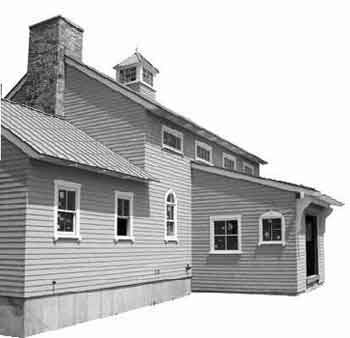
I run a specialty millwork shop in Narragansett, R.I. For several years I’ve been working with a local custom builder, David Baud, to produce major components for the high-end homes he builds. Typically, these are relatively complicated pieces of the building that would ordinarily be built on site but require extensive layout, complicated scaffolding setups, and lots of crew. Tackling these tasks off site in the shop simplifies and speeds the entire process. The advantages are numerous — including no weather delays and close control over scheduling and quality — and have proven themselves on job after job. Now, whenever we sit down to bid a set of plans, one of the first things we do is to circle every element that might lend itself to off-site fabrication.
In this article, I’ll describe how we completed a decorative timber-rafter roof overhang for a new home on the coast of Rhode Island. The house was designed to look like a converted barn. Though it was stick-framed, it contained various timber-frame components both inside and out. The eaves details I worked on create the impression of heavy timber rafters, but in fact the roof was conventionally framed with 2×12 rafters on 16-inch centers.
You’ll probably never replicate the exact details shown here. Still, this method could be easily adapted to most any type of decorative rafter tails.
Framing
The false rafter tails actually start at the frieze board, which we used as a kind of mounting plate. The framers stopped the actual 2×12 rafters flush with the plate, minus 11/2 inches to accommodate a 2×8 band, or subfascia. They ran the wall sheathing up over the band, leaving it about 2 inches short of the rafter tops to provide roof ventilation.
When they sheathed the roof, they held the bottom course of plywood up a couple of feet from the ends of the 2×12 rafters. That way, after the overhang assembly was fastened in place, the bottom course of plywood provided a strong lap, securely tying the tails back to the roof diaphragm.
There were two different overhang details on the project shown here. The eaves of the main roof have 22-inch-long shaped tails, while the overhang at the entry and garage has 3-foot-long tails that rest on a beam supported by large structural knee brackets.
Ideally, I would have used solid cedar stock throughout for its exceptional stability, decay resistance, and paintability. But, except for the frieze and rake boards, cedar didn’t fit in the budget, so we ordered green 6×8 #1 Douglas fir instead, specifying no heartwood for best stability.
Because the wood was green, we had to take measures to minimize twisting and checking, and to accommodate shrinkage as it dried. One of the great advantages of doing this work in the shop, out of direct sunlight, is that it protects against rapid moisture loss and the resultant checking you’d get if you were out in the field. Once the tails were installed, they were further protected by the shade of the overhanging roof, allowing the wood to more slowly acclimatize.
The overhang assemblies also included frieze and rake boards; for these we used clear vertical-grain 5/4 western red cedar.
Router Work
While the shorter tails were small enough to be cut out on the band saw, the larger ones, plus the various mortises and tenons, required lots of router work. We use top-bearing (or bearing-over) and bottom-bearing (or bearing-under) pattern bits, depending on what we’re cutting.
For example, after epoxying 22-inch tails to the rake boards, I used a bearing-under bit that followed the tail’s contours to remove the waste from the rake board. This creates the impression that the entire rake board is a full timber rafter.
To cut profiles on the long tails or the stub tenons on the back ends of the tails, I used a bearing-over bit that followed a 1/2-inch-thick MDF template tacked to the fir stock. Templates ensure that every piece is uniformly identical.
Occasionally I’ll make a saddle jig, which is two identical templates separated by a piece of stock equal to the thickness of the beam I’ll be cutting. I slip the jig over the end of a beam and tack or clamp it in place; then I rout one side, flip the beam, and finish the cut on the opposite side without touching the template.
If you have to make repetitive profiles on thicker stock, making a saddle jig is well worth the effort.
Some Site Assembly Required
We sent the shorter rafter tails to the site loose, along with the frieze board. We figured it would be easier and more accurate for the site crew to lay out the exact spacing.
Each of the 22-inch-long tails had a stub tenon on the end, which would fit snugly into a matching mortise cut into the frieze board on site. We provided the framers with the necessary router template for cutting these recesses.
Although the tails could have been recessed at their full dimension into the frieze, the stub tenon — a standard joint in timber framing — allows for wood shrinkage without a gap showing up.
Installation. After cutting the mortises, the crew used TimberLok screws to fasten the tails through the back of the frieze. We installed wall brackets and planks at a comfortable working height below the eaves and raised the assembly into place with a material lift. The rake boards with attached tails went on last.
The plans called for 2-inch button vents through the frieze to provide ventilation for the roof. In addition to these, we installed the frieze assembly over spacer blocks to allow for airflow behind the frieze board, filling the gaps between the blocks with Cor-A-Vent, for a bug screen. We screwed the assembly through the frieze board and blocks into solid framing, then plugged the screw holes.
We set the top of the assembly 3/4 inch lower than the tops of the rafters to account for the thickness of the 1×4 V-groove soffit. After installing the soffit planks, with butt joints over the tails, we set the last course of roof sheathing, gluing it to the tops of the soffit boards (to avoid nailing through the soffit) and securely nailing it to the rafters and tails.


