
Download PDF version (1040.5k) Log In or Register to view the full article as a PDF document.

I’m an independent framing carpenter and experienced ironworker. Over the years, that combination of skills has landed me a number of unconventional and challenging projects. The contemporary home I’ll discuss in this article featured large expanses of glass separated by slender columns supporting a flat roof. Because I work in a 110-mph coastal wind zone, wall bracing was an especially vital consideration.

But in a facade composed of more glass than studs and plywood, there’s little opportunity to incorporate conventional shear walls or engineered panel systems. Instead, you have to resort to a steel moment frame. Whether bolted or welded, the moment connections in a steel frame don’t allow the joint rotation seen in wood-to-wood connections and can therefore resist wind and structural loads that would overwhelm common wood connections.

For this house, the architect and the engineer designed a moment frame — 11-foot-tall steel columns topped by steel I-beams — that wrapped the building’s perimeter. Wood I-joist roof framing hung between the interior faces of the perimeter beams. It was my job to integrate all this steel within the 2x6 walls of a conventional wood frame.

Layout

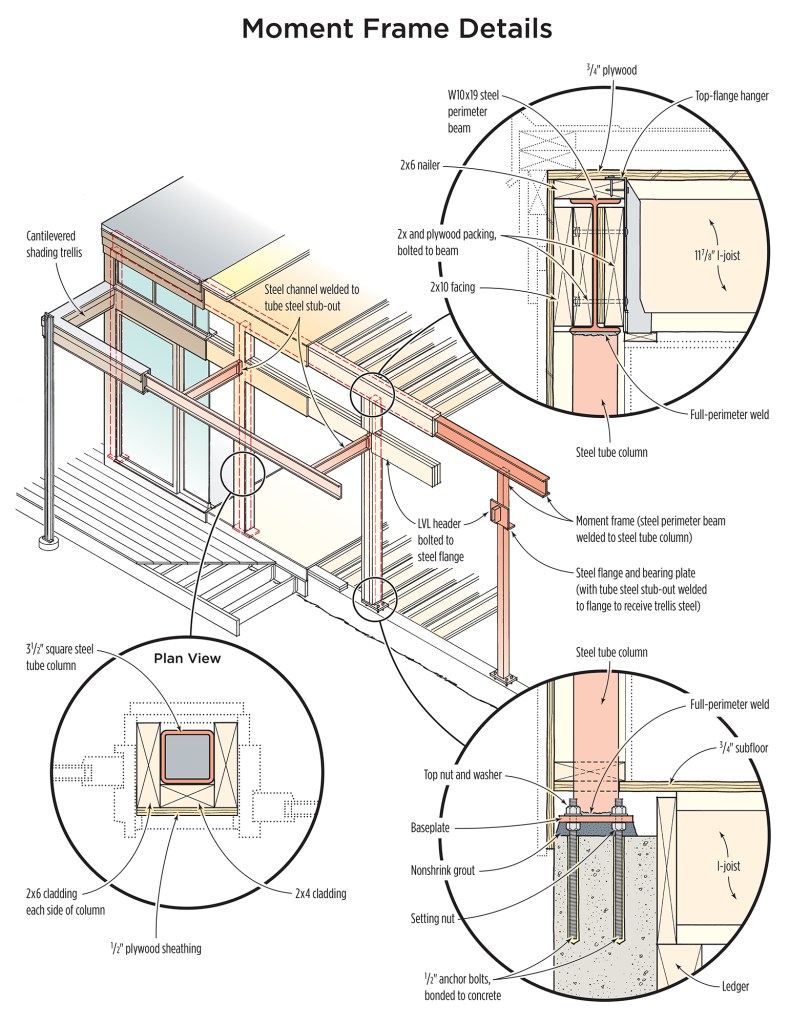
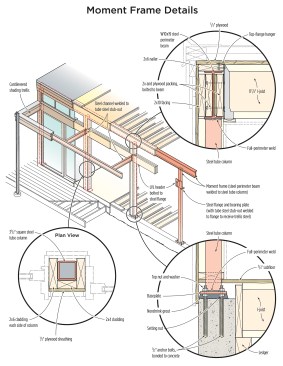
The engineer specified 3 1/2-inch-square tubing columns supporting 10-inch-tall, wide-flange (W10x19) steel perimeter beams. To provide nailing for plywood sheathing and finish trim, I decided to box the columns on three sides with 2-by lumber, a 2x4 on the exterior face and a 2x6 on either side to match the general exterior wall framing (see Figure 1). As a result, the steel framing line lay 1 1/2 inches inside the actual building line — which was helpful because part of the home was built on an existing and somewhat irregular foundation, and this allowed some fudge room for squaring up the new layout.
Image

Figure 1. Where glass walls eliminate the possibility of shear panel construction, welded connections between steel columns and beams provide the necessary resistance to lateral wind pressure. To simplify the application of wood finishes, the moment frame is clad in nonstructural framing lumber attached with powder-actuated fasteners.

Following the plans, I first transferred the centerline spacing of the 29 columns to the existing deck, then snapped lines representing the inside face of the 2x6 perimeter walls, as well as perpendicular lines for key partitions and roof beams. I like to use black chalk because it’s highly visible and remains so for months under tough job-site conditions. I wanted these lines to be visible later when it was time to true the perimeter beams to a laser plumb line.

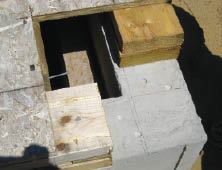
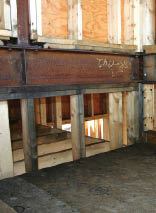
Accommodating elevation changes. The columns weren’t fastened to the wood framing, but directly to the concrete. So at each column location, we cut away the floor framing and mudsill, exposing the foundation (Figure 2). Next, I took accurate elevation readings with a rotating laser and found a difference of 1 1/2 inches between high and low points in the floor joists. Because the lot slopes, the foundation was also 8 inches higher at the back of the building than in front.

Image
Image

Image

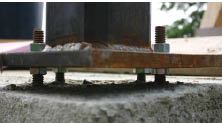
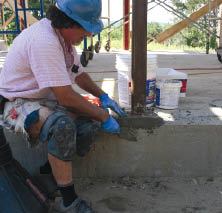
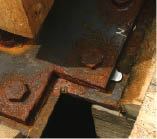
Figure 2. The moment frame begins at the foundation. MDO templates ensure that the holes in the column baseplates match the bolt holes in the concrete (top left). The baseplates rest on setting nuts (top right), which are used to plumb the column and adjust it to finished elevation. The top nuts rigidly hold the columns in place. After the complete frame is assembled, the author packs the voids under the plates with fast-setting hydraulic cement (bottom).

I picked a value about midway between gross high and low as my baseline against which to establish the top-of-steel (TOS) line. The architect specified a finished ceiling height of 10 feet above the finished floor. To determine the top of the roof framing, I added ceiling plaster and I-joist dimensions, then deducted the thickness of the 2x6 nailer affixed to the top of the perimeter beam. This nailer established the top of the I-joist framing and enabled the deck plywood to finish to the outer edge of the steel.

Due to the unevenness of the original foundation, I specified four averaged baseplate elevations and column lengths for the 29 columns. Four 1/2-inch-diameter anchor bolts bonded into the concrete held the baseplates. To accommodate irregularities in the surface, it’s standard practice in steel construction to keep column baseplates about one inch above the concrete. When the column is first set, it rests on setting nuts threaded onto the anchor bolts. Turning these nuts one way or the other adjusts the column both to plumb and to its final height. Once set, a second set of nuts and washers secures the column to the anchor bolts, and later the void under the plate is filled with nonshrink grout.

Shop Fabrication

My brother, Matt, owns Wellfleet Steel Works, which specializes in fabricating and placing structural components and often provides the steel for my jobs. When working with steel, we try to keep to a minimum the variations among parts of each type. For example, we make a standard baseplate for all corner columns, and we keep the centerline spacing on bolt holes the same for every beam connection. It’s common sense: Repeatable details lead to fewer mistakes.

I make anchor-bolt patterns for the baseplates out of scrap MDO plywood or PVC trim board. We make sure our patterns — unlike the CDX patterns Matt often receives — are dead accurate. I make them in triplicate, using three layers of material screwed together and milled at once to ensure a precise match. I drill the bolt-hole centers on a drill press, using a 1/4-inch bit. One pattern goes to the person making the columns, and the other two go back to the job site to guide anchor-bolt installation.

Variations in steel members. It’s commonly assumed that steel members are uniformly straight and dimensionally true, with no twisting or bowing, but this isn’t the case. Though steel is better than lumber, irregularities exist. You have to sight each piece to orient it properly in the frame. Severe bowing is impossible to correct and must be rejected. Flange widths can vary, even on the same beam. Fortunately, on this job, every piece was straight.

Bolt or Weld?

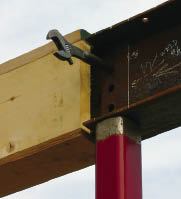
The moment connections we make are of two types, bolted and welded (Figure 3). I prefer welded connections because they’re stronger and easier to fit — you can make adjustments with a grinder or a torch right up to the last minute. The fitting of a welded joint should be precise, with parts fully touching, though the weld can bridge gaps up to 1/8 inch.

Image
Image
Image

Figure 3. The drift-punch handle of a rigger’s wrench aligns beams for bolting (left). Though bolting alone is sufficient, the author likes to add a couple of tacks to the joints to eliminate all possibility of movement (center). At welded perpendicular joints, the beams are coped for a snug fit (right).

Bolted connections, on the other hand, require precise layout of holes, usually six to eight per connection — a time-consuming process. Also, we drill holes only 1/16 inch larger than the bolt size, so just one misaligned hole can prevent installation of one or more bolts, or limit fine adjustments between the parts. Then you have to “egg out” the errant hole to accommodate the binding bolt.

Nevertheless, engineers generally prefer bolted connections because the special-order bolts carry an ASTM rating, giving them known performance properties. Welders like bolted connections, too, because bolting cuts down the amount of welding that has to be done on site — often from a ladder. And because they go together more quickly, bolted connections also reduce the crane time.

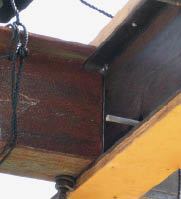
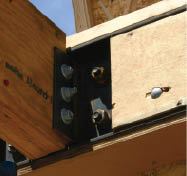
On this job, half of the right-angle connections between beams called for bolted angle clips (Figure 4). The rest were specified as full perimeter welds, meaning a full-contact, coped fit between the beams and a continuous weld around the entire joint — a task that can take 20 minutes or longer.

Image
Image

Figure 4. Bolt-on angle clips can support wood framing, as in the case of this LVL stairwell header (left). A welded bolt flange (right) stiffens the beam web beneath a second-floor column location and also supports a right-angle beam.

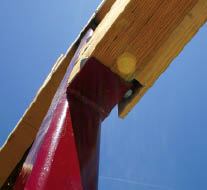
The columns were also welded directly to the beam bottom flanges; we made simple square cuts at the tops, then beveled them for welding to the beam flange (Figure 5).

Image
Image

Figure 5. Wood cladding on the underside of the perimeter beam (left) precluded the use of bolting flanges for the columns. Instead, they’re direct-welded. Beveled edges on the tops of the columns (right) expose the full thickness of the tubing wall for an optimal welded bead.

Attaching lumber. Working in the shop, we drilled pairs of 9/16-inch holes on 16-inch centers through the beam webs for through-bolting 2x10 packing. The packing provided nailing for joist hangers on the interior and cladding on the exterior. We fastened most of the packing to the beams while they were still on horses at the shop — which is a lot faster and safer than doing it on site from ladders 20 feet off the ground.

Though you can use powder-actuated fasteners for attaching plates to the flanges, I prefer to use screws, since the lumber occasionally needs to be temporarily removed to provide clearance for welding.

Setting Columns

I use the baseplate patterns to locate the anchor bolts for columns. I ran a 3/16-inch masonry bit in a cordless hammer drill through the holes in the pattern to mark the concrete, then followed with a hammer drill and a 9/16-inch bit to expand the holes for the 1/2-inch-diameter threaded rod. I used two-part A7 (800/348-3231, itwredhead.com), a fast-curing acrylic adhesive, to set the bolts. To hold the alignment while setting the rods, I used the third copy of the pattern with its holes enlarged to 9/16 inch. Once the adhesive solidified, I leveled the setting nuts to receive the baseplates.

We stood all of the first-floor columns by hand in about three days, spending about a half-hour setting each one. We used the setting nuts to plumb the columns and set them generally level to a laser dot by measuring down from the column tops.

To attach the headers above the sliding doors to the columns, we shop-welded flanges at a uniform distance down from the top (Figure 6). To avoid potential cumulative dimensional errors, we decided to install these headers only after setting the top perimeter beams and welding them to the columns. The headers were made up of double, 11 1/2-inch-wide LVLs, faced on the exterior side with 2x12s to pack them out to the building line.

Image

Figure 6. Where an LVL header meets the steel post, the author welded 3-inch-deep bearing plates to support the beam. Though the LVL adds no structural strength to the frame, it matches the column thickness and provides stiff backing for the finish trim.

Crane Day

It’s important to educate everyone on site about the hazards of working around a crane. There is always the risk a beam might slip from its sling, so everyone needs to stay focused on the load and stay out of the fall zone. At least two of the crew should be familiar with the hand signals used to guide crane operators. If the operator’s line of sight is blocked, one person must be in view of both the operator and the workers receiving the beam. The deck needs to be clear of debris and obstacles, with pipe staging and stepladders arranged and ready.

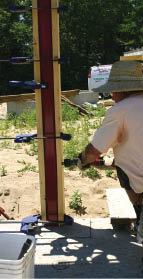
Before the lifting starts, we use powder-actuated nails to fasten 2-by cladding to the outside faces of the corner columns so we can attach temporary braces for steadying and plumbing the frame as it goes together. On this job the GC, Art Hultin, provided us with dozens of adjustable concrete form braces. These can’t be beat for quick fine-tuning during assembly (Figure 7).

Image
Image

Figure 7. Adjustable form braces provide the fine-tuning required to compensate for the jostling that occurs when heavy perimeter beams are set (left). The author clamps 2x6 cladding to a column and secures it with powder-actuated pins (right).

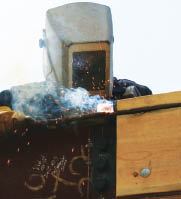
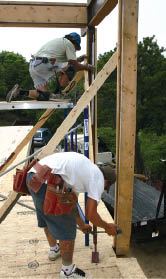
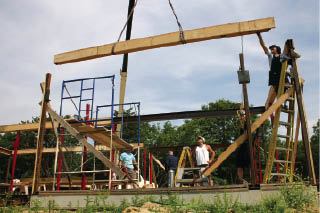
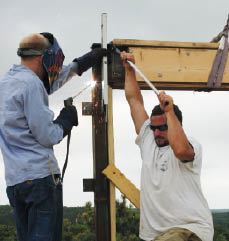
Setting beams. Beginning at a corner, we set the first perimeter beam and tack-weld it to the column (Figure 8). A tack weld is about 1/2 to 1 inch long. That’s long enough to hold, but not so long as to require extensive grinding to remove in case of error. The square cut on top of the column is no guarantee that the beam sits plumb, but if a web isn’t plumb, we’ll have trouble lining up holes between the connecting members. So while the welder tacks the column, a helper pulls the beam plumb using a bar clamp or a wrench as a lever (Figure 9). Since the action of welding tends to forcefully pull pieces toward the weld, the first tack goes on the side of the beam that needs to move down.

Image

Figure 8. Working with a 68-foot boom, the crew set the first-floor perimeter beams in one long day. Installing the wood cladding while the steel was still at the shop saved plenty of on-site labor.

Image

Figure 9. Because steel parts tend to pull toward the bead during welding, a worker uses an extension handle on the rigger’s wrench to steady a beam while the welder applies a tack.

Next, we tack the corner column at the other end of the beam, and then take a moment to check our bracing. Each time you lower a beam into position, it acts like a wrecking ball to pound the framework out of plumb. To keep tabs, I use a PLS5 vertical laser to project a dot from the chalk lines on the floor. We adjust the braces until the dot streaks the edge of the 2x6 plate on top of the beam. This takes only a few seconds and ensures precise alignment.

As we work our way around the building, we inspect for a consistent TOS. Just as with framing lumber, one steel beam of a stated height may be slightly shorter or taller than the adjacent one. We can still adjust the columns up or down on the setting nuts to maintain a consistent top alignment.

Once most of the beams are on columns and tacked, we finish the welds and tighten the nuts and bolts at all connections, using a socket wrench on a cordless impact driver. This is a lot faster than tightening by hand and ensures that each bolt is tightened with equal force. Even though the bolted connection is engineered to stand alone, we still weld a few inches of bead along each angle clip to eliminate even the slightest movement in the connection.

Packing the baseplates. With every beam leveled, bolted, and welded, I grout the voids under the column baseplates, using hydraulic cement. Because it sets so fast, I mix the cement in small batches. I premeasure the powder, use ice water to give me a little more working time, and mix the material to a stiff consistency. I wear good nitrile gloves and pack the cement with my fingers under the baseplate and around the bolt shanks. It’s faster and more thorough this way, and it saves me from having to clean tools later.

Second-Story Steel

Before tackling this building’s second-story steel, we installed the roof I-joists and plywood decking. The frame shook noticeably while we were slamming the pieces of lumber into place, so we kept the braces on the columns for the duration. Once the roof diaphragm was completed, though, most of the shaking disappeared.

The second-floor steel installed much like the first, except that the columns were 2 feet shorter and bolted directly to the first-floor beams. At all column locations, whether above or below the beam, we welded stiffeners to the web (Figure 10). Without these stiffeners, the beam flanges would distort when they were welded to the column and throw it out of plumb.

Image
Image

Figure 10. Web stiffeners at column locations are critical to preventing distortion of the beam flange during welding (left). Stainless steel shims help plumb second-floor columns (right).

Since the top of the first-floor beam was completely level, we didn’t need setting nuts on the upper floor. Instead, we used stainless steel shims to plumb the second-floor columns. We buy these shims in an assortment of thicknesses — down to 1/1,000 inch — from Manhattan Supply (800/645-7270, mscdirect.com).

With the second-floor frame fully assembled, the bolts snugged tight, and the welded connections complete, we welded the bolted baseplates to the beam flange. Structurally, these welds were redundant, but we knew that they would take a small but perceptible amount of shimmy out of the frame.

Overhangs and Cantilevers

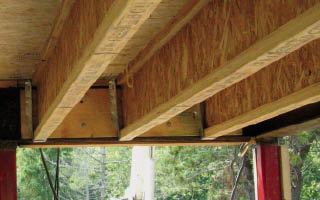
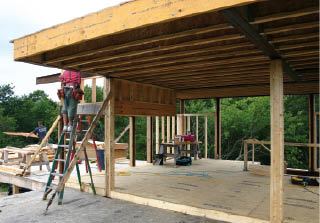
The roof over the second floor was designed with a 7-foot overhang hovering above a rooftop sun deck (Figure 11). The overhang was supported by three projecting W10x22 beams, with wood I-joists filling in between, parallel to the face of the building. Steel beams and moment connections perform exceptionally well under these conditions, ably resisting both sagging and wind uplift. In my experience, long overhangs framed with wood develop problems, often right from the beginning. Steel is the way to go.

Image

Image

Image
Image

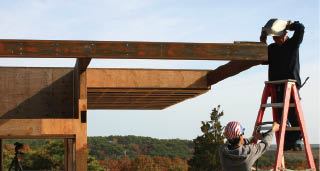
Figure 11. Three projecting steel beams support the wood I-joist framing in this 7-foot-deep roof overhang (top). A cantilevered shading trellis (center) projects from the western face of the house, attached to the steel posts by welded butt connections (bottom left and right).

The trellis structure on this house incorporated a true cantilever: Level channel struts projected several feet from the building and were simply welded to the face of the steel columns. This type of right-angle joint isn’t possible to execute in wood.

Cost

Considering both the recent doubling of the price of steel (along with every other metal) and the fact that this building couldn’t be built using conventional wood framing techniques, there’s not much point in making a direct cost comparison. However, for the record, labor and material costs for the rough framing ran about $175,000, or $53 per square foot.

Ed McPartland is a framing carpenter in Wellfleet, Mass.


