
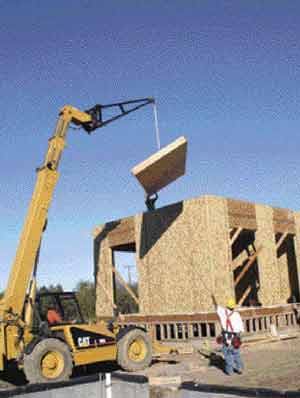
About 20 years ago, I watched a video about a house being built with structural insulated panels, or SIPs. It was the first time I’d seen the process: Instead of framing one stick at a time, the carpenters were installing entire sections of wall, which had arrived on site sheathed on both sides and insulated. It impressed me as a faster and better way to build, so I tried SIPs on my very next house. That first one was difficult because I had no one around to explain the technical details. But we stuck with it, and now my company builds only projects that include SIPs.
What Are SIPs?
SIPs are made by bonding a sheet material — OSB, plywood, steel, or fiber-cement — onto both sides of an expanded polystyrene (EPS) or polyurethane foam core. By themselves, these materials are not strong enough to support loads, but once they’re made into panels they can be used for structural elements like walls, roofs, and floors. The most common panels consist of OSB over EPS.
Raw panels are produced in factories and then cut to size in fabrication plants, or sometimes on site.
Size and thickness. OSB-faced panels come in sizes up to 8 feet by 24 feet. Foam cores are sized in thickness to match the width of standard framing lumber; that way, you can reinforce a panel or provide nailing by inserting a piece of framing stock. For example, a 6-inch panel is actually 6 1/2 inches thick, made with a 5 1/2-inch-thick piece of foam sandwiched between two sheets of 1/2-inch OSB.
Walls are typically made from 4- or 6-inch panels. Floors and roofs might be made from 6-, 8-, 10-, or even 12-inch panels.
Why Use SIPs?
We use SIPs because it takes less time — fewer labor hours — and less skill to assemble precut panels than it does to stick-frame. The parts of the building made from panels are straight and true, and won’t shrink or warp. Plus, they are exceptionally well insulated and sealed against air infiltration.
Our clients want their homes to be “green,” and SIP buildings qualify because they’re energy-efficient and make good use of natural resources. The OSB skin is made from fast-growing trees that are plantation-grown specifically for OSB.
Also, there’s very little job-site waste with SIPs; the panels are cut by a fabricator, who can easily recycle cutoffs or use them when smaller panels are called for.
Insulation Value
The R-values associated with various building materials are misleading because they don’t reflect how and where the material is installed. For example, 5 1/2-inch fiberglass batts are rated R-19, but a wall insulated with these batts is not R-19, because there will be thermal breaks at every stud, plate, and header.
Whole-wall R-value. A more realistic way to look at insulation is to consider “whole-wall R-value,” a method developed at Oak Ridge National Laboratory (ORNL), in Oak Ridge, Tenn., for estimating the R-value of various assemblies. The whole-wall R-value includes the insulation plus everything else that’s in the wall.
According to ORNL, a 2×6 wall framed 24 inches on-center with plywood sheathing, drywall, and 5 1/2-inch batts has a whole-wall R-value of 13.7. The same wall built with 6-inch OSB SIPs has a whole-wall R-value of 21.6. Why the difference? The foam in the SIPs has a higher R-value than the batts, and the SIP assembly contains fewer thermal breaks.
Ordering Panels
It’s possible to buy raw panels and cut them to size on site, but it’s better to pay a fabricator to do the cutting. Many fabricators have computer-controlled equipment that cuts panels far more accurately than we ever could.
Design. Like any building, a SIP structure starts out as a set of plans. Just about any stick-framed plan can be converted to SIPs, although it’s easier when the initial design is done with panels in mind.
Either way, the first step in any SIP project is to produce a detailed set of shop drawings that show door and window openings, corners, edges, and wiring chases, as well as how the pieces will be joined on site.
Once the drawings are approved, delivery of the panels takes six to eight weeks. The process is a lot like ordering trusses, except in our case we produce the shop drawings in-house.
The fabricator could draw them, but we prefer to do it ourselves because we gain more control over how the panels will go together.
Handling. SIPs arrive at the site on one or more semitrailers. Small panels are light — a 4×8 6-inch panel, for example, weighs about 115 pounds.
Larger panels are heavy, so we rent an all-terrain forklift to handle those.
Floor Structure
SIPs can be installed over any type of floor system. In our area of Northern California, most homes have wood-framed floors on stem-wall foundations with crawlspaces below.
Structurally, there’s no reason we couldn’t build the floor with SIPs. Doing so would be much faster than stick framing, and the insulation value would be very high.
But on most projects we still use conventional floor framing; even with the labor savings, SIP floors aren’t always cost-effective in a mild climate like ours.
In colder areas, of course, where insulating the floor is a major concern, building a floor with SIPs might make more sense.
Sound transmission. Even if they did cost less, we wouldn’t use SIPs for upper floors.
The panels are good at preventing airborne noise from entering through the walls and roof, but walking on them creates a drumming effect that’s annoying to the people below.
Setting Walls
Our panels arrive on the job cut to size with door and window openings, but without solid lumber inserted.
The foam is recessed along the edges, so there’s room to make insertions: bottom plates to fasten panels to the floor; splines to join them edge-to-edge; and top plates to stiffen the top of the wall and provide nailing for the roof or floor above.
We install these lumber members over beads of sealant (provided by the panel manufacturer), then nail them in place through the face of the panel.
For an extra charge, some manufacturers will install the nailers for you.
Plates. With SIPs, wall plates are nailed, screwed, or bolted to the floor and then the panels are slipped over them.
If the wall lands on a stem wall or slab, the plate and panel must be isolated from the concrete. To do this, we install a strip of pressure-treated plywood — sealed to the concrete with foam sill seal — and then install the plates over a bead of sealant.
Before installing the wall panel, we run sealant along the top and both edges of the wall plate, then stand the panel over it.
After bracing the panel plumb, we nail it to the plate through the OSB skin.
Hold-downs. In many regions, this nailed connection is all that’s needed to hold panels to the floor or foundation. But we build in a seismically active area, so some of the panels are designated as shear walls and must be tied to the foundation with hold-downs.
The old way to do this was to connect threaded rods to the foundation and run them all the way up through the panels.
An easier method is to put double studs in the edge of the shear panel, cut a hole in the OSB, remove some of the foam, and install a conventional hold-down inside.
The hold-down is then bolted to the foundation and the double studs.
Another method is to run a strap up from the foundation and screw it to the outside of the panel at a double stud.
Joining Panels
We edge-join the panels with splines that fit into slots in adjoining edges and work like gussets. They’re installed over beads of sealant and nailed in place through the skin of the panel.
We use three types of splines: solid pieces of lumber; surface splines, which are 4-inch rips of OSB; and block splines, which are basically a smaller SIP that fits inside the edges of adjoining panels. We prefer the foam block or surface splines because they don’t produce thermal breaks.
About 20 years ago, I watched a video about a house being built with structural insulated panels, or SIPs. It was the first time I’d seen the process: Instead of framing one stick at a time, the carpenters were installing entire sections of wall, which had arrived on site sheathed on both sides and insulated. It impressed me as a faster and better way to build, so I tried SIPs on my very next house. That first one was difficult because I had no one around to explain the technical details. But we stuck with it, and now my company builds only projects that include SIPs.
What Are SIPs?
SIPs are made by bonding a sheet material — OSB, plywood, steel, or fiber-cement — onto both sides of an expanded polystyrene (EPS) or polyurethane foam core. By themselves, these materials are not strong enough to support loads, but once they’re made into panels they can be used for structural elements like walls, roofs, and floors. The most common panels consist of OSB over EPS.
Raw panels are produced in factories and then cut to size in fabrication plants, or sometimes on site.
Size and thickness. OSB-faced panels come in sizes up to 8 feet by 24 feet. Foam cores are sized in thickness to match the width of standard framing lumber; that way, you can reinforce a panel or provide nailing by inserting a piece of framing stock. For example, a 6-inch panel is actually 6 1/2 inches thick, made with a 5 1/2-inch-thick piece of foam sandwiched between two sheets of 1/2-inch OSB.
Walls are typically made from 4- or 6-inch panels. Floors and roofs might be made from 6-, 8-, 10-, or even 12-inch panels.
Why Use SIPs?
We use SIPs because it takes less time — fewer labor hours — and less skill to assemble precut panels than it does to stick-frame. The parts of the building made from panels are straight and true, and won’t shrink or warp. Plus, they are exceptionally well insulated and sealed against air infiltration.
Our clients want their homes to be “green,” and SIP buildings qualify because they’re energy-efficient and make good use of natural resources. The OSB skin is made from fast-growing trees that are plantation-grown specifically for OSB.
Also, there’s very little job-site waste with SIPs; the panels are cut by a fabricator, who can easily recycle cutoffs or use them when smaller panels are called for.
Insulation Value
The R-values associated with various building materials are misleading because they don’t reflect how and where the material is installed. For example, 5 1/2-inch fiberglass batts are rated R-19, but a wall insulated with these batts is not R-19, because there will be thermal breaks at every stud, plate, and header.
Whole-wall R-value. A more realistic way to look at insulation is to consider “whole-wall R-value,” a method developed at Oak Ridge National Laboratory (ORNL), in Oak Ridge, Tenn., for estimating the R-value of various assemblies. The whole-wall R-value includes the insulation plus everything else that’s in the wall.
According to ORNL, a 2×6 wall framed 24 inches on-center with plywood sheathing, drywall, and 5 1/2-inch batts has a whole-wall R-value of 13.7. The same wall built with 6-inch OSB SIPs has a whole-wall R-value of 21.6. Why the difference? The foam in the SIPs has a higher R-value than the batts, and the SIP assembly contains fewer thermal breaks.
Ordering Panels
It’s possible to buy raw panels and cut them to size on site, but it’s better to pay a fabricator to do the cutting. Many fabricators have computer-controlled equipment that cuts panels far more accurately than we ever could.
Design. Like any building, a SIP structure starts out as a set of plans. Just about any stick-framed plan can be converted to SIPs, although it’s easier when the initial design is done with panels in mind.
Either way, the first step in any SIP project is to produce a detailed set of shop drawings that show door and window openings, corners, edges, and wiring chases, as well as how the pieces will be joined on site.
Once the drawings are approved, delivery of the panels takes six to eight weeks. The process is a lot like ordering trusses, except in our case we produce the shop drawings in-house.
The fabricator could draw them, but we prefer to do it ourselves because we gain more control over how the panels will go together.
Handling. SIPs arrive at the site on one or more semitrailers. Small panels are light — a 4×8 6-inch panel, for example, weighs about 115 pounds.
Larger panels are heavy, so we rent an all-terrain forklift to handle those.
Floor Structure
SIPs can be installed over any type of floor system. In our area of Northern California, most homes have wood-framed floors on stem-wall foundations with crawlspaces below.
Structurally, there’s no reason we couldn’t build the floor with SIPs. Doing so would be much faster than stick framing, and the insulation value would be very high.
But on most projects we still use conventional floor framing; even with the labor savings, SIP floors aren’t always cost-effective in a mild climate like ours.
In colder areas, of course, where insulating the floor is a major concern, building a floor with SIPs might make more sense.
Sound transmission. Even if they did cost less, we wouldn’t use SIPs for upper floors.
The panels are good at preventing airborne noise from entering through the walls and roof, but walking on them creates a drumming effect that’s annoying to the people below.
Setting Walls
Our panels arrive on the job cut to size with door and window openings, but without solid lumber inserted.
The foam is recessed along the edges, so there’s room to make insertions: bottom plates to fasten panels to the floor; splines to join them edge-to-edge; and top plates to stiffen the top of the wall and provide nailing for the roof or floor above.
We install these lumber members over beads of sealant (provided by the panel manufacturer), then nail them in place through the face of the panel.
For an extra charge, some manufacturers will install the nailers for you.
Plates. With SIPs, wall plates are nailed, screwed, or bolted to the floor and then the panels are slipped over them.
If the wall lands on a stem wall or slab, the plate and panel must be isolated from the concrete. To do this, we install a strip of pressure-treated plywood — sealed to the concrete with foam sill seal — and then install the plates over a bead of sealant.
Before installing the wall panel, we run sealant along the top and both edges of the wall plate, then stand the panel over it.
After bracing the panel plumb, we nail it to the plate through the OSB skin.
Hold-downs. In many regions, this nailed connection is all that’s needed to hold panels to the floor or foundation. But we build in a seismically active area, so some of the panels are designated as shear walls and must be tied to the foundation with hold-downs.
The old way to do this was to connect threaded rods to the foundation and run them all the way up through the panels.
An easier method is to put double studs in the edge of the shear panel, cut a hole in the OSB, remove some of the foam, and install a conventional hold-down inside.
The hold-down is then bolted to the foundation and the double studs.
Another method is to run a strap up from the foundation and screw it to the outside of the panel at a double stud.
Joining Panels
We edge-join the panels with splines that fit into slots in adjoining edges and work like gussets. They’re installed over beads of sealant and nailed in place through the skin of the panel.
We use three types of splines: solid pieces of lumber; surface splines, which are 4-inch rips of OSB; and block splines, which are basically a smaller SIP that fits inside the edges of adjoining panels. We prefer the foam block or surface splines because they don’t produce thermal breaks.
More from Journal of Light Construction
-
Durable Rooftop Decks
8 MIN READ
-
Practical Energy Upgrades
12 MIN READ
-
Monopour Lessons Learned
11 MIN READ