
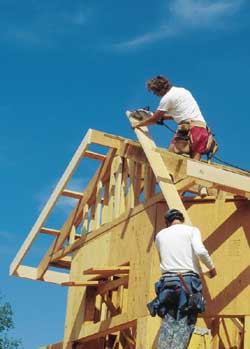
As a custom home framer on the West Coast, I often build large houses with a variety of rake walls. These range from simple gables to complicated multi-sloped affairs full of beam pockets and window openings. It can be daunting the first time you try one of these walls, but they become easier with some simple procedures. For safety and convenience, I like to frame rake walls after the outside walls have been stood up and braced. I snap out the rake layout full-scale right on the deck, then build to the lines. In this article, I’ll explain my step by step procedure for rake wall layout, using the most common type I run into — the cathedral ceiling.
Let’s suppose we have to build the gable end of a 16-foot wide room with two 9-foot exterior walls supporting an 8/12 roof. To make room for more insulation, the cathedral rafters are 2x10s, while the rest of the house has 2×6 rafters. There’s an exposed 6×12 ridge beam and two windows in the wall.
In reviewing the plans (see illustration, above), a red flag goes up: The roof frame has more than one size rafter, but the rafter tails and fascia are at the same level around the entire perimeter of the house. I could accommodate the deeper rafters by shortening the walls of the cathedral room, but it’s easier to handle the transition by manipulating the layout of the birdsmouth.
Birdsmouth First
I lay out the rake wall so it will fit tight under the pair of opposing common rafters that is flush with the gable end. This solidly attaches the gable rafters along the full length of the rake wall, and I won’t have to rip the gable rafters in order to get a tight fit.
The low point of the rake wall is determined by the location of the birdsmouth (seat cut). I first determine its location for the 2×6 rafters of the main roof, then lay out the 2×10 cathedral rafters with the same heel stand (see illustration, above). I use a standard heel stand of 5 3/8 inches, which also works well for 2×6 rafters in an 8/12 roof on 2×4 walls. Using a scrap of 2×10, I make a full-scale birdsmouth using my heel stand. The layout shows that the birdsmouth will need to notch around the 2×4 wall, and that the bottom of the 2×10 rafter will end up extending 3 3/4 inches below the inside of the wall.
Low Point, High Point
Now I can find the low and high points of the wall. The low point occurs where the rake wall attaches to the eaves wall. Using the full-scale birdsmouth layout, it’s easy to find the low point by subtracting 3 3/4 inches from the outside wall height. On the West Coast, we commonly use 104 1/4-inch studs and three framing plates that add up to an overall thickness of about 4 11/16 inches. (Our plate stock tends to be closer to 19/16 inches thick, but if you measure the material you’re using on site you’ll never go wrong.) The wall ends up being about 9 feet 15/16 inch (give or take 1/16 depending on the moisture content). Subtracting 3 3/4 inches, I get a low point height on the rake wall of 8 feet 9 3/16 inches.
Calculate the high point. I pull out the Construction Master to find the top of the rake wall. First, I divide the distance between the inside of the two opposing exterior walls in half. In our example, the span is 15 feet 5 inches, so the half-span, or run, is 7 feet 8 1/2 inches. On the calculator, I enter a pitch of 8 inches and a run of 7 feet 8 1/2 inches, hit the Rise key, and get 5 feet 1 11/16 inches. Adding this to the low point of 8 feet 9 3/16 inches yields 13 feet 10 7/8 inches as the peak of the wall in the center of the room. This may seem like a lot of math to some, but in the field it only takes minutes. A lot less time than if you have to rip those gable rafters or rebuild a miscalculated wall.


